Tools › Formulation Router — Door to Drawer
Formulation Router — Door to Drawer
From presenting complaint to protocol, for the unified clinical model
Formulation Router — Door to Drawer
19 August 2026, updated same day. The drawer now holds twelve protocols, and this page is how a presenting complaint finds the right one. It interlocks with two siblings and does not repeat them: the Decision Aid — Locating the Floor reads signs → floor (where the stuck prior lives and what can reach it); the Case Formulation — One Page runs the five questions at that floor. This router reads complaint → drawer — which protocol leads, which modules ride along, and in what order when several risers present at once, which is most real cases. Held by the therapist; run under supervision; the protocols' own Phase 0 gates always govern. Made, not found, like everything in this drawer.
The spine, stated once
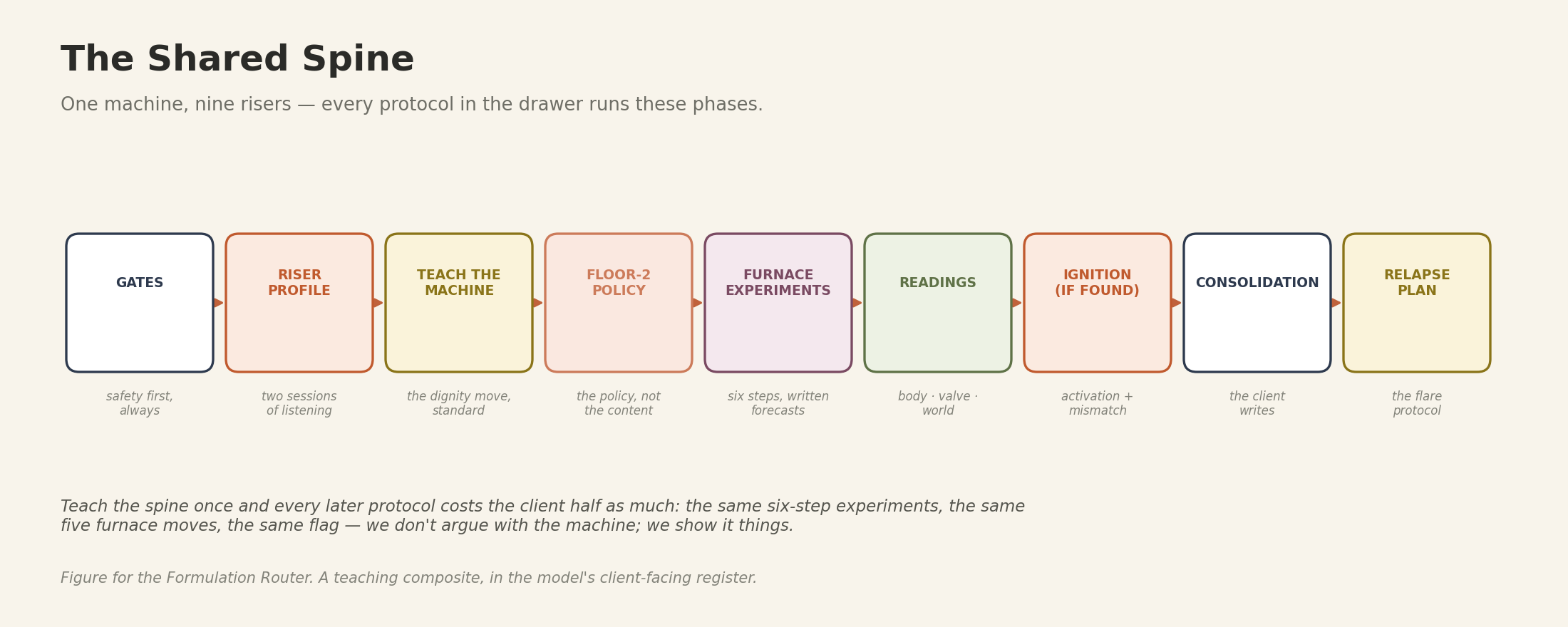
Every protocol in the drawer is the same machine tuned to a different riser. All twelve run: gates → riser profile → teach the machine → floor-2 policy → furnace experiments (six steps, written forecasts, §6.2's surprise metric) → supply the readings → the ignition scene, if found → consolidation up the building → relapse as forecast. All twelve share the dignity move (nothing here is broken; made, not found), the flag (we don't argue with the machine — we show it things), and the two therapist rules (never argue with the verdict; match the tempo and watch the transfer rule). What differs per riser is the forecast, the flagship furnace move, the floor-2 policy, and the experiment that subpoenas it. Teach the spine once and every later protocol costs the client half as much.
Step 0 — The gates trump the routing
Before any drawer opens: the Decision Aid's Step 0 in full — acute risk (route to risk protocols, not to this page), the reversed dial (psychosis/mania → different standard of care; no prior-loosening, no prediction-error work), the environment as pathogen (a machine reading a hostile field correctly is not a disorder — ecology first, always), and the calibration gate (medical rule-outs per the presenting protocol; the body gets real medicine before its alarms get treated as false). Every protocol's own Phase 0 then re-runs these locally, heavier where the riser demands it (depression's risk gates, PTSD's whole first page, insomnia's differential screens, OCD's harm-content assessment, the addiction protocol's withdrawal medicine, chronic pain's once-then-closed medical file, the grief protocol's time gate).
Step 1 — Ask where the alarm points
The complaint names the alarm's jurisdiction; the jurisdiction names the drawer.
The body.
- Catastrophe this minute — seconds-scale, sensation-triggered, escape-shaped → Protocol — Panic.
- Disease over time — scanning, googling, appointment-shaped, reassurance-hungry → Protocol — Health Anxiety.
- The night — the bed as battle station, the day spent forecasting the next one → Protocol — Insomnia (and ask immediately: did the nights break first, or the days?).
- Pain that outlived its injury — hurt re-filed as harm, the guarding, the shrinking map, the workup that keeps re-opening → Protocol — Chronic Pain (the physician's sorting first, once, thoroughly — then the file closes).
The mind's own content.
- Ego-dystonic intrusions + rituals (overt or mental) + a 100% certainty demand → Protocol — OCD.
- Ego-syntonic, realistic-content, topic-hopping future dockets billed as preparation → Protocol — Worry (GAD).
- Past-directed circling on the problem of me, under a dark global forecast with the effort gone → Protocol — Depression.
Rooms and audiences. The judgment forecast, the armor, the post-mortem → Protocol — Social Anxiety.
A scene with a date. Re-experiencing, matches, a perimeter, verdicts written at a known address → Protocol — PTSD (and its gates before anything else).
A substance, or a procedure with one. The relief forecast, the craving escaped at its peak, the concealment map, the morning-after verdict → Protocol — Addiction (withdrawal medicine is medicine — its gates run before anything psychological).
A person the world no longer contains. Yearning-shaped, person-shaped pain past the calendar's line; the two armors — the room avoided, or the room enshrined → Protocol — Prolonged Grief (the time gate is diagnostic law: grief before it is grief, and gets accompaniment, not a drawer).
The self, across all of it. The verdict predates and outlasts every episode; the treaties (perform, please, hide) run the personality; praise bounces, criticism sticks → Protocol — The Self-Story (Low Self-Esteem) — standalone when it presents alone, and a module wherever it's found load-bearing.
Three sorting instruments, when the pointer is ambiguous: the timescale question (seconds → panic; days-to-years → health anxiety; the future as such → worry); the ego-syntonic question (does the client endorse the thought's content as theirs? worry says yes, OCD says God-no — the horror is diagnostic); and the date question ("can you date when this became true?" — a date points at floor 6 and often at the PTSD or ignition-scene machinery; datelessness points at the water, the house, or the self-story).
Step 2 — Confirm with the machinery, not just the content
Content misleads; machinery doesn't. Check the complaint against the drawer's mechanics — if the flagship move and floor-2 policy don't match the label, trust the machinery and re-route:
| Protocol | The forecast | Flagship furnace move | Floor-2 policy | The subpoena |
|---|---|---|---|---|
| Health Anxiety | this symptom is the disease | checking | body-monitoring | response prevention + interoceptive exposure |
| Depression | effort won't pay; reward won't arrive | withdraw effort | rumination (past-facing) | activation as forecast experiments |
| Social Anxiety | they'll see it and judge | armor (safety behaviors) | inward camera + post-mortem | armor-off trials + footage |
| Panic | this sensation = catastrophe now | escape | body-scanning | the summons (interoceptive) |
| Worry | unresolved = unsafe | simulation billed as work | the charter (beliefs about worry) | postponement + deliberate irresolution |
| OCD | if I don't act, harm — and it's mine | ritual / neutralize | noise read as message + responsibility charter | ERP, door held shut |
| Insomnia | tonight fails, tomorrow is ruined | sleep effort (provoke) | monitoring + effort at sleep | stimulus control + restriction, diary as referee |
| PTSD | it is NOW | avoid (the unfiled scene) | hypervigilant scanning + circling | stabilized filing (activation + mismatch) |
| Self-Story | I am not enough, and it must not show | the treaties (rules for living) | the prosecutor | rule-breaks + the anomaly log |
| Chronic Pain | hurt = harm; my body is fragile | guard · brace · rest (prepayment) | flare forecasting + body-scanning | somatic tracking + armor-off graded return |
| Addiction | this feeling is unsurvivable; relief is one move away | use (prepayment) | permission thoughts — the lawyer | the crest, witnessed — surfed to the readout |
| Prolonged Grief | they are still expected | the two armors (avoid / enshrine) | the betrayal gatekeeper + counterfactual circling | deliberate encounters + the telling as filing |
Read the table's columns as the one-page's OBSTACLE question, pre-answered per riser: name the move that's manufacturing the confirming evidence, and the drawer usually names itself.
Step 3 — Sequence, when several risers present (they usually do)
- Gates trump routing — always, at every re-entry.
- Senior partner first. Ask what broke first and what would remain if the other resolved: panic attacks inside PTSD are matches firing (PTSD leads); insomnia inside depression usually predates and outlasts it (treat both; see rule 3); worry that only worries about disease is health anxiety; social fear that's really the self-story's exhibit runs the module inside the protocol. Three seniority notes for the new drawers: active moderate-to-severe substance use is a senior partner for nearly everything — the machinery it soaks (sleep, mood, panic) can't be read until the chemistry quiets, so it leads, concurrently, with its medical gates governing. Depression inside chronic pain is screened as its own riser, never assumed to be "just the pain" — though it often lifts when the alarm quiets. And a traumatic death runs the two-files rule: the scene (Protocol — PTSD) before or alongside the absence (Protocol — Prolonged Grief) — you cannot mourn a person while the machine is still mid-emergency about how they died. When the answer is unclear, treat the one carrying the risk, then re-profile.
- The sleep exception. Insomnia is the drawer's great junior partner and is treated early anyway, whatever else leads — its mechanics are cheap, fast, and lift every other protocol's floor 7 (the pinned block stands behind this). It is the one module that never waits its turn.
- One riser at a time, modules welcome. A protocol runs to consolidation before the next riser's phases begin — but modules compose freely: the self-story module inside depression or social anxiety, insomnia's mechanics inside anything, PTSD's grounding platform wherever dissociation shows. The client keeps one home protocol at a time; everything else visits.
- Shared machinery pays twice. The certainty demand (OCD, health anxiety, worry), the armor accounting (every riser), the effort paradox (insomnia, and its cousins in relaxation and intimacy), the shell-game/ratchet expectation (worry, OCD), the "paid-to-care" dimmer move (everywhere) — teach each once, then cash it in the next drawer by name: same gate, same answer; new costume, same policy.
- Stuck? Re-run the differential, in this order: wrong drawer? (machinery mismatch — back to Step 2) · missed senior partner? (something upstairs is refilling the riser) · self-story load-bearing? (experiments move behavior, verdict re-asserts → run the module) · wrong floor? (words aimed at concrete → the Decision Aid — Locating the Floor, Step 5's full loop: furnace uninterrupted, dimmer off, stakes unmet).
Step 4 — Say the transfer rule out loud, at the door
The model's standing forecast, told to every client in every drawer, early: conquering this riser doesn't conquer the others, and the machinery that built it — the intermittent house, the vigilant childhood, the verdict — will audition new costumes. This is not pessimism; it is the reason the spine is taught and not just run: a client who owns the six steps, the furnace's five moves, and their own flare protocol is not a graduate of one protocol — they are the house's new superintendent, and the next riser meets a different owner.
Maintenance note: this router is updated when the drawer is — new protocols get a row in the table, a pointer in Step 1, and a seniority note in Step 3.