Protocols › Protocol — PTSD
Protocol — PTSD
Protocol19 August 2026. Filed in Clinical Tools beside the Decision Aid and the other protocols. Honesty label, in the appendix spirit: made, not found. This is a model-derived reorganization of components that existing trauma treatments have tested separately — prolonged exposure (Foa), cognitive processing therapy (Resick), the Ehlers & Clark model, EMDR's outcome base, stabilization and grounding work, and imagery rehearsal for nightmares. The sequence is the model's contribution (gates → stabilization → perimeter → readings → the filing itself → consolidation → relapse plan), and the sequence has no outcome data of its own. The scope line, stated before anything else: this protocol, more than any other in this drawer, is written for supervised practice toward licensure. Trauma-specific training is the standard of care for the memory work at its center. A student's lane is the gates, stabilization, psychoeducation, and the perimeter phases — with Phase 6 co-run under supervision or referred until licensure and training. That line is structural, not decorative. Companions: floor-notes/Floor 6 — Procedure and Emotion, floor-notes/ Floor 4 — Relational Templates, floor-notes/Floor 7 — Body and Interoception, the furnace (§2.3), and the Craske and van IJzendoorn pins in the ledger.
The formulation in one line
PTSD presents on every floor at once — floor 7's body alarms, floor 3's verdicts about the world and the self, floor 5's avoidance armor, floor 2's hypervigilant scanning and circling, floor 4's broken templates, floor 1's annexed identity — but the engine is a floor-6 trace stored raw and timestamped NOW; it sits in floor-8 water that silences or blames, and it taxes every dial at once — and the treatment follows the building down to floor 6, in that order, because in this riser Phase 6 is not a contingency: it is the destination, and everything before it is the road.
The model's distinctive reading
Three claims organize everything below.
PTSD is floor 6 refusing to file the scene as past. Ordinary memories are processed and shelved with a date on them. This one arrived too hot to process — the system ran triage, correctly: survival first, filing later — and later never came, because every approach to the file re-sounded the alarm that postponed the filing. So the scene sits on the active board, stored raw: sensory fragments wired to the original alarm, timestamped NOW, triggered by matches — the smell, the angle of light, the tone of voice, the date. A flashback is not a memory misbehaving; it is an unfinished emergency being re-presented for completion. The nightmare is the filing clerk working the night shift on a file it cannot close. Ehlers & Clark's "sense of current threat," in the model's terms: the render says NOW, and the body believes the render, because that is what bodies are for.
The forecast has annexed the world and the self. Two verdicts were written at the scene, and both over-generalized from the machine's worst data point. About the world: nowhere is safe; people are what that person was; it can happen any time — hypervigilance is that verdict running as hardware, the dial's precision cranked planet-wide, the deadband at zero everywhere. About the self: I am what happened — what I did, what I failed to do, what was done to me — the shame verdicts (complicit, weak, ruined, guilty), which are frequently more disabling than the fear and are load-bearing in exactly the cases where the fear work alone stalls. One scene has been promoted to the operating manual for a whole life.
Avoidance is the filing clerk's enemy. Every furnace move defends the unfiled state: avoid (the route not driven, the anniversary not mentioned, the telling never told), filter at its deepest setting (numbing, and dissociation — the machine leaving the room entirely), withdraw effort (the life shrunk to the patrolled perimeter), provoke (the hostility that manufactures confirming conflict; the recklessness that re-enters the scene with the odds re-rolled). Each move blocks the single thing that would let floor 6 close the file: sustained, regulated contact with the memory and its matches while the present's evidence is in the room. Activation-plus-mismatch is the model's engine everywhere in this drawer — and PTSD is its purest case, because here the disorder simply is an unmetabolized trace, and the treatment simply is the metabolizing, done on purpose, at a survivable dose, with the client holding the controls.
Phase 0 — The gates (the longest in the drawer, and never fully retired)
Risk, fully. Suicide screening at the depression protocol's standard (structured instrument, every-session monitoring where indicated, safety planning, means-safety, escalation thresholds pre-agreed with the supervisor); harm-to-others assessment where the picture includes rage or revenge content; self-harm asked about plainly.
Safety NOW — the accurate-forecast gate at maximum. You cannot file as past what is still present. Where the threat is live — the abusive partner still in the house, the stalker active, the neighborhood in fact dangerous, the deployment upcoming — the machine is reading a real field correctly, and that is intelligence, not disorder. Ecology first: safety planning, exits, advocacy, reporting channels, shelter logistics — the environment is the pathogen rule, run before any memory work, which otherwise asks a sentry to stand down inside an active war.
Dissociation, screened and skilled. Dissociation is not a contraindication; it is a pacing instruction. Screen it (DES-II or clinical assessment), and where it runs high, grounding skills are trained to fluency before any trauma content — because exposure a client isn't present for files nothing and can harm. The dissociation ladder is taught early: notice the leaving, name it, return through the senses and the feet.
Substances. Numbing has vendors — alcohol, benzodiazepines, cannabis, opioids — and the audit is compassionate and structural: the substance is armor, the armor blocks the filing, and the sequencing decision (concurrent treatment is now standard practice; the Seeking Safety lineage) belongs to supervision. Withdrawal states complicate everything and get medical partnership.
Complexity sorted honestly. Single-incident adult trauma and prolonged developmental trauma are different projects. Where the history is childhood abuse, captivity, or years of exposure, the plan reshapes: longer stabilization, floor 4 doing heavy work (the relational templates are the injury — the 4F machinery got installed as personality), titration slower, the referral bar lower, and the disorganized-attachment literature (van IJzendoorn, pinned) standing behind the formulation. This protocol's spine still holds, but the dose, order, and timeline bend, and supervision decides how far a student walks into it at all.
Moral injury, flagged as its own species. Where the wound is perpetration, witnessed atrocity, or betrayal by leadership, the load-bearing verdict may be partly accurate — and fear-extinction machinery aimed at accurate guilt misses. The mismatch there is not "it's safe now" but accurate sizing, amends where real, meaning-making, and sometimes the clergy's ancient jurisdiction. Name it in the profile; adapt or refer.
Timing. The first month after a trauma is not PTSD — it is a system doing its filing at its own pace, and most complete it. Watchful support, practical help, and no critical-incident debriefing (the evidence says it can interfere). This protocol begins where natural recovery has demonstrably stalled.
The medication boundary. SSRIs are legitimate, evidence-backed company — alongside, not instead. Benzodiazepines specifically carry guideline-level cautions in PTSD (they can blunt the learning the treatment exists to produce, and dependence risk runs high in this population) — an observation routed to the prescriber as always, never issued to the client. Prazosin and the nightmare pharmacopoeia are the prescriber's lane; this protocol holds the behavioral one.
Grief, distinguished and accompanied. Traumatic loss carries both files — the death and the scene of it. The grief is not a target; it is a companion process, and the protocol interleaves accompaniment with trauma work rather than treating mourning as symptom.
Phase 1 — Locate and formulate (the riser profile, paced differently)
In every other protocol Phase 1 opens the story. In this one it labels the drawer without opening the file: headlines, not scenes — the client controls depth from the first minute, and the therapist says so out loud ("we will not be opening the file today; we're labeling it, and you hold the handle"). The profile assembles:
- The index event or events, at headline resolution, with dates where they're safe to hold.
- The match inventory — what fires it: places, dates, sounds, smells, weather, kinds of people, kinds of touch. (This becomes Phase 4's perimeter map.)
- The armor map — what's avoided, what's numbed, what's patrolled; where in the room the client sits and why.
- The verdicts, both kinds, in the client's words: the world-sentences and the self-sentences. The self-sentences get written down verbatim — they are Phase 6's hot spots and Phase 7's targets.
- The 4F signature and the floor-4 reading, especially in complex presentations: which defense got installed, and what the templates predict people will do.
- Sleep and nightmares, logged.
Baselines: PCL-5, PHQ-9, DES, sleep/nightmare log, and the life-shrinkage map (what the perimeter has annexed — drawn honestly, because its re-expansion is the outcome).
Phase 2 — Teach the client the machine
Client-facing telling, in the model's images — and in this riser the dignity move carries the most load it carries anywhere: nothing here is broken, and nothing here is weakness. Everything in the symptom list is the machine doing exactly what machines do with unfinished emergencies. The filing-room telling: the system ran triage at the scene — survival first, filing later — and has been trying to complete the file ever since, which is what the intrusions are; the alarm still fires because the file still says NOW; the avoidance felt like management and has been keeping the file open. The freeze or the compliance or the blankness at the scene gets its own dignity line, because the self-verdicts often live exactly there: the machine chose the move that kept you alive — it ran the numbers faster than any deliberate mind could have, and it won: you're here.
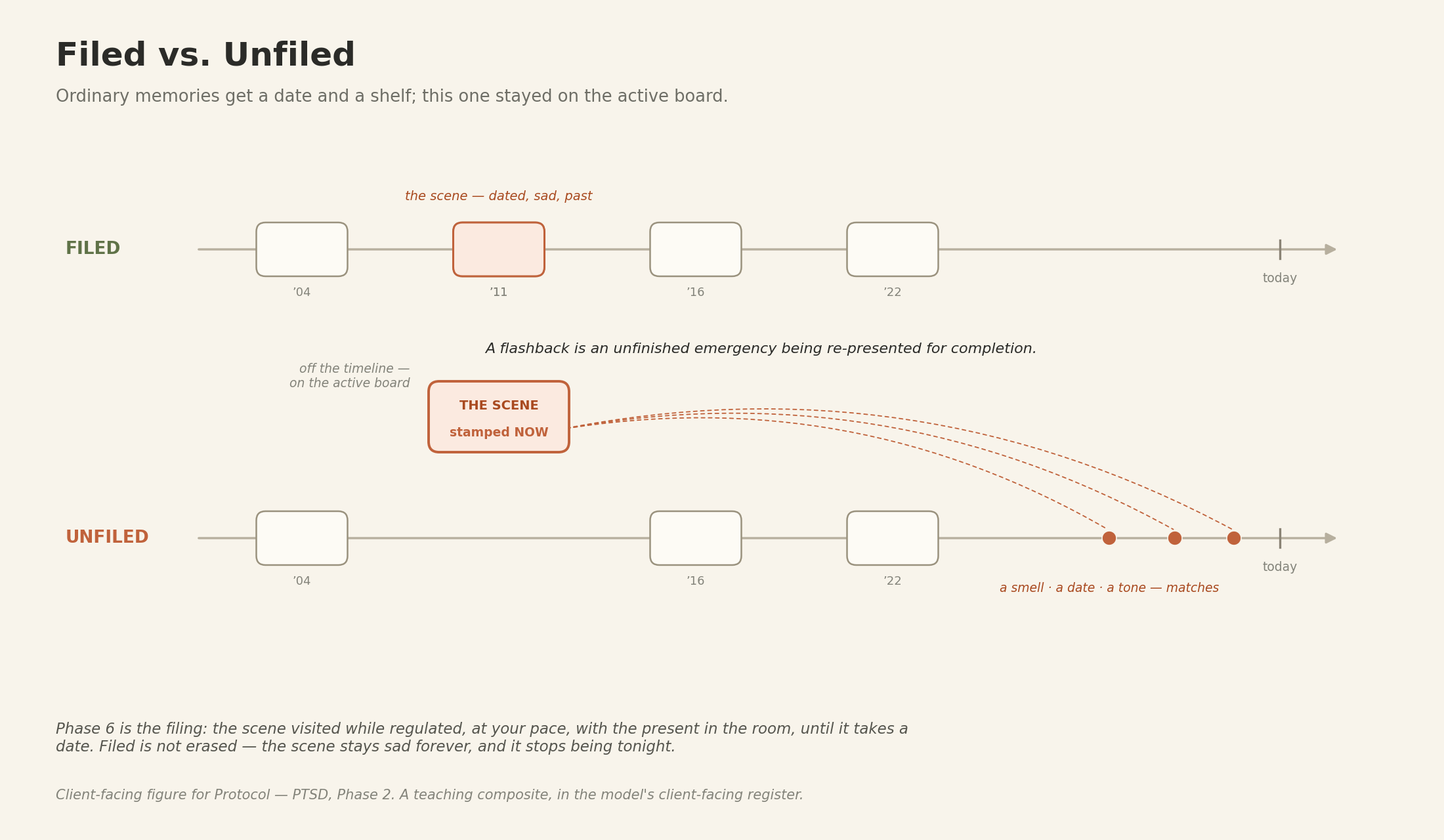
Filed versus unfiled — the dated shelf, and the active board where the scene waits, wired to its matches.
Then the claims that reorganize everything, stated flat:
The alarm is not weakness — it is the record of what you survived, still filed under NOW. And: the scene needs to be filed, not erased. Filed is not forgotten; filed is when it gets a date on it and stops being tonight.
Draw the loop for the session:
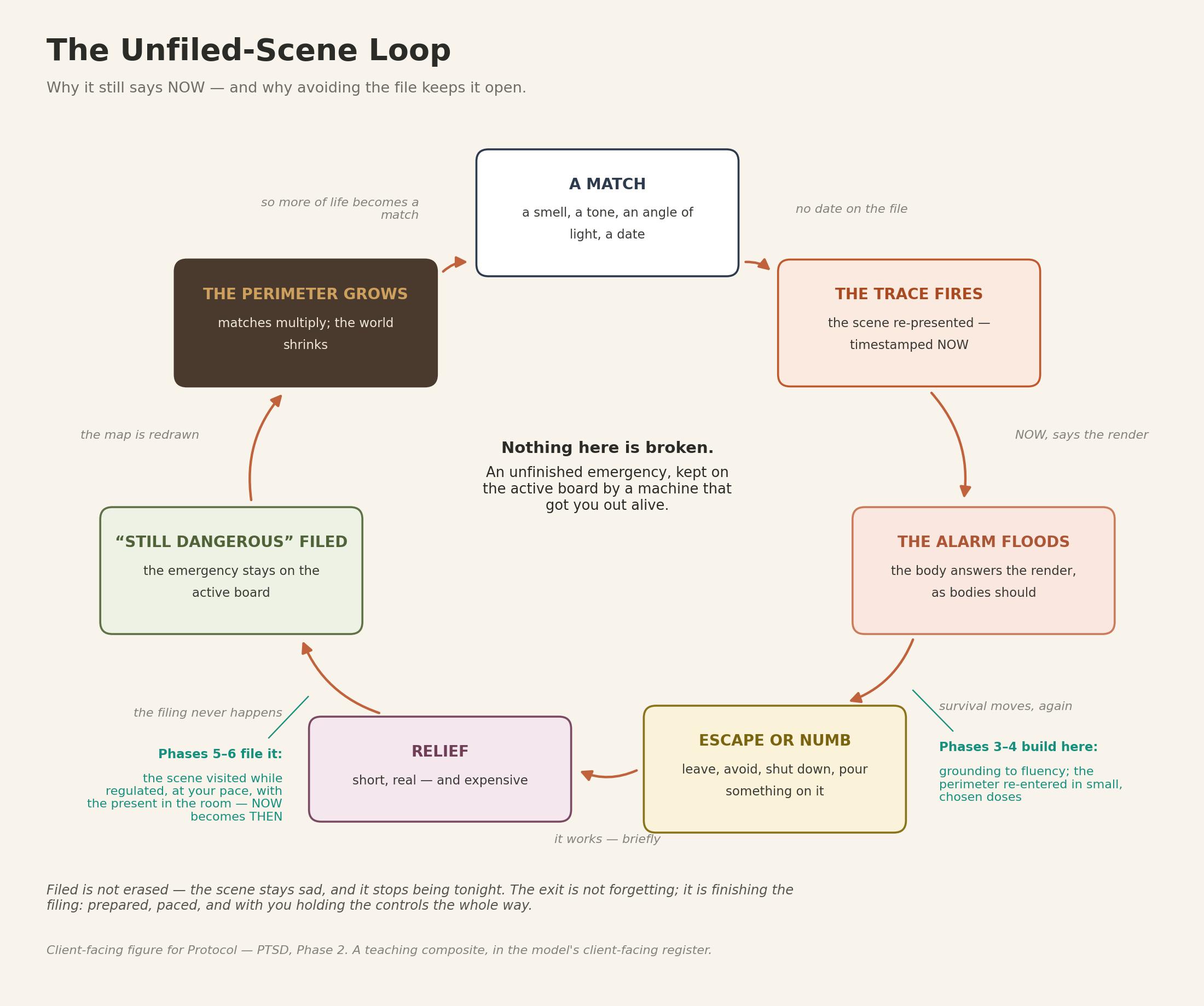
The loop's mechanics, the intervention points (Phases 3–4 build the platform and shrink the perimeter; Phases 5–6 complete the filing), and the dignity line at the center. And the flag, which in this protocol is a treaty: "We go at your pace, with you holding the controls — the stop signal is absolute, the dose is negotiated every time, and nothing gets opened that we haven't prepared for together. Pressure is the grammar of what happened to you; it will not be the grammar of this room."
Phase 3 — Stabilization and floor 2 (the platform)
In this riser the gatekeeper work is a platform build, and it precedes everything:
- Grounding to fluency. Present-anchoring drilled while calm so it holds while activated: orientation, the senses run in sequence, temperature, the feet on the floor, the room named. The dissociation ladder rehearsed until the client can catch the leaving early and climb back down. This is floor 7 skill-work in floor 2's service: attention that can be steered is the precondition for every later phase.
- The scanning policy, cost-accounted. Hypervigilance is the world-verdict running as hardware — the exits counted, the back to the wall, the crowd scanned on loop. The sentry's service record is honored (it was commissioned by a real event) and its jurisdiction audited: what has the scanning caught since, at what cost in exhaustion? The deadband gets re-taught in demonstrably safe contexts first, and preference is distinguished from patrol — the wall seat can stay; the sentry's overtime goes.
- The circling policy. The "why me / what if I had / I should have" loop is the gatekeeper circling the unfiled scene — rumination as cognitive avoidance, orbiting the memory instead of entering it (the depression protocol's two-minute test adapts: circling produces the same sentence at higher volume; the file only closes from inside). Named now, retired properly in Phase 6.
- Sleep triage begun. The mechanics from Protocol — Insomnia as the junior module; nightmares logged for Phase 5's rehearsal work.
Phase 4 — Interrupt the furnace at the perimeter (floor 5)
Before the file opens, the armor retires at the edges — in-vivo work on the match inventory, run in the house six-step format (prediction named → confidence rated → written before → smallest real trial → compared out loud → "how many times before the rule revises?"): the avoided grocery store, the driving route, the crowd, the dark, the barbecue smell, the evening news. Craske's rules as everywhere — expectancy violation, sized so the machine shows up, varied, run to the read-out. This phase does three jobs at once: it returns annexed territory early (morale is treatment), it proves the method on survivable stakes before the main event, and it builds the client's own evidence that activation passes without catastrophe — the exact conviction Phase 6 will draw on. The counterattack named in advance: filter (survived trips uncounted — the ledger holds them), reinterpret ("it was fine because I was lucky / because I kept my eyes on the door" — variation and armor-off answer it), provoke (the picked fight after a good week — the machine manufacturing familiar weather), and the numbing audited honestly: it never numbed selectively, and the joy went with the fear — which is why the repatriated territory gets lived in, not just visited.
Phase 5 — Supply the readings (floor 7, floor 4, and the dimmer)
- The body re-entered. Trauma lives somatically, and the body gets re-occupied on purpose: movement, breath, strength — as experiments, not rescue rituals — the body reclaimed as habitable ground rather than the scene of the crime.
- Nightmares worked directly. Imagery rehearsal within scope: the recurring nightmare re-scripted while awake and rehearsed to fluency; the pinned sleep mechanics behind it; prazosin questions routed to the prescriber.
- The dimmer, at its most decisive. Trauma's deepest damage is frequently relational — the world-verdict says people are what that person was — and the therapy relationship is the first standing disconfirmation: an authority who believes the account, doesn't flinch at the content, doesn't punish the telling, and keeps every treaty made in Phase 2. For betrayal traumas the relationship is not the container for the experiment — it is the experiment, run weekly. Watch the furnace eating it ("paid to care," "if they really knew") and name the move gently. Then the dimmer turns up on the world: one safe person, one true sentence, forecast and read — the ladder-first rule from the one-page (safest person, not the most important), because shame dies in accurate company and the self-verdicts soften more from being seen without contempt than from any argument.
Phase 6 — The filing itself (the destination)
Activation-plus-mismatch at full formality, inside the treaty, inside the window of tolerance, with grounding on standby — co-run under supervision or referred until licensure and trauma-specific training; the model is insistent on the engine and agnostic about the vehicle:
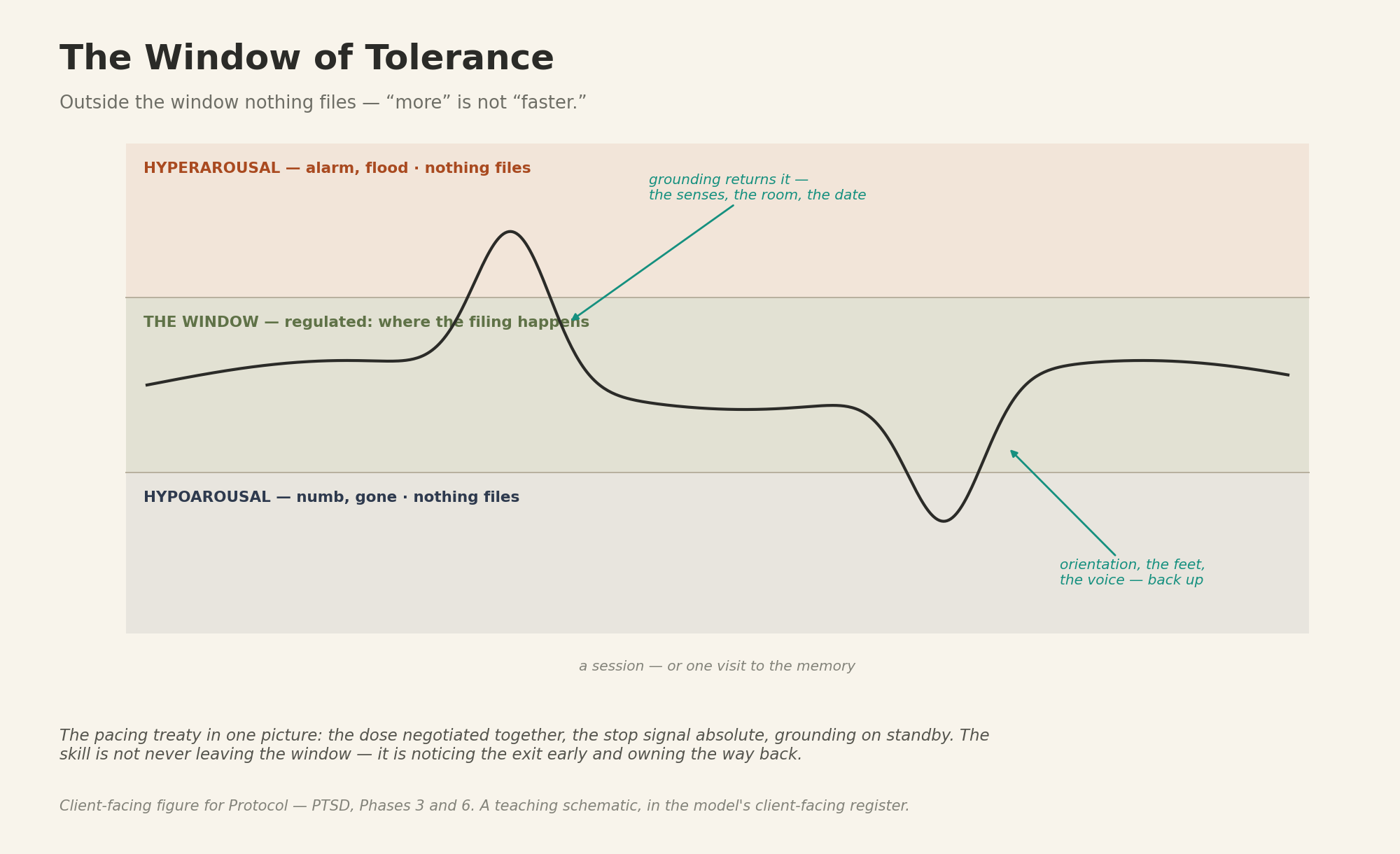
The pacing treaty in one picture — outside the window, nothing files.
- The engine: the scene visited while regulated, at negotiated dose, repeatedly, until the file completes — the memory contacted and the present's evidence in the room at the same time, which is the mismatch that lets NOW become THEN.
- The vehicles: prolonged exposure runs the engine through sustained narrative revisiting; CPT runs it through the verdicts, retrying the stuck points against the scene's actual evidence; EMDR runs it through dosed dual-attention passes. Pick per training, supervision, and client fit; the outcome literature supports the family, and the model reads them as one engine in three chassis.
- Hot spots get the visits. The worst frames — and the meaning frozen inside each (that's when I knew I was dying; that's when I froze; that's the moment it became my fault) — surfaced and mismatched with the adult's data, the scene's full evidence, and the 4F dignity line: the freeze was the machine's best move, executed perfectly.
- Moral injury adapted: where guilt is partly accurate, the mismatch is accurate sizing, amends where they exist, and meaning — not exoneration, which the client's own integrity would reject.
- The tell that the filing completed: the memory can be called up at will, told start to finish, with a date on it — sad, not sirened. Filed is not erased: the scene stays sorrowful forever, and stops being tonight.
Phase 7 — Consolidation up the building
Now floor 3 retries the verdicts formally, because the evidence exists: the world-sentences rewritten against the perimeter ledger and the scene's own record; the self-sentences retried with the full file open — and the desert move from the one-page run at its deepest: the losses were real; deserved was the forged signature. Floor 4 re-templates through the dimmer's accumulated data — the templates predict what people will do, and the ledger now contains people who did otherwise. Floor 1 re-authors at the deepest level this drawer reaches: the ruined one becomes the one it happened to, who survived it with the machinery available, and who filed it — post-traumatic growth permitted, never prescribed. Floor 8 gets named where it silenced or blamed — the family's secret-keeping, the unit's code, the congregation's discomfort, the culture that priced the victim — because half of shame is the water it was learned in, and naming the water is half its cure. And the life comes back on purpose: the map re-expanded room by room, the years mourned that avoidance took — that grief is legitimate and gets its accompaniment.
Phase 8 — Relapse as forecast, not failure
Anniversaries, matches, new losses, and the news will re-activate the file under load — and the model says so in advance: a flare is the filing system under stress, not the return of the war. The written flare protocol: the grounding stack, rehearsed and listed; the one-page account of what is true now (written in Phase 7, kept where it can be found at 3 a.m.); the fast re-contact rule — avoided territory revisited inside the week, because the perimeter only re-annexes what gets evacuated; the anniversary calendar, pre-planned rather than ambushed. Early-warning signature named while well: the numbing creeping back, the route quietly changing, sleep fragmenting, the phone screened. Booster sessions are maintenance, not failure. Close by reviewing the baselines — the PCL-5 arc, the map re-expanded — as the story of the treatment.
Two therapist-side rules, all phases
- Never argue with the verdict — and never rush the telling. Pressure to disclose is the perpetrator's grammar — demand overriding consent — and it re-enacts the injury in the room built to heal it; titration and the treaty are the treatment working, not the treatment delayed. The shame verdicts are not argued with either: they are outlived in accurate company and retried on evidence, in that order. And the therapist's own face is data read at maximum precision — composure without coldness is a clinical skill, the flinch is a reading the client will file, and the clinician's secondary load is real and belongs in supervision, not in the room.
- Match the tempo, and watch the transfer rule. The window of tolerance governs everything — outside it, nothing files, and "more" is not "faster." Expect the machinery in adjacent costumes: the vigilance in the parenting, the numbing in the marriage, the perimeter in the career — and in complex presentations expect the transfer rule at scale: every riser in the building may carry the house's fingerprints, and they are worked floor by floor, over time, per the Decision Aid's loop. And expect success to open grief — the mourned years arrive when the alarm finally quiets; schedule room for them.
Pin targets
| Lead | For | Status |
|---|---|---|
| Craske et al. 2014 | expectancy violation — Phases 4–6 design rules | PINNED |
| van IJzendoorn et al. 1999 | disorganized attachment — the complex-trauma formulation | PINNED |
| Kube et al. 2019 | immunization — the reinterpret move | SUPPORTIVE — not settled. Two experimental studies (2019); a 2024 replication from the same group failed on one manipulation. Cite as evidence for the move, not proof of it. |
| Sleep block (Riemann; Espie; Harvey) | Phase 3 triage; Phase 5 mechanics | PINNED (ledger) |
| Ehlers & Clark 2000, Behaviour Research and Therapy | current-threat model — the NOW claim | unpinned |
| Foa & Kozak 1986; Foa et al., PE trials | emotional processing; Phase 6's first vehicle | unpinned |
| Resick et al., CPT | the verdicts retried; Phase 6's second vehicle | unpinned |
| Bisson et al., meta-analyses (incl. EMDR equivalence) | the vehicle family's outcome base | unpinned |
| Weathers et al., PCL-5 | the running instrument | unpinned |
| Bernstein & Putnam, DES-II | Phase 0's dissociation screen | unpinned |
| Krakow et al., imagery rehearsal | Phase 5's nightmare lane | unpinned |
| Najavits, Seeking Safety | Phase 0's substance sequencing | unpinned |
| Litz et al., moral injury | Phase 0/6 adaptation | unpinned |
| Rose et al., Cochrane on debriefing | Phase 0's timing gate | unpinned |
| Walker, Complex PTSD (4F) | the defense signature — paraphrase-check flag stands | unpinned |