Protocols › Protocol — Insomnia
Protocol — Insomnia
Protocol19 August 2026. Filed in Clinical Tools beside the Decision Aid and the other protocols. Honesty label, in the appendix spirit: made, not found. This is a model-derived reorganization of CBT-I — the best-validated behavioral protocol in medicine — through the model's machinery: Spielman's 3P frame, Bootzin's stimulus control, sleep restriction, Espie's attention–intention–effort pathway, and Harvey's cognitive model. The sequence and the framing are the model's contribution (gates → policy → retraining → readings → ignition → consolidation → relapse plan); the components' evidence is CBT-I's own, and unusually for this drawer, the sleep sources are already pinned. Written by a counseling student; runs under supervision; composes with, never replaces, program training, site protocols, and sleep medicine. Companions: floor-notes/Floor 7 — Body and Interoception, floor-notes/Floor 5 — Scripts and Behavior, floor-notes/Floor 2 — Metacognition, the furnace (§2.3), and the pinned sleep block in the ledger (Espie 2006; Harvey; Riemann 2023).
The formulation in one line
Insomnia presents on floor 7 (the body that won't stand down), but runs on floor 5 (a bed re-taught as a battle station, and armor that dilutes the very sleep pressure it protects) and floor 2 (a monitoring-and-effort policy aimed at sleep itself), is priced by floor-3 verdicts about ruined tomorrows, is often ignited from floor 6 (the stretch of nights that started it), sits in floor-8 water that prices sleep as either weakness or a performance metric, and is frequently another riser's floor 7 in flames — and the treatment follows the building, not the complaint.
The model's distinctive reading
Three claims organize everything below.
Sleep is the one door that locks when pushed. Sleep is a released state, not an executed act — floor 5 owns no script for it, and every script written for it (trying, forcing, monitoring for its approach) runs arousal, which is sleep's off-switch. This is the effort paradox at its purest, and the model files it precisely: sleep effort is the provoke move aimed at one's own nervous system — checking for sleep chases it, wanting it loudly forbids it, and the 3 a.m. arithmetic (hours left × tomorrow's wreckage) is arousal doing math. Espie's attention–intention–effort pathway is this claim in the literature: good sleepers do nothing to sleep, and that nothing is the whole skill.
The bed has been re-taught, and the machine learned exactly what it was taught. Enough nights of wakeful, furious, calculating time in the bed converts the bed, the hour, and the dark from sleep cues into battle stations — conditioned arousal, floor 5's plainest demonstration (the tell: sleeps on the sofa, in hotels, anywhere but the marital pillow, where the head touches down and the eyes open). Nothing is broken; the association machinery did its job on the data it was given, and machinery that learned once can be re-taught. The armor makes it worse in the model's exact sense: the early bedtime, the lie-in, the nap, the cancelled morning — every compensation dilutes sleep pressure and de-anchors the clock, so the armor weakens the very drive it guards, and each thin night confirms that the armor is needed.
The daytime forecast does the night damage. If I don't get eight hours, tomorrow is ruined and my health is dissolving — the catastrophic pricing raises the stakes that raise the arousal that costs the sleep: prepayment at midnight for a bankruptcy that isn't coming. And the felt night and the recorded night routinely differ in this direction — the machine reports the night it forecast, and objective sleep runs longer than the render suggests (said with care, never as dismissal: the exhaustion is real; the ledger is what's off). The five moves in pajamas: provoke (the effort, the clock math), avoid (the evening dreaded, the bed approached like a exam), filter (the decent nights uncounted), reinterpret ("I only slept because I was destroyed"), withdraw effort (the mornings cancelled, the life narrowed to protect a sleep that narrows further).
Phase 0 — The gates (run first, and never fully retired)
The differential gate is the heaviest in this protocol, because insomnia has body-doubles. Screen before formulating: apnea (snoring, witnessed pauses, gasping, morning headache, neck size, daytime sleep attacks — STOP-BANG or equivalent; a positive screen routes to sleep medicine before this protocol, because treating conditioned arousal in an untreated apneic is treating the wrong machine); restless legs / periodic limb movement (the crawling urge that motion relieves — its own referral); circadian phase disorders (the young adult who "can't sleep" at 11 but sleeps perfectly 3-to-11 has a clock problem, not an arousal problem — light and timing, not restriction); narcolepsy flags (cataplexy, paralysis, hallucinated entries); parasomnias named and routed. Medical suppliers audited: pain, nocturia, reflux, thyroid, and the pharmacy (steroids, stimulants, some antidepressants' timing, beta-blockers' dreams) — with the prescriber, never around them.
The mania gate, absolute. Short sleep without fatigue — three hours and electric — is not insomnia; it is a reversed dial and a psychiatric flag, and sleep restriction is contraindicated twice over (restriction can induce mania in bipolar machines). Screen history before any window is set.
Restriction's own contraindications. Sleep restriction is this protocol's strong medicine and is dosed like one: bipolar history, seizure disorders, parasomnias, and safety-critical occupations (drivers, operators, on-call surgeons) either exclude it or convert it to gentler sleep compression, per supervision and the site's medical backup. Pregnancy and chronic illness adapt the dose.
The hypnotic status quo. Sleeping pills are the prescriber's jurisdiction, full stop — no unilateral changes, ever. The protocol runs happily alongside a stable dose; tapers, if the client wants one, are the physician's project that this protocol can support with the behavioral floor it builds. The chemical-armor observation (survivals credited to the pill) is routed as a question, never issued as an instruction.
Routing. Where the sleeplessness is another riser's floor 7 — the depression that wakes at 4, the worry that convenes at 11, the trauma that guards the dark — the senior partner is treated first or jointly (Protocol — Depression, Protocol — Worry (GAD), Protocol — PTSD), with this protocol's mechanics as the junior module. The router's question: did the nights break first, or the days?
Phase 1 — Locate and formulate (the riser profile)
The diary before the story: two weeks of sleep diary run before formulation (bed time, lights out, latency, wakings, final wake, out-of-bed, naps, caffeine, alcohol) — because this riser's render and its record disagree, and the protocol treats the record. Then the sorting questions, Appendix A machinery with a night filter:
- "When did the machine learn this, and what was true then?" The newborn year, the ICU rotation, the divorce spring, the deadline season — floor 6 usually holds the original stretch, and the armor (early beds, lie-ins, the nap) usually made sense then. The profile honors the armor's service record before retiring it.
- "What do you do about sleep — all of it?" The full armor inventory: the 8:45 bedtime "to get a head start," the weekend lie-in, the nap, the cancelled morning, the tracker consulted like an oracle, the supplements, the rituals that have hardened from wind-down into liturgy.
- "What happens in the bed when sleep doesn't come?" The battle log: the clock checked, the arithmetic run, the phone, the trying, the rage, the partner resented for breathing. This is floor 2's policy caught verbatim.
- "What does a bad night cost the next day — as forecast, and as actually read?" Sets up Phase 4's daytime experiments; the gap between those two numbers is treatment material.
Baselines from the diary: sleep efficiency (SE%), latency, wake-after-onset, total sleep time; ISI; the armor count; caffeine and alcohol load; tracker dependence (the orthosomnia flag — a wearable consulted hourly is a pulse-check in a wristband, and it may need a sabbatical).
Phase 2 — Teach the client the machine
Client-facing telling, in the model's images, and the dignity move comes standard: nothing here is broken. Two magnificent systems — sleep pressure, which rises with every waking hour and spends itself at night, and the circadian clock, which opens the gate on schedule — plus one learned association, doing exactly what it was taught by a bad stretch that was real. The machine can be re-taught, by the same mechanism that taught it.
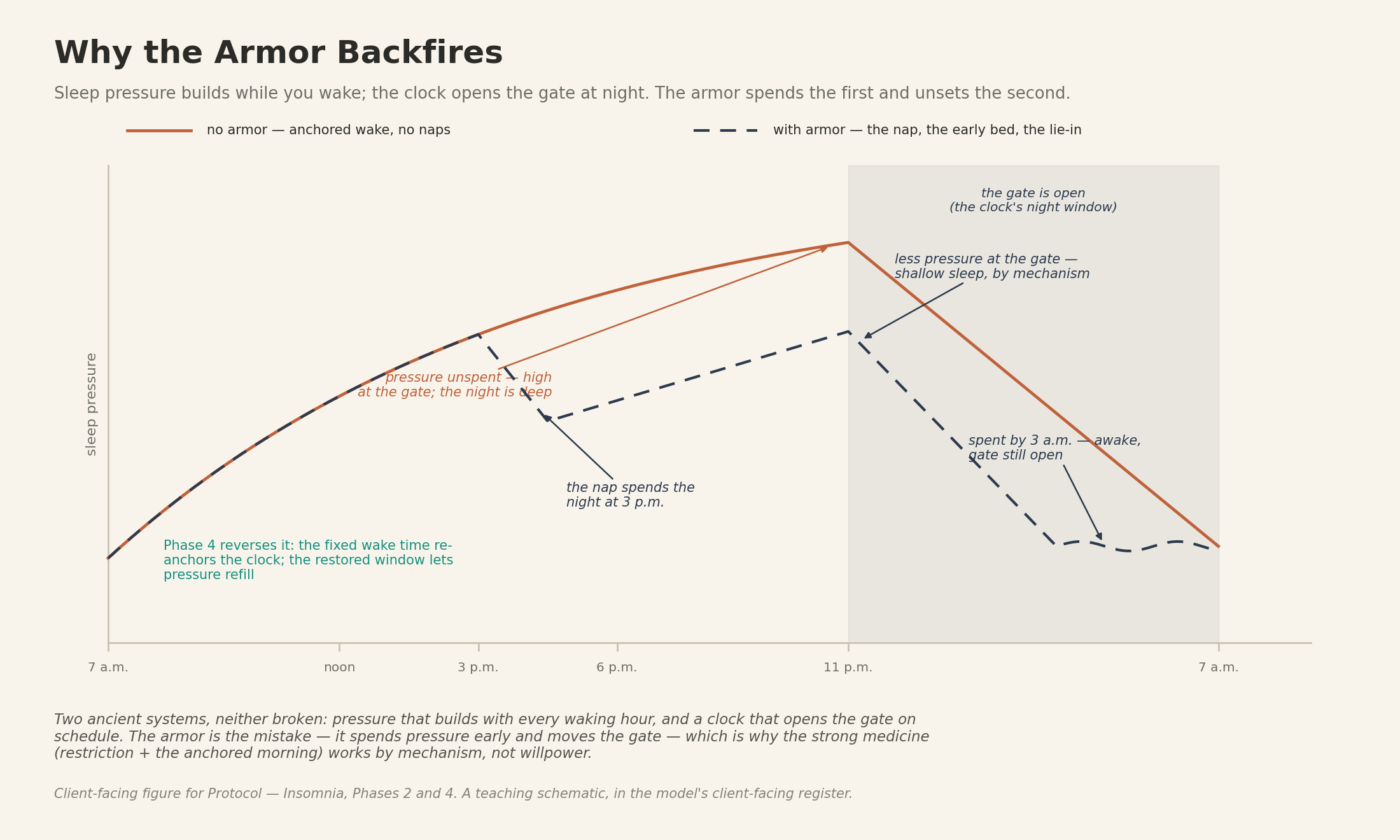
The two systems, drawn — pressure and the gate, and why the armor backfires by mechanism.
Then the claims that reorganize everything, stated flat:
Sleep cannot be executed — only permitted. Effort is the off-switch. And: the bed will be re-taught by evidence, not by trying.
Name the prepayment: the midnight arithmetic is the machine paying tomorrow's bankruptcy tonight, with interest, in the only currency that guarantees the debt.
Draw the loop for the session:
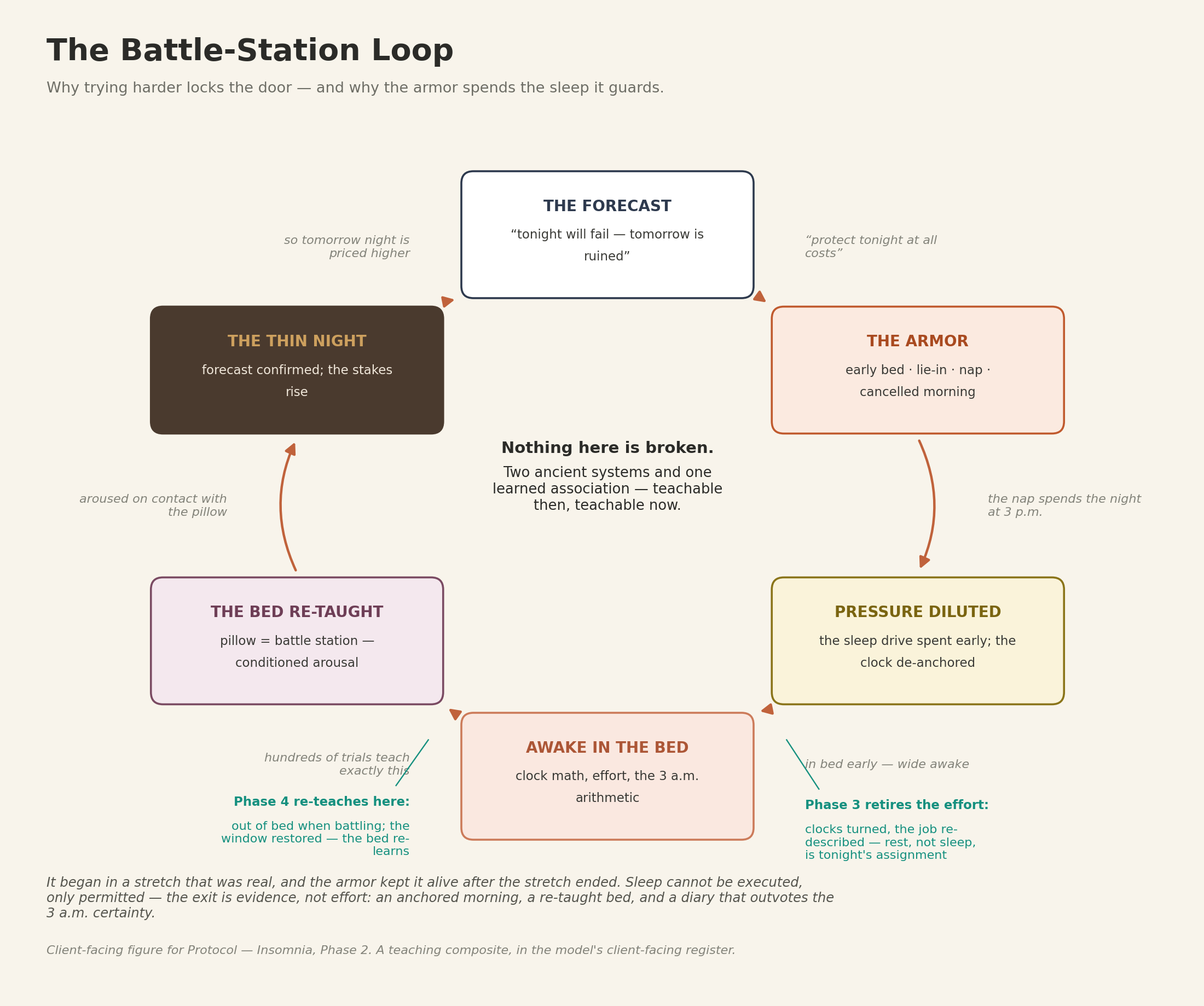
The loop's mechanics, the two intervention points (Phase 3 retires the monitoring-and-effort policy; Phase 4 re-runs the conditioning with the arrow reversed), and the dignity line at the center. And the flag, adjusted for this riser's special honesty requirement: "This will get harder before it gets easier — we'll say exactly when and why — and we will not be trying to sleep at any point. We're going to make sleep the only thing left in the room."
Phase 3 — Floor 2 first, because floor 2 is the gatekeeper
The monitoring-and-effort policy retires before the retraining, or the retraining is run as one more technique-to-try-hard-at — the failure mode of every self-help sleep book on the client's nightstand. Targets:
- The clock faces turn. The 3 a.m. arithmetic is arousal doing math; the alarm still rings without being watched. Clock faces away, phone out of reach, the tracker on sabbatical where it has become the oracle — the numbers this protocol trusts are the morning diary's, written once.
- The effort paradox, named and demonstrated. Espie's pathway told plainly: attention → intention → effort, each step a lock on the door. Where the client is a sleep perfectionist, paradoxical intention runs as the formal experiment: tonight's job is to rest with eyes open and not fall asleep — the one instruction the machine cannot weaponize, because effort in either direction is still effort, and surrendering the project is the point.
- The job re-described. "Your job tonight is not to sleep. Your job is to be restfully awake and let two systems that predate your species do their work. Sleep is what happens when you stop applying."
Deliverable: consent to the retraining, with the dip forecast in writing — week one to two runs on less sleep, by design, and the machine will call it proof of failure; the forecast of the dip is the protocol's inoculation against the reinterpret move.
Phase 4 — Interrupt the furnace (floor 5): the retraining
The two engines of CBT-I, run in the house format as forecast experiments:
- Stimulus control — the bed re-taught. The bed is for sleep (and sex) only; awake past the felt twenty minutes → out, to a dim and boring room, back when sleepy, as many rounds as the night requires; fixed wake time, seven days a week — the anchor everything else hangs from; no naps (or one defined exception, dosed). The forecast written before the first week: "getting out of bed will wreck the night" — confidence, in writing. The reading after: the nights the client left the bed versus the nights they battled in it. The bed's new lesson requires the consistency of the old one — the machine learned from hundreds of trials, and it re-learns from dozens of clean ones.
- Sleep restriction — the pressure restored. The window set from the diary's actual average sleep (floored at 5.5–6 hours per safety and supervision), same wake time regardless of the night, window titrated weekly on SE% (≥90% earns fifteen minutes; <85% holds or trims). Framed honestly as the strong medicine it is: two rough weeks forecast in advance, in writing — so when the dip arrives on schedule, it confirms the model, not the machine ("the dip is the pressure refilling; it is the treatment working, exactly as predicted").
- The daytime forecasts on trial. After each thin night, the machine's morning verdict is written (function today: 2/10, the meeting will be a disaster) and read against the actual evening reading. The finding the client collects personally, the same one every riser in this drawer produces: the forecasts run darker than the readings — tired days are degraded, not ruined, and the performance forecast misses low, week after week, in their own handwriting.
- The armor retires piece by piece, two-condition style with forecasts attached: the early bedtime, the weekend lie-in, the nap, the nightcap — each tested, not confiscated. The furnace's counterattack named in advance: reinterpret ("I only slept because I was wrecked" — the diary's trend line answers), filter (decent nights uncounted — the diary holds them), provoke (mid-night diary-checking and effort creeping back — caught and named), avoid (the 8:45 retreat re-offered every hard week).
Session metric (§6.2): if nothing surprised the client, nothing changed — and in this riser the surprise usually arrives in week three, when the machine sleeps through the window it swore it couldn't fill.
Phase 5 — Supply the readings (floor 7 serviced, the clock fed)
- Light and dark, on schedule. Morning light within the first hour (outside, or bright); evening dimmed; screens exiled or filtered late — the circadian machinery fed its actual inputs. For owls and larks the window shifts to the chronotype rather than fighting it, within life's constraints.
- The suppliers audited as experiments. Caffeine run against its half-life math (the 3 p.m. cup is a midnight dose at quarter strength) — two-week trial, diary as referee. Alcohol priced honestly: sedation is not sleep; the nightcap buys the first third and fragments the rest, and the 3 a.m. rebound has a vendor. Exercise timed; the hot bath's cooling curve used; the room cooled.
- The runway, kept honest. A wind-down hour as permission architecture — dim, slow, pleasant, no liturgies. The watch: any routine whose absence causes panic has crossed from runway to armor, and gets the two-condition test like everything else.
- The dimmer. The co-sleeper enlisted: the protocol explained (the 11:40 lecture on how the client "just needs to relax" is furnace fuel), the logistics negotiated (separate blankets, the reading light, the snoring conversation had with the physician where the screen said so), the bed re-taught for two.
Phase 6 — The ignition scene, if Phase 1 found one
Where the sleeplessness carries a scene — the years of night shifts, the newborn ICU stretch, the bedroom where the fear lived, the house where night was when it happened — mechanics restore the numbers and a dread of the dark persists, or sleep returns everywhere except one bed. Night is the unguarded hour, and some machines learned dark = danger long before this mattress. The trace needs activation-plus-mismatch — within scope and supervision, or by referral — and where the scene is trauma proper, Protocol — PTSD leads and this protocol carries the mechanics behind it (nightmares get their own lane: imagery rehearsal within scope; prazosin questions to the prescriber).
Phase 7 — Consolidation up the building
Now floor 3 writes, because the diary exists for the sentences to describe: the client states the revised model in their own words, against their own SE% curve and forecast-versus-reading ledger. Floor 1 re-authors — "insomniac" comes off the nameplate: not an identity, a stretch of re-taught nights; the person who slept badly becomes the person who re-trained a bed, and the difference governs every future flare. Where floor-8 water is in play, it usually runs two currents at once — the hustle culture that priced sleep as weakness ("I'll sleep when I'm dead") and the optimization culture that priced it as a performance metric with a leaderboard — both get named as the same water at different temperatures. The maintenance settings are written down like a service manual: the anchor wake time kept within the hour, the window rules, the two-week rule for any experiment.
Phase 8 — Relapse as forecast, not failure
Flares are certain — illness, travel, the newborn, the deadline, grief — and benign if the armor stays off: acute insomnia is weather; chronic insomnia is the armor's response to weather. The written flare protocol is three rules, small enough for a wallet card: keep the wake time (the anchor holds even when the night doesn't), no compensation (no early beds, no lie-ins, no naps — the debt is repaid by pressure, not by scheduling), out of bed when battling (the bed's lesson is never un-taught by one bad week, only by a month of fighting in it). Early-warning signature named while well: the lie-in creeping past the hour, the clock math returning, the 8:45 bedtime re-proposed. Booster sessions are maintenance, not failure. Close by reviewing the diary's arc — the ISI at intake and now — as the story of the treatment.
Two therapist-side rules, all phases
- Never argue with the verdict. The 3 a.m. certainty cannot be reasoned with at 3 p.m. — the diary is the only witness worth calling, and it testifies weekly. Never sell tonight (the protocol owns no single night — it owns trend lines), and never become the sleep-hygiene lecturer: tips without the retraining are homeopathy for chronic insomnia, and they discredit the real machinery by association.
- Match the tempo, and watch the transfer rule. Restriction is dosed to the life — exams, infants, freeway commutes adjust the window and sometimes park the strong medicine entirely; compression exists for exactly those seasons. And this riser is the drawer's great junior partner: when the nights restore and the days don't lift, the senior riser was always upstairs — route to its protocol. Expect the effort paradox in other costumes too: the client who fought sleep this way often fights relaxation, sex, and creativity the same way — the doors that lock when pushed are a set, and naming one unlocks the account of the others.
Pin targets
| Lead | For | Status |
|---|---|---|
| Espie et al. 2006, attention–intention–effort | the effort paradox — the distinctive claim | PINNED (ledger) |
| Harvey, cognitive model of insomnia | the daytime forecast; monitoring; misperception | PINNED (ledger) |
| Riemann et al. 2023, European insomnia guideline | CBT-I as first line; the component evidence | PINNED (ledger) |
| Kube et al. 2019 | immunization — the reinterpret move | SUPPORTIVE — not settled. Two experimental studies (2019); a 2024 replication from the same group failed on one manipulation. Cite as evidence for the move, not proof of it. |
| Craske et al. 2014 | expectancy-violation design rules | PINNED |
| Spielman et al. 1987 | 3P model; sleep restriction's origin | unpinned |
| Bootzin 1972 | stimulus control — Phase 4's first engine | unpinned |
| Morin; ISI (Bastien et al. 2001) | the running instrument | unpinned |
| STOP-BANG (Chung et al. 2008) | Phase 0's apnea screen | unpinned |
| Wickwire / Krakow, imagery rehearsal | Phase 6's nightmare lane | unpinned |