Protocols › Protocol — Depression
Protocol — Depression
Protocol19 August 2026. Filed in Clinical Tools beside the Decision Aid and the Health Anxiety protocol. Honesty label, in the appendix spirit: made, not found. This is a model-derived reorganization of components that existing depression treatments have tested separately — behavioral activation (Lewinsohn through Jacobson and Martell), Beck's cognitive lineage, rumination-focused work (Nolen-Hoeksema, Watkins), sleep treatment, and the expectation-persistence literature (Kube). The sequence is the model's contribution (gates → policy → interruption → readings → ignition → consolidation → relapse plan), and the sequence has no outcome data of its own. Written by a counseling student; runs under supervision; composes with, never replaces, program training and site protocols. Companions: floor-notes/Floor 2 — Metacognition, floor-notes/Floor 5 — Scripts and Behavior, floor-notes/Floor 3 — Propositional Beliefs, the furnace (§2.3), and the Kube and Swann pins in the ledger.
The formulation in one line
Depression presents on floor 3 (the verdicts: worthless, hopeless, pointless), runs its engine on floors 5 and 2 (the shutdown loop, governed by a rumination policy), starves the body on floor 7 (sleep first), is often ignited from floor 6 (a loss, a defeat, a humiliation — or an old forecast that reaching makes it worse), sits in floor-8 water (worth priced in productivity), and is worn on the mattering dial — and the treatment follows the building, not the complaint.
The model's distinctive reading
Three claims organize everything below.
Depression is a dark forecast, not a dark measurement. The machine is predicting — globally, with high confidence — that effort won't work, that reward won't arrive, that people won't want what shows up. Anhedonia is the forecast it will feel like nothing delivered so early it replaces the experience. The tiredness is a forecast wearing the body. This is the paper's §2.1 run at its bleakest setting: the client isn't perceiving a gray world; they're perceiving their machine's render of one.
The shutdown is the furnace's fifth move running as a whole-life policy. Withdraw effort — §2.3's quietest move — is depression's flagship: every untried attempt is logged as a save ("dodged another failure"), so the dark forecast compiles a perfect, undefeated record while never once taking the field. The other four moves run guard duty around it: avoid (the unanswered texts, the declined invitations), filter (the compliment unheard, the win uncounted), reinterpret (the disconfirming success re-explained — "they were just being nice," "anyone could have"; Kube's cognitive immunization, pinned, is exactly this move caught in the lab), and provoke (Swann's allure of negative feedback, pinned — the depressed prior actively soliciting its own confirmation). Treatment is therefore furnace work: the forecast must be brought face-up to the table while reality answers it — argument alone gets immunized.
The dial reads empty, and the gauge is not lying about the feeling — it's mislabeling the cause. The mattering gauge reports you don't matter here; often the rank gauge adds defeat, no exit. The readings are real experiences produced by real machinery — the dignity move is to locate the fault in the forecast that feeds the gauge, never in the person reading it.
Phase 0 — The gates (run first, and never fully retired)
Depression's gates are heavier than any other protocol in this drawer, and they stay open all treatment.
Risk, directly and every time. Suicidality is assessed at intake with a structured tool (C-SSRS or equivalent), asked about plainly — asking does not plant it; the evidence is settled — and re-screened at every session (PHQ-9 with item-9 follow-up as the running instrument). Where indicated: a collaborative written safety plan (Stanley–Brown format) built with the client in session, warning signs through reasons for living through contacts; a direct, practical means-safety conversation as standard care; crisis resources given in writing (in the US, 988), and the site's crisis pathway rehearsed before it's needed. Escalation thresholds are agreed with the supervisor in advance, not improvised. A student runs this protocol under supervision or not at all.
The calibration gate. Real fatigue in a real body gets real medicine: medical rule-outs (thyroid, anemia, vitamin D and B12, sleep apnea — especially where the sleep complaint predates the mood), medication review for depressogenic contributions, and a bipolar screen before any activation work (a machine that has ever run hot changes the plan and the referral).
The medication boundary. Moderate-to-severe presentations get a psychiatric evaluation referral alongside this protocol, not instead of it — and the model's framing keeps the dignity intact: medication is an input to the machine, a legitimate lever on the same equipment this protocol works, not a rival explanation and not a defeat. The stance from the ledger: audit inputs; nothing here outranks the prescriber.
Grief is not a target. Where the profile finds mourning doing its work, the protocol stands down to accompaniment. The gate question: is the machine processing a loss, or has it generalized a loss into a verdict about the self? Only the second is this protocol's business.
Phase 1 — Locate and formulate (the riser profile)
Two sessions of ordinary listening, Appendix A machinery with a mood filter. The sorting questions:
- "When did the lights go out — was there a day, or a dimmer?" A day, an event, an anniversary pattern → check floor 6 for a scene (loss, defeat, humiliation, betrayal). A slow dimmer → suspect the floor-5/7 erosion loop (withdrawal and sleep debt compounding) and floor-8 water.
- "When something goes well, what does the voice say?" Surfaces the filter and reinterpret moves in the client's own vocabulary — this sentence becomes Phase 4's named opponent.
- "If you woke up tomorrow and it had lifted, what would you do by noon?" Maps what the withdrawal is protecting, recovers buried values for Phase 4's menu, and quietly measures hope.
- "What did needing help get you, growing up?" Screens the floor-6 attachment forecast (reaching makes it worse) that will otherwise sabotage the therapy relationship itself.
Baseline the furnace in numbers, because the numbers are the outcome measures: activity sampling (what actually fills a day, hour by hour, without judgment), sleep window and wake times, PHQ-9, plus the client's own three-item list of what a lifted week would contain.
Phase 2 — Teach the client the machine
Client-facing telling, in the model's images, and the dignity move comes standard: nothing here is broken. The machine is running a defeat program — an ancient energy-conservation strategy that once kept losing animals alive by stopping them from spending effort a lost situation wouldn't repay. The program's logic is coherent; its forecast is wrong about this life. Then the two claims that reorganize everything, stated flat:
The tiredness is a forecast, not a fuel gauge. And: the machine has been predicting the party will feel like nothing — and handing you the prediction instead of the party.
Draw the loop for the session:
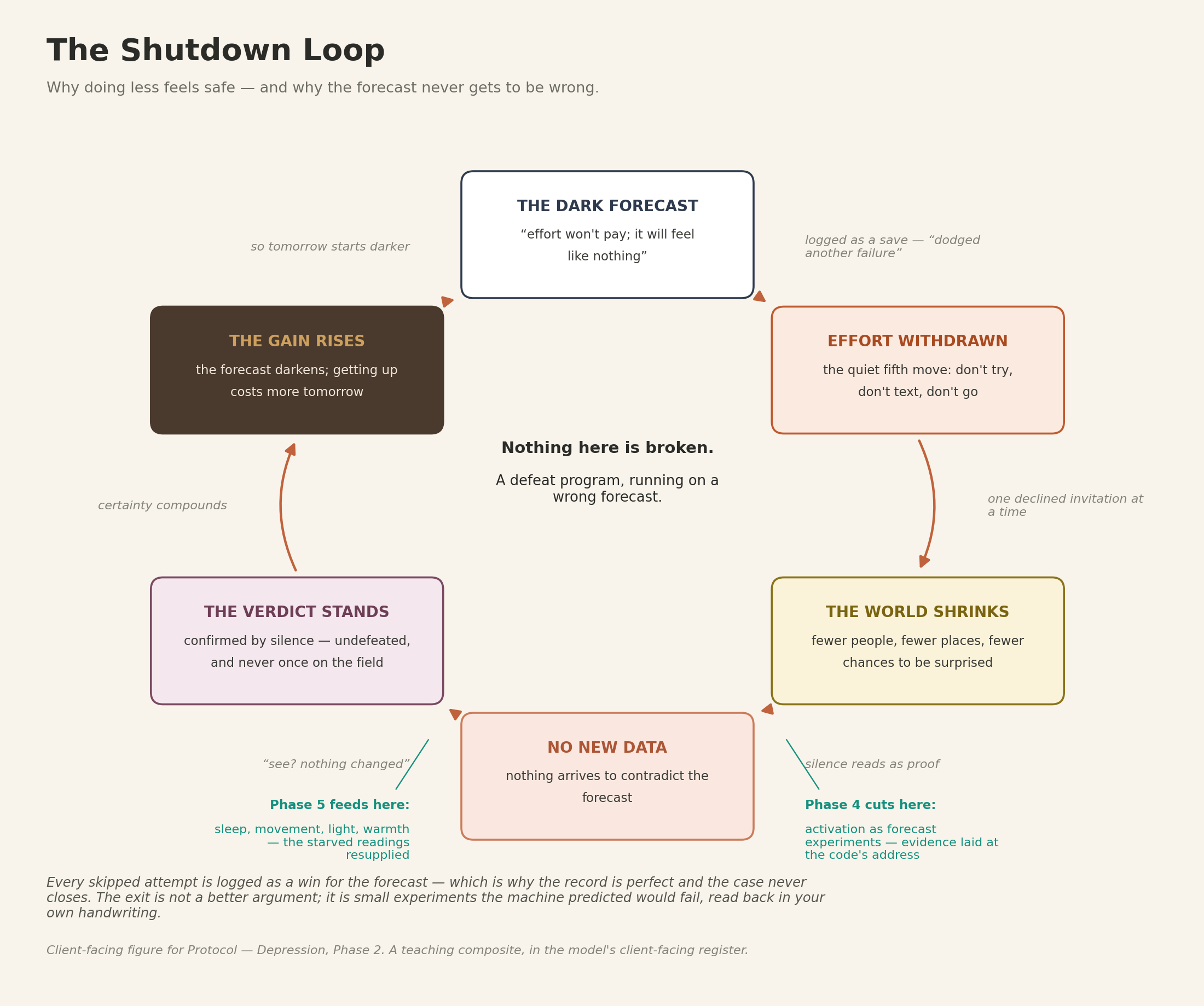
The figure carries the phase's claims at once: the loop's mechanics — the verdict → effort withdrawn → the world shrinks → no new data → the verdict stands, confirmed by silence → the gain rises — the two intervention points (Phase 4 cuts the withdrawal arrow; Phase 5 feeds the starved readings), and the dignity line at the center. Plant the flag that governs all of it: "We will not be arguing you out of this, because the part of you that's certain doesn't read arguments. We're going to show it things instead."
Phase 3 — Floor 2 first, because floor 2 is the gatekeeper
Depression's monitoring policy is rumination — the conviction that analyzing the problem of me, long enough and hard enough, will produce the exit. It is the checking of health anxiety pointed inward, and Phase 4 is experienced as frivolous ("rearranging deck chairs") until the policy is re-described. Targets:
- Cost accounting — what has analysis actually produced, in exits found versus hours lost? The client audits their own record: has the answer ever once arrived by circling?
- The two-minute test (Watkins) — rumination caught and named live: is this solving, or circling? Solving produces a next action inside two minutes. Circling produces the same sentence at higher volume. The catch, not the suppression, is the skill.
- The motivation contract — the policy I'll act when I feel like it is re-described as the forecast it is: in this program, motivation is the output of action, not its fuel. We act first, at experiment scale, and audit what arrives.
Deliverable: consent to the experiment. "We're testing the machine's forecasts. Your worth was never on the table."
Phase 4 — Interrupt the furnace (floor 5): activation as disconfirmation
Behavioral activation, run in the model's format — not as scheduling pleasant events, but as forecast experiments (§2.3 meets Chapter 10 of the ledger's own literature): every scheduled activity gets a written prediction before (enjoyment 0–10, mastery 0–10, "what the machine says will happen") and a written reading after. The robust finding the client collects personally within two weeks: the machine's predictions run systematically darker than the readings. That gap, in their own handwriting, is the treatment — evidence laid at the exact address where the dark code lives.
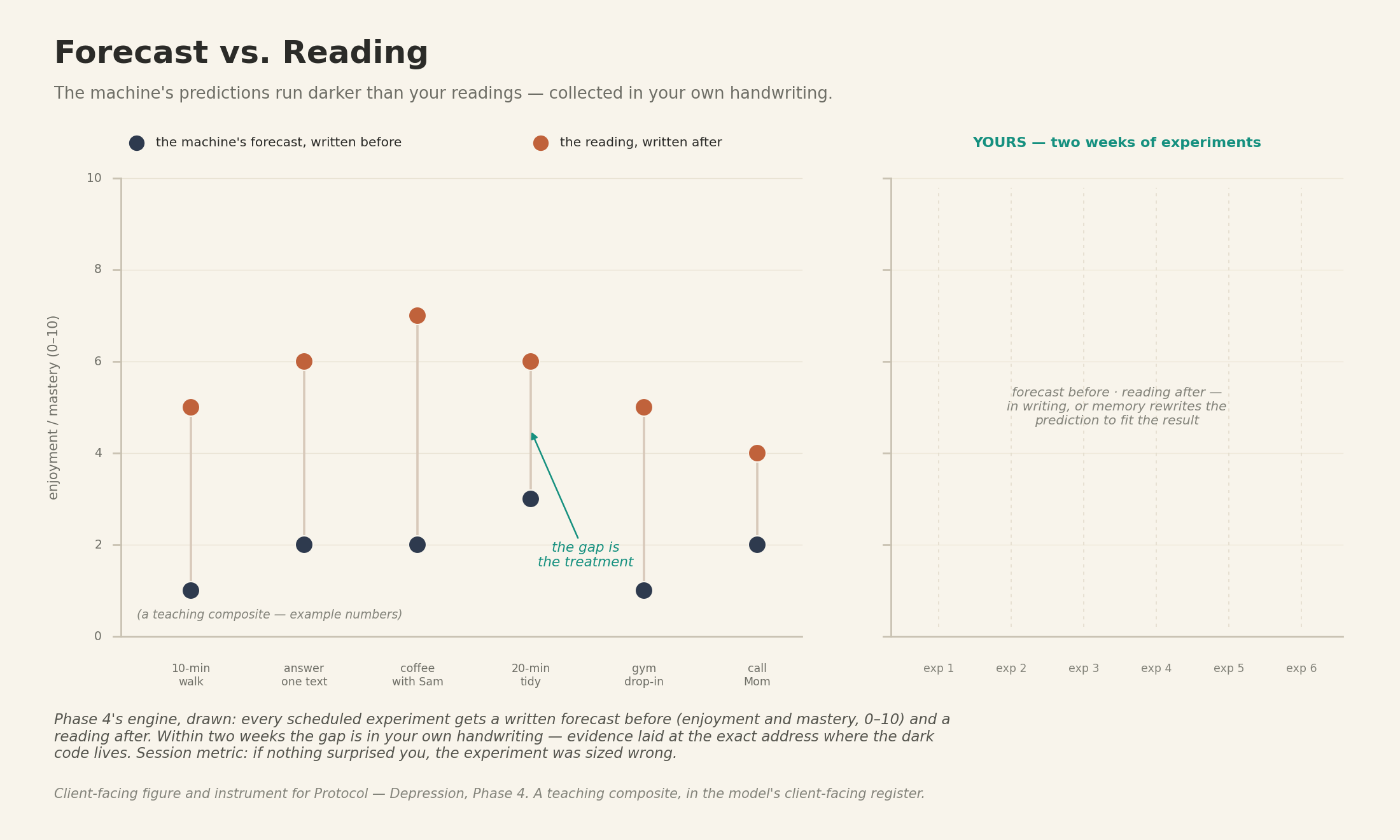
The gap chart — a worked example beside a blank panel for the client's own two weeks.
Design rules: smallest real experiments first (a ten-minute walk, one text answered, one meal at the table), values-linked from Phase 1's noon-list (mattering experiments outrank chore experiments — the dial is fed by contribution and contact, not laundry), and graded against the sleep-debt reality of floor 7. And the furnace's counterattack is named in advance, move by move, so the client can catch it: the reinterpret ("doesn't count, anyone could") gets logged next to the reading it's attacking; the filter gets audited weekly (what went well that never made it into memory?); the provoke gets caught in-session — the reassurance-seeking that solicits criticism, the self-deprecation fishing for confirmation. Session metric (§6.2): if nothing surprised the client, nothing changed — an experiment that merely confirmed expectations was sized wrong; shrink and rerun.
Phase 5 — Supply the readings (floor 7 and the dimmer)
With the withdrawal arrow cut, feed the starved instruments:
- Sleep first. The model treats sleep as the forecaster's maintenance window, and the insomnia-depression loop as one system (the sleep block in the ledger is pinned): fixed wake time, stimulus-control basics, the bed re-trained as a place sleep happens — CBT-I elements within scope, referral where the insomnia is the senior partner.
- The body votes. Movement, light, and outdoor time run as bottom-up forecast revision — prescribed in experiment format (predict the run's effect; read the actual), because the exercise evidence is strong and the model explains why: the body's state is data the machine can't fully filter.
- The dimmer is the covert experiment. For the client whose floor-6 forecast is I'm a burden; reaching makes it worse, the therapy relationship itself is the disconfirmation: warmth delivered, session after session, to someone whose machine predicted it wouldn't come. Perceived responsiveness is the demand side — watch for the furnace eating it ("she's paid to care") and name that move gently when it runs.
Phase 6 — The ignition scene, if Phase 1 found one
Where a floor-6 trace is underneath — the layoff that meant defeat, the divorce that meant unwanted, the childhood house where reaching reliably failed — activation lifts function but leaves a pilot light. The trace needs activation-plus-mismatch: the scene revisited while regulated, grief given its actual work, the meaning re-metabolized on lived evidence — within scope and supervision, or by referral until licensure. The tell that Phase 6 is needed: Phases 4–5 restore the days, and a dateless heaviness persists, or the riser relights each year on schedule.
Phase 7 — Consolidation up the building
Now floor 3 writes, because the evidence exists for the sentences to describe: the client states the revised model in their own words, against their own ledger of forecasts-versus-readings — never the therapist's affirmations, which the furnace would immunize on contact. Floor 1 re-authors: the person whose story was the failed one becomes the one whose machine ran a defeat program, and who walked it back out into the world — made, not found, and said out loud. If floor 8 was in play — worth priced in productivity, rest booked as theft — the water gets named and renegotiated explicitly, or the riser rebuilds on schedule with the next slow season. The mattering dial gets its legal channels listed and scheduled: the contribution, the contact, the place they're counted on.
Phase 8 — Relapse as forecast, not failure
The model expects return and says so out loud: the dark prior is outcompeted, not erased (§6.2's two regimes), and load — loss, illness, a brutal quarter — re-raises its gain. The ending includes a written flare protocol: the client's personal early-warning signature (sleep fragmenting is usually first; then the unanswered texts; then the voice), the three pre-agreed re-entry experiments that require no motivation to start, the standing rule that a dark week is a reading and not a verdict, and the door back — booster sessions named as maintenance, not failure. Close by reviewing the baseline numbers as the story of the treatment.
Two therapist-side rules, all phases
- Never argue with the verdict. Cheerleading and reassurance are arguments, and the machine doesn't attend hearings — worse, each defeated argument gets logged as further proof that even the therapist's case for you was weak. The answer is always the experiment, never the debate.
- Match the tempo, and watch the transfer rule. Pace under psychomotor slowing — an agenda run at the therapist's speed reads as one more failed performance. And conquering this riser doesn't touch the others: where the defeat program was installed by an intermittent house, expect the machinery to reappear in a new costume — anxiety, over-work, the next riser — and say so before it does.
Pin targets
| Lead | For | Status |
|---|---|---|
| Kube et al. 2019, Psychological Medicine | cognitive immunization; expectation persistence — Phase 4's named opponent | SUPPORTIVE — not settled. Two experimental studies (2019); a 2024 replication from the same group failed on one manipulation. Cite as evidence for the move, not proof of it. |
| Swann et al. 1992, J. Abnormal Psychology | allure of negative feedback — the provoke move in depression | PINNED |
| Jacobson et al. 1996 component analysis; Martell/Dimidjian BA | Phase 4's chassis | unpinned |
| Lewinsohn, behavioral model of depression | the shutdown loop | unpinned |
| Nolen-Hoeksema; Watkins (RFCBT) | Phase 3's rumination policy | unpinned |
| Beck, cognitive model / the triad | floor 3's verdicts as forecasts | unpinned |
| Gilbert, defeat–entrapment; social rank | the rank gauge's readings; the defeat program | unpinned |
| Sleep block (Riemann 2023; Espie; Harvey) | Phase 5 | PINNED (ledger) |
| Stanley & Brown safety planning; C-SSRS | Phase 0 | unpinned |
| Exercise for depression (Schuch et al. meta) | Phase 5 | unpinned |
| Joiner & Metalsky 2001 | excessive reassurance-seeking — the provoke move's social form | PINNED |