Protocols › Protocol — Worry (GAD)
Protocol — Worry (GAD)
Protocol19 August 2026. Filed in Clinical Tools beside the Decision Aid and the other protocols. Honesty label, in the appendix spirit: made, not found. This is a model-derived reorganization of components that existing GAD treatments have tested separately — Borkovec's avoidance theory and stimulus-control work, Wells's metacognitive model, the intolerance-of-uncertainty program (Dugas), worry exposure, and applied relaxation. The sequence is the model's contribution (gates → charter → policy → interruption → readings → ignition → consolidation → relapse plan), and the sequence has no outcome data of its own. Written by a counseling student; runs under supervision; composes with, never replaces, program training and site protocols. Companions: floor-notes/Floor 2 — Metacognition, floor-notes/Floor 5 — Scripts and Behavior, floor-notes/Floor 7 — Body and Interoception, the furnace (§2.3), and the Kube, Joiner, and sleep pins in the ledger.
The formulation in one line
Worry presents on floor 3 as an endless docket of verdicts-in-waiting (the crash, the diagnosis, the layoff, the child unaccounted for), but it lives on floor 2 — a simulation-and-monitoring policy with a written charter — runs its engine on floor 5 (checking, reassurance, over-planning, the 3 a.m. list), keeps floor 7 at battle stations for years (tension, jaw, gut, sleep), is often ignited from floor 6 (the house where the child kept the watch), sits in floor-8 water where worry is priced as love and preparedness as virtue, and is worn on the mattering dial's caretaker edge — and the treatment follows the building, which in this riser means floor 2 is nearly the whole building.
The model's distinctive reading
Three claims organize everything below.
Worry is the gatekeeper running a protection racket. Floor 2's officer has a policy: simulate every catastrophe in advance, and bill the simulation as work. The model names the con: worry feels like preparation and is structurally avoidance — the furnace's avoid and filter moves wearing cognitive clothing. Borkovec's finding gives the mechanism: worry runs verbal, not visual — a narrated catastrophe instead of a felt one — and the narration suppresses the imagery and the body's full response, so the feared material is grazed forever and metabolized never. GAD is the only riser in this drawer whose furnace product is routinely mistaken for a virtue: diligence, responsibility, love. That is why it survives decades of disproof — it has a good lawyer.
The deadband is set to zero across the whole board. Panic's alarm annexes the body; social anxiety's annexes rooms; this alarm has annexed the future as such. The forecast under all the specific forecasts: unresolved = unsafe. Uncertainty itself reads as threat, so the dimmer behaviors are resolution rituals — the confirmation text, the fourth proofread, the symptom googled, the itinerary triple-checked, the reassurance extracted from the spouse at midnight — and certainty is the drug. The con's cruelest clause: the checking never actually delivers the felt certainty it promises (or it wouldn't need repeating by breakfast), so the client pays daily for a product that is never in stock.
Worry works — that's the problem. The machine's ledger shows worry followed by non-catastrophe, every time, because catastrophes are rare — superstition's perfect accounting, the amulet that has never once failed to keep tigers away. Occasionally vigilance catches a real detail, and the intermittent payout locks the schedule the way casinos do. And above the docket sits the charter — the floor-2 beliefs about worrying: "worry keeps them safe," "worrying is what caring feels like," "if I worry, I can't be blindsided," and beneath them their dark twin, "I can't stop it." This is why answering the worries never works: resolve one docket item and the policy issues the next by lunch. Treat the policy, never the docket.
Phase 0 — The gates (run first, and never fully retired)
Routing first, because worry impersonates every riser. Ego-dystonic intrusions answered by rituals and a certainty demand → Protocol — OCD. A single annexed domain — the body's diseases → Protocol — Health Anxiety; catastrophe-this-minute → Protocol — Panic; rooms and audiences → Protocol — Social Anxiety. Past-directed circling on the problem of me → Protocol — Depression's rumination policy (same officer, facing backward). This protocol owns the future-directed, topic-hopping, realistic-content docket.
The accurate-forecast gate. Some dockets are real: the diagnosis pending, the deportation case, the marriage actually failing. A person in a live storm needs problem-solving, accompaniment, and advocacy, not worry treatment — the environment is the pathogen rule from the Decision Aid. The sorting question: is the machine simulating rare catastrophes, or tracking a present one? Only the first is this protocol's business; the second gets support and gets its storm respected.
The calibration gate. Thyroid, stimulants, caffeine load, medication effects (steroids, albuterol, decongestants), perimenopause where indicated — floor-7 arousal has suppliers, and a wired body will fund any docket. Alcohol and cannabis audited both directions: as arousal sources and as the nightcap that fragments the very sleep whose loss the client worries about.
Risk and mood. Standard screens; chronic worry carries real depression comorbidity and an exhausted system. The reversed dial (mania's racing future-orientation can impersonate worry) diverts per the Decision Aid.
The medication boundary. SSRIs/SNRIs are legitimate company — alongside, not instead, and nothing here outranks the prescriber. Standing benzodiazepine use gets the same honest framing as everywhere in this drawer: chemical certainty is still a resolution ritual, and the scheduling conversation belongs to the prescriber.
Phase 1 — Locate and formulate (the riser profile)
Two sessions of ordinary listening, Appendix A machinery with a future filter. The sorting questions:
- "If the worrying stopped tomorrow, what are you afraid would happen?" The riser's master question — it surfaces the charter directly: then I'd be blindsided; then it would be my fault; then it would mean I don't care. Write the answers verbatim; they are Phase 3's targets, in the client's own hand.
- "Who taught you to keep the watch?" Floor 6 usually holds a house: the parentified child, the parent whose moods had to be forecast, the family whose finances or sobriety or health could collapse without notice. The watch was often load-bearing once — the profile honors that before the protocol retires it.
- "What gets checked, asked, googled, planned twice?" The resolution-ritual inventory, floor 5, itemized — including the socially invisible ones: the confirmation texts, the over-preparation, the mental rehearsal of conversations, the reassurance extracted from the same three people on rotation.
- "What does the worry do at night, and what does your body do all day?" Floor 7's bill: sleep latency and the 3 a.m. board meeting, the jaw, the shoulders, the gut. Chronic worry is a somatic occupation, and the body's numbers are outcome measures.
Baseline the furnace in numbers: GAD-7, PSWQ, a one-week worry log (topics, trigger, duration, what resolved it), resolution-ritual counts (checks, texts, reassurance asks), sleep window.
Phase 2 — Teach the client the machine
Client-facing telling, in the model's images, and the dignity move comes standard: nothing here is broken. The sentry is magnificent — usually commissioned young, in a house where someone had to keep the watch, and the machine learned that the watch must never stand down because once, it really couldn't. Its logic is coherent; its jurisdiction is wrong about this life. Then the claims that reorganize everything, stated flat:
Worry is not preparation. It is the feeling of preparation, billed at preparation's price, delivering avoidance. And: the machine has annexed the future. We're going to repossess it.
Name the prepayment while it's on the table: this riser is prepayment as a lifestyle — ten thousand catastrophes paid for in advance, of which the overwhelming majority never ship, with no refunds issued and the amulet's record cited as proof the payments work.
Draw the loop for the session:
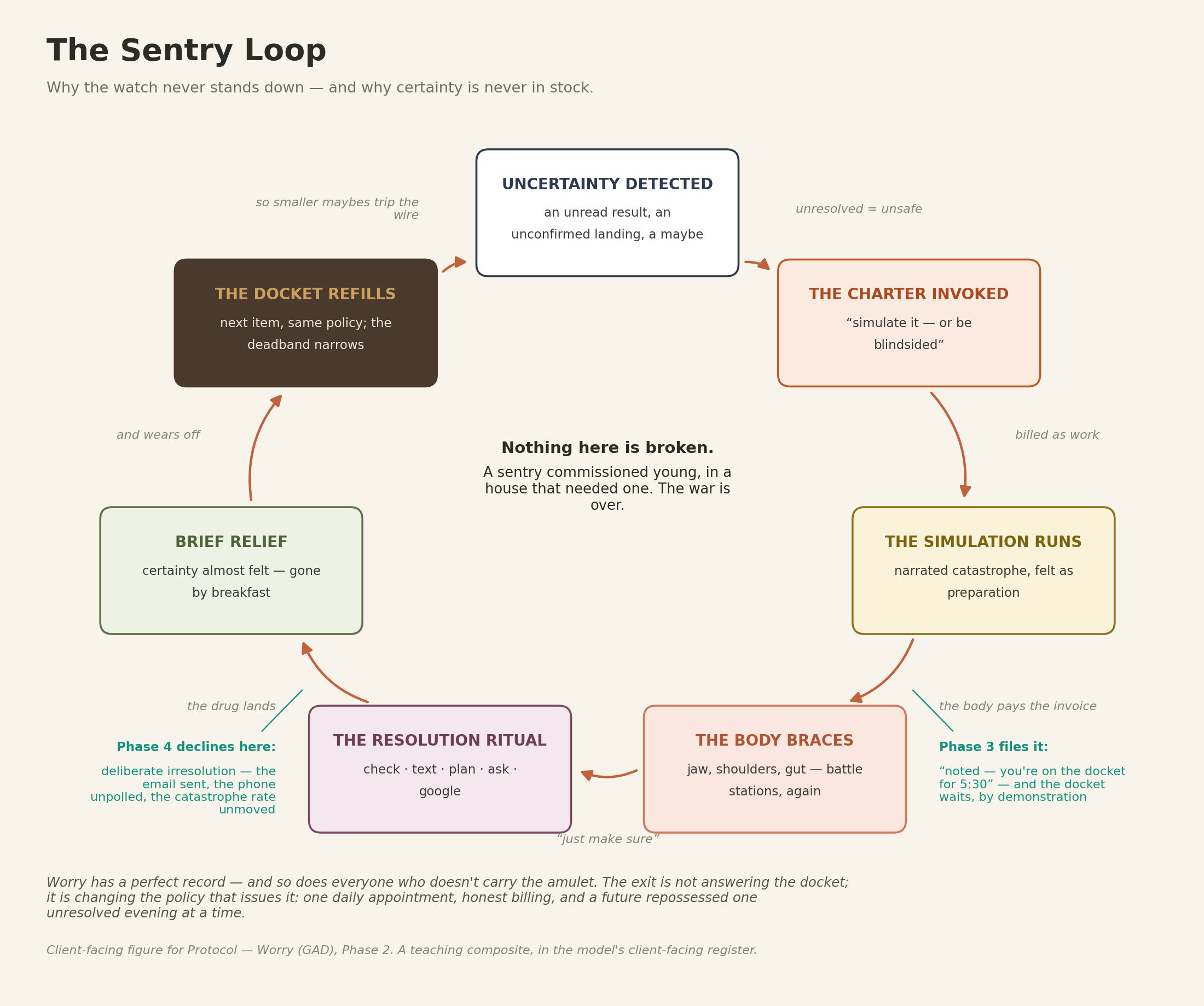
The loop's mechanics, the two intervention points (Phase 3 retries the charter; Phase 4 retires the rituals), and the dignity line at the center. And the flag: "We will not be answering the worries, because the part of you that issues them doesn't read answers — it issues the next one. We're going to change the policy instead."
Phase 3 — Floor 2 first — and in this riser, floor 2 is the main event
The charter on the table. The beliefs about worry — positive ("it keeps them safe," "it's how I care," "it catches things") and negative ("I can't stop it," "it will damage my health") — elicited and written. These, not the docket, are what treatment argues with, and even here the arguing is done by experiment.
Cost accounting. The client audits their own record: of last month's docket, how many items shipped? Of those that shipped, did the pre-worrying help when it arrived — or did the arrival get handled by the competent adult who shows up for real problems? Hours billed; the tension bill; the presence bill (the vacations attended in body only). The superstition ledger read out loud: the amulet has a perfect record, and so does everyone who doesn't carry one.
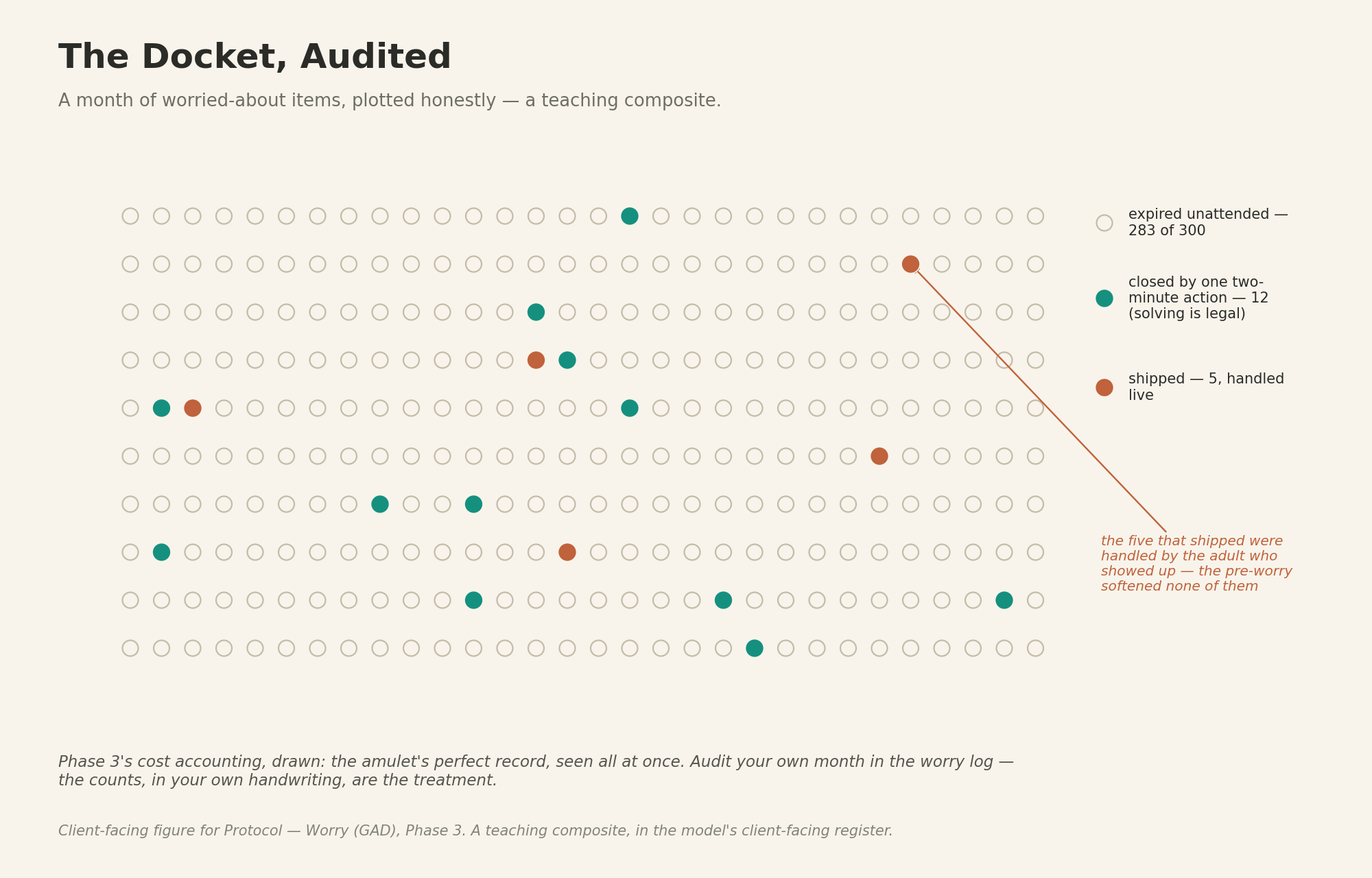
The docket, audited — a composite month; the client's own month goes in the worry log.
The two-minute test, future tense (Watkins's discipline pointed forward): is this solving, or simulating? Solving produces a next action inside two minutes — then the action is taken, today, and honored as legal (this protocol never pathologizes actual planning; a will, an insurance call, a doctor's appointment are solutions, not rituals). Simulating produces the same scene at higher resolution. The catch is the skill; the client learns to bill honestly.
Worry postponement — the uncontrollability experiment wearing a scheduling change. Borkovec's stimulus control, run in the house format: the docket gets one daily appointment — twenty minutes, same time, same chair, notepad out — and items arising elsewhere get filed ("noted; you're on the docket for 5:30") rather than tried on the spot. The forecast is written before the first week: "I won't be able to hold them until 5:30" — confidence 90%. The reading a week later does two jobs at once: the docket waits (the charter's "I can't stop it" clause takes its first disconfirmation, by demonstration), and half the filed items are dead on arrival at 5:30 — expired worries that resolved themselves unattended, counted in the client's own handwriting.
Deliverable: consent to the experiment. "We're testing the policy, not your love for them. Your care was never on the table."
Phase 4 — Interrupt the furnace (floor 5): repossessing the future
The resolution rituals retire as forecast experiments, six-step format (prediction named → confidence rated → written before → smallest real test → compared out loud → "how many times before the rule revises?"):
- Uncertainty experiments, the core. Deliberately leave things unresolved at experiment scale: the email sent without the fourth read; the trip booked without the backup itinerary; the phone left unanswered for an hour; the teenager un-texted till dinner; the task delegated and not inspected. Forecast before ("I won't sleep" — 85%), reading after. The finding the client collects personally: the catastrophe rate does not move, and the tension falls when the checking stops, not when certainty arrives — certainty never arrives; it was never in stock.
- The reassurance economy, wound down. The spouse and the rotation of three are enlisted and briefed (their "it'll be fine, honey" is furnace fuel); replacement script supplied — warmth without the verdict. Joiner's pin stands behind the move: reassurance-seeking is the provoke move's social form, and it taxes the very relationships it polls.
- Worry exposure, for the uncancelable dockets. Where a feared scene can't be tested (the death of the parent, the plane with the child on it), the avoidance theory prescribes the opposite of the narration: the scene run as imagery, to its worst frame, held long enough for the emotional weather to actually arrive and pass — supervised, titrated, and framed honestly: the machine has been protecting the client from a feeling, and the feeling, felt, is survivable in a way the endless grazing never demonstrates.
- The counterattack, named in advance. Reinterpret: "it went fine because I worried" — answered by the no-worry trials already accumulating in the ledger. Filter: the expired worries and quiet weeks get counted weekly, or they vanish. Provoke: the reassurance ask caught live, warmly. And the policy's signature move, forecast so the client catches it: the shell game — treated on finances, the machine reopens on health; answered on health, it finds the marriage. New topic, same policy; the client learns to say "new costume" and return to the charter.
Session metric (§6.2): if nothing surprised the client, nothing changed — an uncertainty experiment that merely confirmed expectations was sized wrong; resize and rerun.
Phase 5 — Supply the readings (floor 7 and the dimmer)
The body has been at battle stations for years; stand it down with data, not commands:
- Sleep first. The 3 a.m. board meeting is evicted with the same machinery: postponement honored at night ("docketed for 5:30"), stimulus control (out of bed when the meeting convenes; the bedroom stripped of its conference-room furniture), fixed wake time — CBT-I elements within scope, Protocol — Insomnia where the insomnia is the senior partner. The sleep block is pinned; the model's line: the forecaster's maintenance window, restored.
- The body's own experiments. Applied relaxation or movement run in forecast format — not as niceties but as tests: does a stood-down body shorten the docket? (It usually does; a braced body is a standing vote for the charter.) Caffeine audited with the same honesty as panic's.
- The dimmer is the covert experiment. For the sentry, the disconfirming experience is sharing the watch: delegation that sticks, a co-parent handed a whole domain, a partner allowed to drive — literally — while the client rides without the phantom brake. The mattering forecast underneath ("only my vigilance keeps them safe; if I stand down, I don't count") gets its readings here: they were safe, and the client still mattered, off duty.
- Presence reps. Scheduled unguarded time — play, absorption, the walk without the phone — run as experiments and counted: the life the premiums were eating, sampled and read.
Phase 6 — The ignition scene, if Phase 1 found one
Where a floor-6 trace is underneath — the house that needed a seven-year-old sentry; the blindside (the death nobody saw coming, the accident on the ordinary Tuesday) that taught relaxing is when it strikes — postponement and experiments lift the days and leave the pilot light. The tells: the watch stands down everywhere except one old domain; or relaxation itself triggers alarm (the guard who panics when the shift ends); or the client can retire every ritual except the one aimed at the person the original watch was for. The trace needs activation-plus-mismatch — the scene revisited while regulated, the child's commission honored and then formally ended on the adult's evidence — within scope and supervision, or by referral until licensure. The discharge papers are written on lived data: the watch was necessary then; the war it was raised for is over.
Phase 7 — Consolidation up the building
Now floor 3 writes, because the ledger exists for the sentences to describe: the client states the revised policy in their own words, against their own numbers — the expired-worry count, the untouched catastrophe rate, the docket that waited. Floor 1 re-authors: the worrier becomes the one who kept the family's watch as a child, and who has now stood down a war that ended years ago — made, not found, and said out loud. Where floor-8 water is in play — worry priced as love's proof, the anxious-parenting waters, the news cycle's standing IV drip — it gets named and renegotiated (the feed audited like caffeine), or the deadband re-narrows with the next headline. And the mattering dial gets its legal channels: care delivered as presence and acts — the shown-up-for recital, the actual conversation — because the sentry's love was always real; it was just being paid in the wrong currency.
Phase 8 — Relapse as forecast, not failure
Real uncertainty spikes — the new baby, the diagnosis, the layoff — and the watch will offer to re-enlist; the model says so in advance. The ending includes a written flare protocol: the lengthening docket and the reconvened 3 a.m. meeting are readings, not verdicts; the re-entry moves are pre-agreed and require no deliberation (postponement resumed same day, one deliberate unresolved thing inside the week, the reassurance rotation left unpolled); the standing rule — new topic, same policy — travels wherever the shell game lands next; and the early-warning signature is named while well (the confirmation texts creeping back, the itinerary printed twice, sleep latency stretching). Booster sessions are maintenance, not failure. Close by reviewing the baseline numbers — GAD-7, PSWQ, the ritual counts, the sleep window — as the story of the treatment.
Two therapist-side rules, all phases
- Never argue with the docket. Answer one worry and you are the 5:30 appointment now — the session becomes the resolution ritual, scheduled weekly, co-paid. The discipline is warm refusal of the item and full engagement with the policy: "that one's for the docket; let's look at what issued it." And watch this riser's special disguise: worry presents as diligent therapy — homework over-done, sessions over-prepared, the treatment itself simulated in advance. The furnace will wear the protocol as armor; name it warmly when it does.
- Match the tempo, and watch the transfer rule. This riser's gains are undramatic — no summoned attack, no conquered mall; the watch stands down by degrees, and the client may read quiet weeks as "nothing happening" (log them; they are the outcome). And conquering this riser doesn't touch the others: the same machinery returns as checking, as health anxiety, as the depression rumination policy facing backward — the officer changes desks, and the siblings from the vigilant house (perfectionism, over-preparation, the one who can't delegate) report in costume. Say so before they do.
Pin targets
| Lead | For | Status |
|---|---|---|
| Kube et al. 2019, Psychological Medicine | immunization — the reinterpret move | SUPPORTIVE — not settled. Two experimental studies (2019); a 2024 replication from the same group failed on one manipulation. Cite as evidence for the move, not proof of it. |
| Joiner & Metalsky 2001 | reassurance-seeking — the provoke move's social form | PINNED |
| Sleep block (Riemann 2023; Espie; Harvey) | Phase 5 | PINNED (ledger) |
| Craske et al. 2014 | expectancy-violation design rules | PINNED |
| Salkovskis 1991 | safety behaviors blocking disconfirmation — generalizes to resolution rituals | PINNED metadata (PDF via ILL) |
| Borkovec, avoidance theory of worry; stimulus-control/postponement | the con named; Phase 3's chassis | unpinned |
| Wells, metacognitive model of GAD | the charter — positive and negative beliefs about worry | unpinned |
| Dugas et al., intolerance of uncertainty | the deadband-at-zero claim; Phase 4's experiments | unpinned |
| Newman & Llera, contrast-avoidance | why the brace never stands down — optional second mechanism | unpinned |
| Spitzer et al. 2006 (GAD-7); Meyer et al. 1990 (PSWQ) | the running instruments | unpinned |