Protocols › Protocol — OCD
Protocol — OCD
Protocol19 August 2026. Filed in Clinical Tools beside the Decision Aid and the other protocols; sibling to Protocol — Health Anxiety (same certainty demand, wider jurisdiction). Honesty label, in the appendix spirit: made, not found. This is a model-derived reorganization of components that existing OCD treatments have tested separately — exposure and response prevention (Foa lineage), the Salkovskis responsibility-appraisal model, the intrusion-normality literature (Rachman & de Silva), and the checking-degrades-confidence work (van den Hout & Kindt). The sequence is the model's contribution (gates → gate re-taught → charter → interruption → readings → ignition → consolidation → relapse plan), and the sequence has no outcome data of its own. Written by a counseling student; runs under supervision — and in this riser the supervision line is structural: ERP is collaborative, consented, and supervised, or it is not run at all. Companions: floor-notes/Floor 2 — Metacognition, floor-notes/Floor 5 — Scripts and Behavior, the furnace (§2.3), and the Craske and Kube pins in the ledger.
The formulation in one line
OCD presents on floor 3 as emergencies (contamination, harm, blasphemy, error, wrongness), but the fault is at floor 2's gate — mind-noise read as message, tried under a responsibility charter — executes on floor 5 (rituals overt and mental, and a household recruited into accommodation), is sometimes ignited from floor 6 (the blamed child, the scrupulous house, the coincidence that convicted), sits in floor-8 water (purity codes, doctrine, certainty-worship), and is worn on the mattering dial's moral edge — and the treatment follows the building, not the content.
The model's distinctive reading
Three claims organize everything below.
The intrusion is normal; the appraisal is the disorder. The founding datum (Rachman & de Silva): intrusive thoughts with clinical OCD's exact content — harming a child, shoving the stranger, the blasphemy mid-prayer, the stove, the germ — occur in the overwhelming majority of ordinary minds. Every mind is a machine room; noise is what machinery sounds like. The disorder begins at floor 2's gate, where this machine misfiles its own noise as message: a thought about harm is read as a signal about danger, intention, or character — thought-action fusion, the gate's signature failure. Panic misreads the body's noise; OCD misreads the mind's. And the content is a values map read upside down: the machine flags what would matter most if true, which is why the loving parent draws harm thoughts and the devout draw blasphemy — the gate checks the most precious cargo hardest. The dignity move is built into the science: the thoughts are not a confession; they are an inventory of what the client loves.
Responsibility is the current that keeps the gate seized. Salkovskis's appraisal, in the model's terms: the charter that converts noise into emergency reads if my thought, act, or omission could contribute to harm, and I fail to neutralize it, the harm is mine. The forecast under every obsession: if I don't act on this signal, catastrophe — and it will be my fault. Guilt is prepaid; the client is serving the sentence for an uncommitted crime, daily. Attached to the charter is the certainty demand: ordinary machines close files at "almost certainly fine"; this gate demands a felt 100% that no human equipment can produce — so the file never closes, and the checking is the file being reopened for a feeling that isn't coming.
The ritual is the perfect crime against learning — and it manufactures the doubt it treats. Compulsions — washing, checking, redoing, confessing, and the covert menu: counting, praying-as-neutralizing, mental review, argument with the thought — are the dimmer at its most elaborate: each ritual "prevents" a catastrophe that was never coming, files another save, and blocks the one reading that would close the case. But this riser adds a mechanism no other protocol has: the remedy degrades the instrument. Checking corrodes memory confidence (van den Hout & Kindt — the tenth check leaves you less sure than the first), washing amplifies contamination salience, review scrambles the record, and engaging the thought as signal raises its gain. The machine's cure manufactures the uncertainty that demands the cure. The five moves in costume: avoid (knives, driving, the child's bath, being last out), filter and reinterpret (clean survivals credited to rituals), provoke (the scan that asks "am I having the thought? do I feel certain yet?" — and summons it), withdraw effort (whole domains ceded to the ritual's schedule — and a household annexed as accommodation staff).
Phase 0 — The gates (run first, and never fully retired)
The harm-content differential, handled with both hands. This is the gate a student must walk with a supervisor, every time. Ego-dystonic harm obsessions — unwanted, horrifying to the client, fought with rituals — are OCD, carry no elevated enactment risk in the literature, and are treated as OCD: misreading them as danger is iatrogenic twice over (it confiscates the treatment and confirms the client's worst appraisal). But the assessment must actually be done, not assumed: ego-syntonic ideation, wish-flavored content, command phenomena, intent, plan, or a picture that doesn't fit the intrusion-plus-ritual engine route to risk protocols and psychiatric referral instead. Postpartum intrusions get their own flag: extremely common, terrifying, massively under-reported, and the highest-stakes misread in the drawer — a new parent with ego-dystonic harm thoughts and checking rituals needs this protocol and reassurance about prevalence, not a report that ends the breastfeeding.
Risk and mood. OCD carries heavy depression comorbidity and real suicide risk under decades of shame — full standard screens, plus the specific question the shame hides: "some people with these thoughts start to believe they'd be safer gone; has that visited you?"
Routing. Realistic-content, topic-hopping worry without rituals → Protocol — Worry (GAD). Disease fear fed by checking → Protocol — Health Anxiety (same machinery, single jurisdiction — the protocols compose). Insight lost entirely, or the picture smells of psychosis (the reversed dial) → divert per the Decision Aid; note OCD's insight runs a spectrum and dips under load, so the differential is pattern and history, not one bad hour. Hoarding, tics/PANDAS flags in minors, and body-focused repetitive behaviors have their own literatures — name, adapt, or refer per supervision. Ego-syntonic perfectionism without intrusions (OCPD's architecture) is a different building.
The accommodation census. OCD uniquely annexes the household: the spouse answering the same question nightly, the parent doing the laundry rite, the family's routes and menus bent around the rituals. Map it at intake — who provides what reassurance, who performs what ritual by proxy, what the household may not do — because Phase 4 winds it down and the family are co-therapists or counter-therapists, never bystanders.
Scrupulosity's ally. Where the content is religious, the protocol targets the disorder and never the faith — the machine has taken the faith hostage, and treatment returns it. With consent, the client's own clergy can be enlisted (most traditions have doctrine for exactly this; confessors have known scrupulosity for centuries) so that exposures are built inside the client's actual theology, not against it.
The medication boundary. SSRIs at OCD dosing are legitimate, evidence-backed company — alongside, not instead; nothing here outranks the prescriber.
Phase 1 — Locate and formulate (the riser profile)
Two sessions of ordinary listening, Appendix A machinery with a gate filter. The sorting questions:
- "What does the thought accuse you of?" The obsessional content, taken down verbatim and then read back through the values map: what would have to matter this much for the machine to guard it this hard? The client hears their own indictment reframed as an inventory of what they love — the protocol's first mismatch, delivered in session one or two.
- "What must you do when it arrives — and what happens if you can't?" The full ritual inventory, with the covert menu explicitly hunted: the counting, the silent undoing prayer, the mental review of the drive home, the confession disguised as conversation, the reassurance question worn as curiosity. Miss the mental rituals and Phase 4 will run exposure with the back door open — the single commonest failure in this riser.
- "How sure do you have to be before you can stop?" The certainty demand, quantified. "One hundred percent" is the tell, and the number gets written down for Phase 3 to retry.
- "Whose standards run this courtroom?" Floor 6 and floor 8: the house where mistakes were moral events, the blamed child, the doctrine, the coincidence that convicted (the thought that preceded the grandmother's stroke). The commission of the charter, located.
Baseline the furnace in numbers: Y-BOCS, ritual log (episodes, minutes per day), avoidance map, the accommodation census, reassurance count, insight rating. Minutes per day is the number families feel first when it falls.
Phase 2 — Teach the client the machine
Client-facing telling, in the model's images — and in this riser the dignity move is a demonstration, not a speech: the normal-intrusion inventory read together (the published lists of what ordinary minds produce — the shoving, the swerving, the stove, the sacrilege), so the client sees their catalog on everyone's shelf. Then: your machine does not have worse thoughts — it has a gate that flags them and a courtroom that tries them. The values-map claim lands here: the harm thought in a loving parent is the machine checking its most precious cargo; a person who cared nothing for the child would get no alarm. Then the claims that reorganize everything, stated flat:
A thought is not a message. The felt certainty you're waiting for does not exist — for anyone. And: the ritual is the engine, not the brake.
Draw the loop for the session:
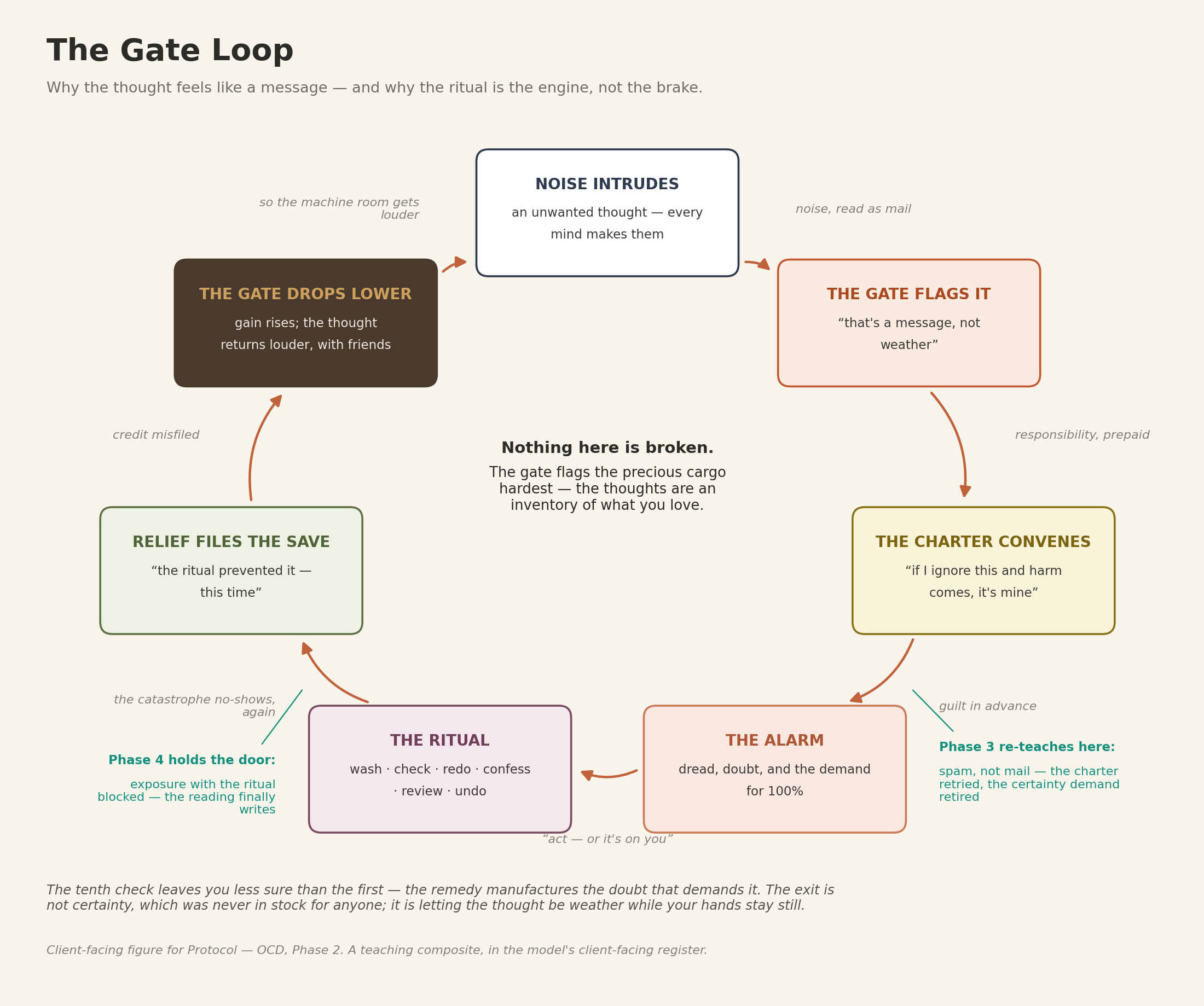
The loop's mechanics, the two intervention points (Phase 3 re-teaches the gate and retries the charter; Phase 4 holds the ritual shut while the reading writes), and the dignity line at the center. And the flag: "We will not be winning arguments with the thought — arguing is a ritual with better manners. We're going to change what happens at the gate."
Phase 3 — Floor 2 first, because floor 2 is the gatekeeper
The gate re-taught: noise versus message. The client learns to classify rather than adjudicate: intrusions are weather from the machine room, and the skill is spotting the form (intrusive, urgent, demanding certainty, threatening fault) rather than debating the content. The engagement rule is the discipline that carries every later phase: the thought gets neither obedience nor rebuttal — no ritual, and no argument, reassurance, disproof, or mental trial either, because engagement of any polarity files it as mail. Spam, not mail: noticed, named, left unopened.
The charter retried. Salkovskis's machinery in the house style — the responsibility pie drawn for a feared event (every contributing cause sliced before the client's thought gets its sliver); the double-standard instrument, written ("your friend confides this exact thought — what does it prove about him?"); the omission audit (the charter bills omissions like commissions — no court on earth does). The certainty demand renamed as the impossible product: every stopped ritual in Phase 4 is also a certainty the client agreed to live without, and the gate learns the deadband every other mind runs on.
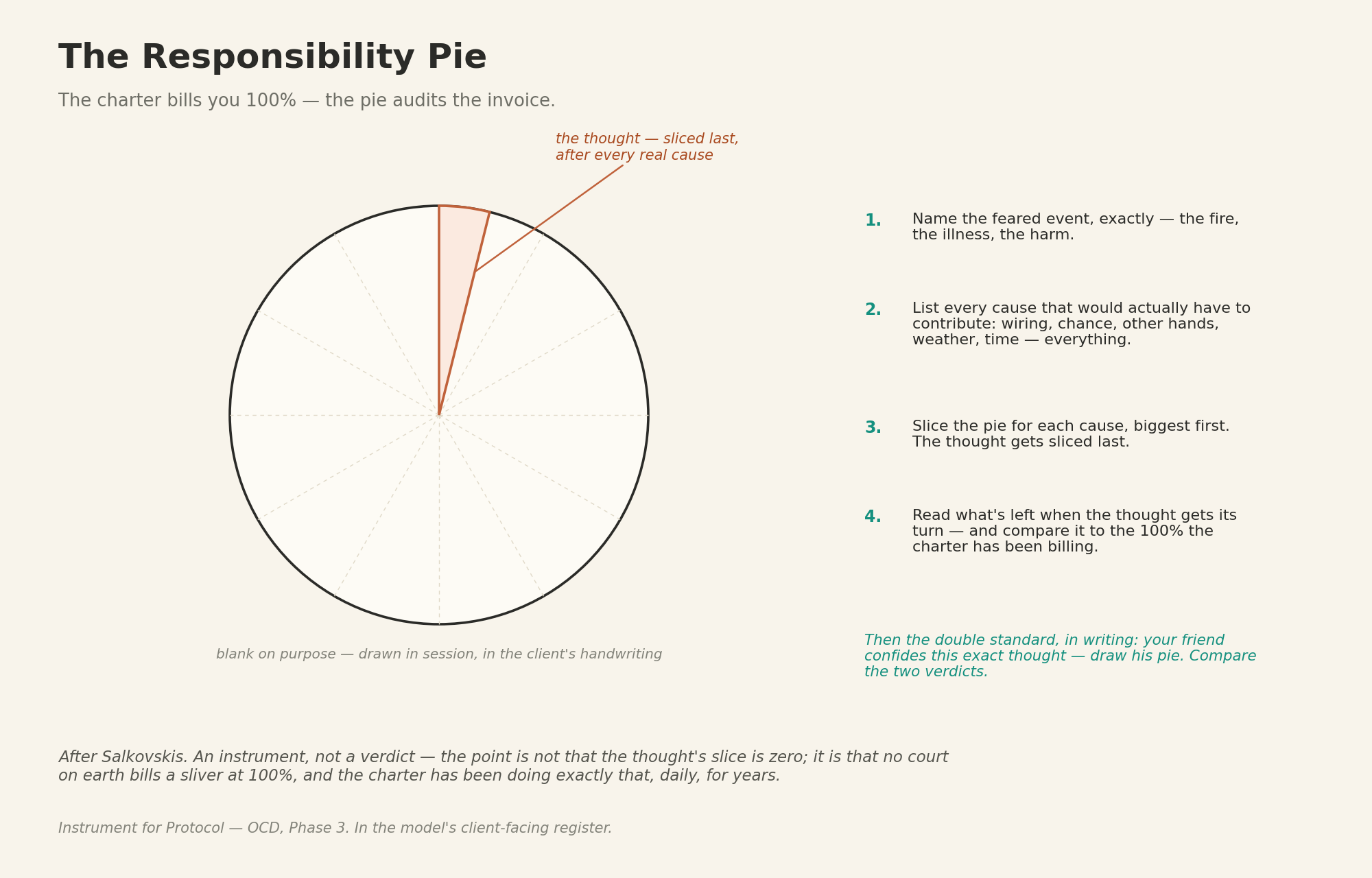
The pie — an instrument, drawn in session, in the client's handwriting.
The demonstration experiment. Checking-degrades-confidence, run live per van den Hout: the stove (or lock, or email) checked once versus checked ten times, memory confidence rated each round — the client watches the tenth check return less certainty than the first, in their own numbers. The remedy indicted by its own output; Phase 4's consent signs itself.
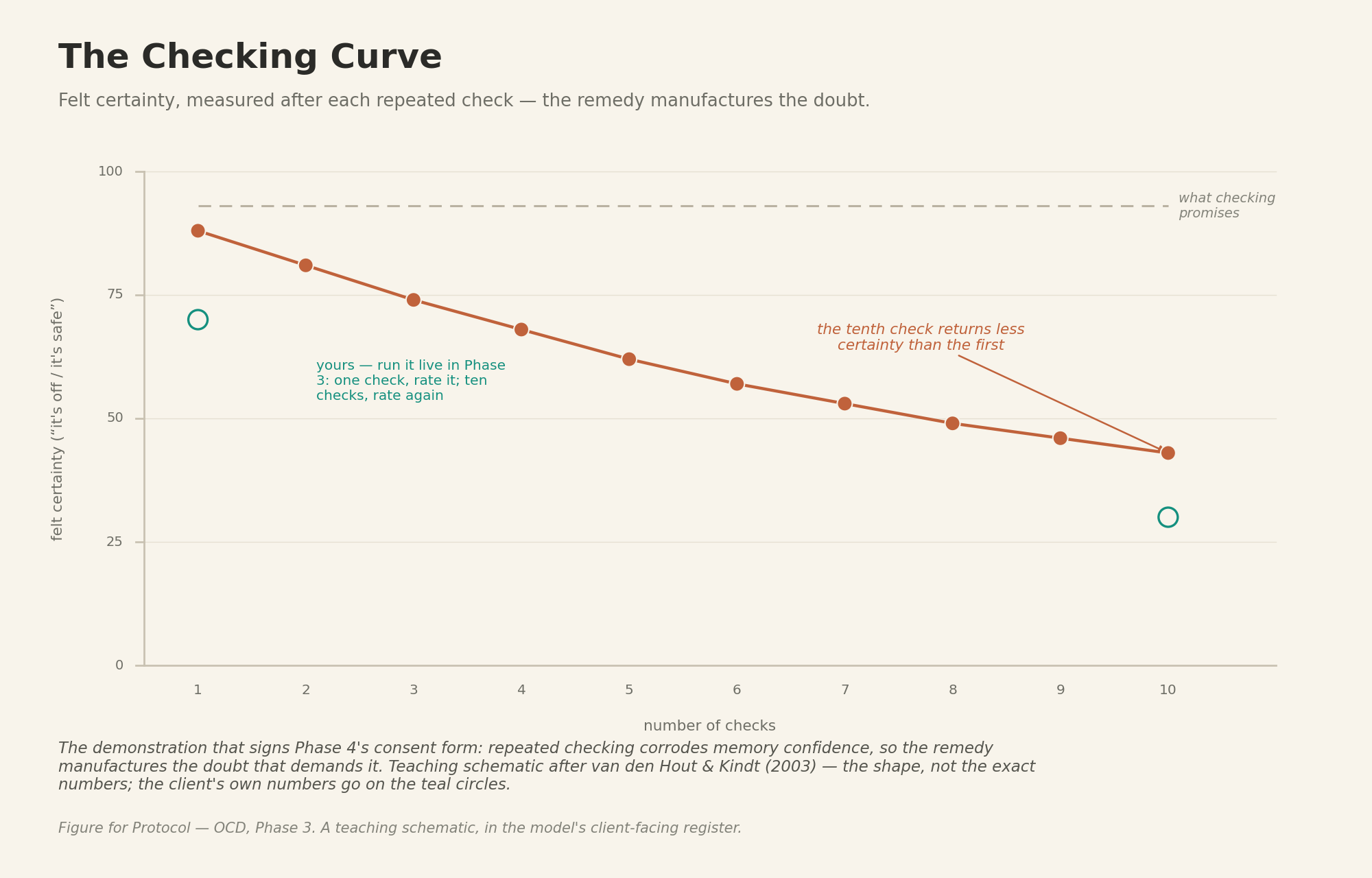
The checking curve — the shape after van den Hout & Kindt; the client's own numbers go on the teal circles.
Deliverable: consent to ERP, informed and specific. "We're going to let the thought be weather while your hands stay still — and read what actually happens."
Phase 4 — Interrupt the furnace (floor 5): exposure with the door held shut
ERP, run in the house format as forecast experiments — six steps (prediction named → confidence rated → written before → smallest real trial → compared out loud → "how many times before the rule revises?"), with response prevention as the non-negotiable second half: exposure without prevention is rehearsal of the loop, and worse than nothing.
- The menu is built from the profile: contact with the contaminated handle, then the unwashed sandwich; the door locked once and left; the email sent unreviewed; the knife washed beside the spouse; being last out of the building; the child bathed. Each trial's forecast is the charter's, verbatim: "if I touch it and don't wash, the family gets sick and it's mine — 85%."
- The covert menu is blocked by name: no counting, no undoing prayer, no mental review after, no confession-by-anecdote at dinner, no reassurance question in session — the therapist holds the door too.
- Imaginal exposure carries the unactable content: the harm scene, the blasphemy, the hit-and-run already "committed" — written as a script and held as weather, supervised and titrated, because content that can't be staged can still be filed correctly.
- The reassurance economy winds down on schedule: the family briefed in the model's images (their answer is the ritual's second performer; withdrawal is love wearing work clothes), replacement scripts supplied, accommodations retired one per week with the client's consent and the family's relief tracked — it arrives.
- The counterattack, named in advance: reinterpret ("nothing happened because I was careful in some new way" — variation and responsibility-loading answer it: the client locks up alone, cooks for someone, goes last); filter (clean trials uncounted — the written ledger holds them); the ratchet, this riser's shell game, forecast so it can't ambush: content will migrate — contamination falls and morality rises, the machine changes costume — and the client learns the sentence same gate, same answer before the first migration arrives.
Design rules per Craske, as everywhere: expectancy violation over habituation; sized so the machine shows up; varied, not laddered by comfort; run to the read-out. Session metric (§6.2): if nothing surprised the client, nothing changed.
Phase 5 — Supply the readings (floor 7, the dimmer, and the repatriated day)
- The hours come home. Minutes-per-day is the number that falls first, and the protocol spends the recovered hours on purpose: the values the content held hostage get scheduled in the ritual's old slots — the loving parent actually on the floor with the child, not checking on her; the devout actually praying, not neutralizing. The mattering dial gets paid in its own currency at last.
- Floor 7 serviced. Sleep restored per the pinned block (an exhausted gate flags everything; OCD runs worse on debt), stimulants audited, the body's arousal given legal outlets — the standard readings, delivered while the loop is interrupted.
- The dimmer. Shame is this riser's oldest cellmate — decades of believing the thoughts were confessions, told to no one. The therapy relationship disconfirms it weekly: the worst content, spoken aloud, met without a flinch and filed as weather. Where the furnace eats it ("she'd recoil if she really understood"), the move is named — and answered by the supervisor-backed steadiness of a clinician who has actually heard the content and stayed.
- Scrupulosity's readings: ordinary practice restored inside the client's tradition — prayer at the doctrine's cadence rather than the gate's, the confessor's actual counsel followed rather than re-polled — faith returned from the hostage-taker.
Phase 6 — The ignition scene, if Phase 1 found one
Where a floor-6 trace commissioned the charter — the child blamed for the accident ("you should have been watching"), the house where error was sin, the coincidence that convicted (the angry wish and the grandmother's stroke in the same week), the scrupulous formation — ERP moves the rituals and the responsibility feeling persists, dateless, or the ratchet runs endless because every jurisdiction sits on the same bedrock verdict. The trace needs activation-plus-mismatch — the scene revisited while regulated, the eight-year-old's conviction retried with the adult's evidence (a child is not the family's fire marshal; a wish is not a weapon), the charter's commission formally ended — within scope and supervision, or by referral until licensure.
Phase 7 — Consolidation up the building
Now floor 3 writes, because the ledger exists for the sentences to describe: the client states the revised model in their own words — the false-alarm count, the certainty audit, the checked-versus-once numbers — never the therapist's absolution, which the gate would re-poll by Thursday. Floor 1 re-authors: the dangerous one, the dirty one, the damned one becomes the one whose gate flagged everything precious, and who taught it to read again — made, not found, and said out loud. Where floor-8 water is in play — purity codes, doctrine weaponized, the certainty-worship of the client's field (medicine, law, engineering all pay the charter's wages) — it gets named and renegotiated. And the values the content mapped get their legal channels: care enacted directly, at experiment scale first, then as a life.
Phase 8 — Relapse as forecast, not failure
The ratchet is this riser's relapse mode: under load the machine returns in new content, and the model says so in advance — the flare is identified by form, not content (urgency + ritual demand + certainty demand = the machine, whatever the costume). The written flare protocol: the sentence rehearsed (same gate, same answer); one ERP rep inside the week, no reassurance detour first; the family briefed on early warnings (accommodation requests returning, the question asked twice, minutes creeping); the spare-jurisdiction audit (the domain never treated — often mental rituals — checked before it becomes the annex). Booster sessions are maintenance, not failure. Close by reviewing the numbers — Y-BOCS, minutes per day, the accommodation census — as the story of the treatment.
Two therapist-side rules, all phases
- Never argue with the verdict — and never notarize it either. Reassurance is this riser's ritual and the therapist is its favorite notary: answer "but are you sure it's OCD?" twice and the session is the compulsion, co-signed. The same trap wears clinical clothes — re-clarifying content, safety-probing the same obsession weekly — therapist rituals, both. Warm non-engagement with the content, full engagement with the person, and the discipline of holding the door while the reading writes.
- Match the tempo, and watch the transfer rule. ERP outpaced is consent outrun — collaborative or nothing, per the header — but under-paced is furnace maintenance; supervision holds the line between. And the gate generalizes: expect the machinery in health anxiety's jurisdiction, scrupulosity's, perfectionism's — the certainty demand is the common thread, and the client who can say same gate, same answer owns every future costume. Say so before the first migration.
Pin targets
| Lead | For | Status |
|---|---|---|
| Craske et al. 2014, Behaviour Research and Therapy | expectancy violation — Phase 4's design rules | PINNED |
| Kube et al. 2019, Psychological Medicine | immunization — the reinterpret move | SUPPORTIVE — not settled. Two experimental studies (2019); a 2024 replication from the same group failed on one manipulation. Cite as evidence for the move, not proof of it. |
| Salkovskis 1991 | safety behaviors blocking disconfirmation — response prevention's logic | PINNED metadata (PDF via ILL) |
| Sleep block (Riemann 2023; Espie; Harvey) | Phase 5 | PINNED (ledger) |
| Rachman & de Silva 1978 | intrusion normality — the founding datum, Phase 2's demonstration | unpinned |
| Salkovskis 1985; 1999 | responsibility appraisals — the charter | unpinned |
| van den Hout & Kindt 2003 | checking degrades memory confidence — Phase 3's demonstration | unpinned |
| Foa & Kozak; Foa et al., ERP trials | Phase 4's chassis and its outcome base | unpinned |
| Shafran, Thordarson & Rachman 1996 | thought–action fusion — the gate's signature failure | unpinned |
| Goodman et al. 1989 | Y-BOCS — the running instrument | unpinned |
| Abramowitz et al., postpartum intrusions | Phase 0's highest-stakes differential | unpinned |
| Family accommodation (Calvocoressi lineage) | Phase 0's census; Phase 4's wind-down | unpinned |