Protocols › Protocol — Health Anxiety
Protocol — Health Anxiety
Protocol12 August 2026. Filed in Clinical Tools beside the Decision Aid. Honesty label, in the appendix spirit: made, not found. This is a model-derived reorganization of components that existing health-anxiety treatments have tested separately — the Salkovskis/Warwick CBT lineage, metacognitive approaches, interoceptive exposure. The sequence is the model's contribution (gates → policy → interruption → readings → ignition → consolidation → relapse plan), and the sequence has no outcome data of its own. Written by a counseling student; runs under supervision; composes with, never replaces, program training. Companions: floor-notes/Floor 7 — Body and Interoception, floor-notes/Floor 2 — Metacognition, floor-notes/Floor 5 — Scripts and Behavior, the furnace (§2.3), and the riser profile of health anxiety (the hypochondria walk-down, in conversation 12 Aug).
The formulation in one line
Health anxiety presents on floor 3, runs its engine on floor 7, takes its orders from floor 2, executes on floor 5, is sometimes ignited from floor 6 or poured in floor-8 water — and the treatment sequence follows the building, not the complaint.
Phase 0 — The gates
The calibration gate runs first, literally: appropriate medical workup complete — and then closed. The protocol cannot start while investigations are pending; every open investigation is an open fuel line to the furnace. Establish the medical liaison rule at the start, with consent: one designated physician, scheduled contact only, no ad hoc visits — framed as part of treatment, not restriction. Part 7 boundaries: real symptoms in a real body get real medicine; this protocol treats the alarm economy, not the body.
Phase 1 — Locate and formulate (the riser profile)
Two sessions of ordinary listening, Appendix A machinery with a health filter. The two sorting questions:
- "What happens right after the doctor says you're fine?" Relief that fades in days → the furnace loop (floors 2/5/7). Relief that never arrives → check floor 6 for a scene.
- "What would it mean about you if you stopped checking?" Surfaces floor 2's policy, and sometimes the dial underneath.
Complete the profile: when did it start — is there a scene (floor 6)? What was illness for in the original house (floor 8; the need dial — illness as the sanctioned way to receive care)? Baseline the furnace in numbers: checks/day, googling minutes, reassurance requests, appointments/quarter. These are the outcome measures.
Phase 2 — Teach the client the machine
Client-facing telling, in the model's images: the alarm's gain is set high — nothing is broken; the system does exactly what it was built to do — and attention with alarm on it always returns data, so checking will find something every time, forever, in a perfectly healthy body. The loop, drawn for the session:
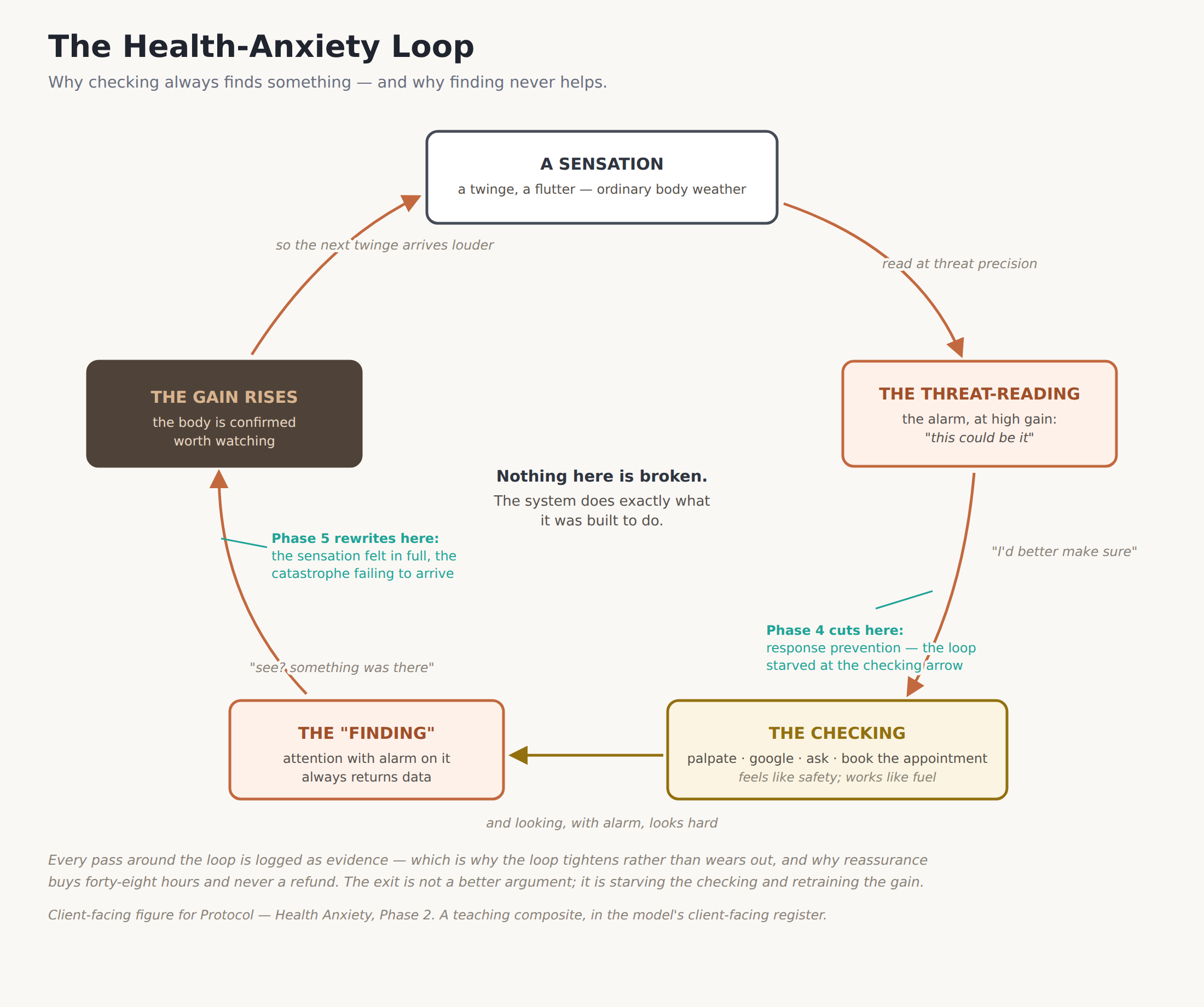
The figure carries the phase's three claims at once: the loop's mechanics, the two intervention points (Phase 4 cuts the checking arrow; Phase 5 rewrites the finding-to-gain arrow), and the dignity line at the center. The dignity move comes standard: architecture, not weakness. Plant the flag for everything that follows: "We will not be arguing you out of this, because the part of you that's afraid doesn't read arguments. We're going to give it experiences instead."
Phase 3 — Floor 2 first, because floor 2 is the gatekeeper
The monitoring policy must be re-described before response prevention is possible — otherwise Phase 4 is experienced as disarming the smoke detector. Targets: monitoring catches it early and the scan I skip is the one that kills me. Moves:
- Cost accounting — what surveillance has actually bought, in found diseases versus lost years.
- The detective reframe — the checking isn't detection; it's the alarm's fuel.
- The uncertainty contract — the goal is not certainty (which no body offers anyone) but a deadband: a range of bodily weather that passes unexamined, the same range every healthy person runs on.
Deliverable: consent to the experiment. "We're testing the policy, not your body."
Phase 4 — Interrupt the furnace (floor 5)
Response prevention on the full equipment list: googling, palpating, mirror checks, pulse-taking, symptom-journaling-as-surveillance — and the reassurance economy: recruit the spouse out of the loop (their "you're fine, honey" is furnace fuel; supply a replacement script), hold the physician-contact rule. Tell the client the model's prediction in advance: anxiety rises first — prepayment has been declined, and the system is sitting in uncertainty it has always bought its way out of. The rise is not deterioration; it is the room finally unheated while a reading gets taken. Track baselines weekly.
Phase 5 — Supply the readings (floor 7)
With the furnace interrupted, deliver the corrective evidence the checking was drowning: interoceptive exposure — deliberately inducing the feared sensation classes (exertion, breath work, caffeine; per supervised protocol) so the catastrophe can fail to arrive while the sensation is fully felt. The pure prediction-error engine: the body says the feared thing, the outcome doesn't come, and — dimmer up, checking unavailable to discount it — the reading writes. Add attention retraining the other direction: sensations allowed to pass unrated.
Session metric (§6.2): if nothing surprised the client, nothing changed. A flat exposure that confirmed expectations wrote nothing; recalibrate difficulty until surprise appears.
Phase 6 — The ignition scene, if Phase 1 found one
Where a floor-6 trace is underneath (the parent who "was fine" and then wasn't; the childhood hospitalization; the anniversary pattern), loop work reduces the behavior but leaves a pilot light. The trace needs activation-plus-mismatch — the scene revisited while regulated, the imagery rescripted — within scope and supervision, or by referral until licensure. The tell that Phase 6 is needed: Phases 4–5 succeed and a hollow, dateless dread persists.
Phase 7 — Consolidation up the building
Now floor 3 writes, because the experiences exist for the sentences to describe: the client states the new model of their body in their own words. Floor 1 re-authors — the person whose body was a bomb becomes the person who spent years guarding against a false alarm; the story gets told out loud, because the desk must file what the lower floors learned. If floor 8 was in play — illness as the care currency — build the replacement channel explicitly: the need dial gets a legal way to ask, or the body reapplies for the job.
Phase 8 — Relapse as forecast, not failure
The model expects return: the old prior may be outcompeted rather than erased (§6.2's two regimes), and stress re-raises the gain. The ending includes a written flare protocol: a symptom may be checked once, by policy, through the designated channel — then the deadband holds. A flare is a reading opportunity, not a verdict. Close by reviewing the baseline numbers as the story of the treatment.
Two therapist-side rules, all phases
- Don't become the reassurance dispenser. The therapy room is a kind of room; this client's dial will try to wire you into the checking circuit ("but do you think it's fine?"). The answer is always the model, never the verdict.
- Watch the transfer rule. Conquering the health riser doesn't touch the others. If the alarm's gain was set by an intermittent house, expect the vigilance to reappear in a new domain — and say so before it does.
Pin targets (unpinned; scholarly support if ever needed)
| Lead | For |
|---|---|
| Salkovskis & Warwick, cognitive-behavioral model of health anxiety | the loop; reassurance as maintenance |
| Wells, metacognitive therapy | Phase 3's policy targets |
| Barlow / interoceptive exposure literature | Phase 5 |
| Abramowitz, health anxiety treatment | the package this protocol reorganizes |