Protocols › Protocol — Social Anxiety
Protocol — Social Anxiety
Protocol19 August 2026. Filed in Clinical Tools beside the Decision Aid, the Health Anxiety protocol, and the Depression protocol. Honesty label, in the appendix spirit: made, not found. This is a model-derived reorganization of components that existing social anxiety treatments have tested separately — the Clark & Wells cognitive model and its trials, the Rapee & Heimberg audience-representation account, safety-behavior and attention-training work, video feedback, imagery rescripting, and the inhibitory-learning exposure rules (Craske). The sequence is the model's contribution (gates → policy → camera → armor → footage → ignition → consolidation → relapse plan), and the sequence has no outcome data of its own. Written by a counseling student; runs under supervision; composes with, never replaces, program training and site protocols. Companions: floor-notes/Floor 2 — Metacognition, floor-notes/Floor 5 — Scripts and Behavior, floor-notes/Floor 3 — Propositional Beliefs, the furnace (§2.3), and the Salkovskis, Craske, Kube, and Swann pins in the ledger.
The formulation in one line
Social anxiety presents on floor 3 (the verdicts: defective, boring, visibly weak), runs its engine on floors 5 and 2 (the armor loop, governed by an inward-facing camera and a post-mortem policy), is usually ignited from floor 6 (a humiliation scene, a critical house), sits in floor-8 water (worth priced in performance and likability), and is worn on the rank dial — and the treatment follows the building, not the complaint.
The model's distinctive reading
Three claims organize everything below.
Social anxiety is a rank forecast mistaken for a rank measurement. The felt certainty in the doorway — they can all see it, they're already judging — arrives with the authority of perception, and it is not perception. It is the machine's render of the room (§2.1), drawn from a prior about what audiences do to people like this, delivered so early and so vividly that it replaces the room. The rank dial is standard human equipment — status tracking was survival accounting for a group species, and everyone runs it — but this dial's precision is cranked to hair-trigger and its deadband is set to zero: every micro-signal (a glance, a pause, a flat "okay") trips a full status alarm. The client is not misreading the audience. The client is reading the forecast instead of the audience.
The camera faces inward. At the exact moments when audience data would disconfirm the forecast, attention flips to self-monitoring — the heartbeat, the heat in the face, the sound of the own voice — and the machine constructs the audience's view out of interoception: felt warmth becomes visible scarlet, a felt tremble becomes a seen shake, the mind gone blank becomes a silence everyone is timing. That constructed self-portrait, usually rendered from the observer's perspective, gets filed as observation. This is the model's sharpest claim about the condition: the client has decades of social experience and almost no audience data — the camera was pointed the wrong way the entire time.
The armor manufactures the evidence. Safety behaviors — rehearsing every sentence, gripping the glass, hiding the hands, safe topics only, low voice, early exit, eyes on the floor — run the same fraudulent accounting as depression's withdraw-effort move: every survived room is logged as saved by the armor, so the catastrophe compiles an undefeated record without ever taking the field. And here the loop has a second, crueler gear: the armor partially causes the impression it guards against — the rehearsed answer reads as stiff, the low voice as disinterest, the averted eyes as coldness — so the machine's forecast manufactures a little of its own confirming data. The other furnace moves run guard duty in social costume: avoid (the declined invitation, the unsent message), filter (the friendliness discounted — "they were just being polite"), reinterpret (the good evening immunized — "they didn't notice this time"; Kube, pinned), and provoke (self-deprecation fishing for reassurance, the confirming audiences sought out — Swann's self-verification, pinned). Treatment is therefore furnace work with the camera turned first: footage, then experiments — argument alone gets immunized.
Phase 0 — The gates (run first, and never fully retired)
Mood and risk. Social anxiety travels with depression often enough that the depression gates run here too, in reduced form: PHQ-9 alongside the LSAS at baseline, item-9 follow-up per the site protocol, and the full Protocol — Depression Phase 0 the moment the profile darkens. Long avoidance histories carry real losses — friendships unmade, careers capped — and the grief in that is named, not treated as distortion.
The alcohol gate. Drink is the most common self-prescription for this condition, and the protocol's rule is stated early and without moralizing: experiments run sober or they don't count. Alcohol is liquid armor — whatever happens with it on board gets credited to it, and the learning doesn't transfer to the sober body (state-dependent, and the machine knows it). Screen (AUDIT-C or equivalent); where the drinking has its own engine, sequence or refer per supervision.
The differential, not the exclusion: a genuinely different machine. Where the profile suggests autistic social processing — lifelong, context-independent, present in safe rooms too — the protocol's central claim (skill present, inhibited by forecast) may be partly false, and running disconfirmation experiments against accurate self-knowledge is invalidation, not treatment. The sorting question is whether the difficulty is pricing (skills that appear intact with trusted people and vanish under evaluation → this protocol) or processing (a different operating style across all rooms → adapt: treat the catastrophic pricing and the post-mortem, leave the accurate self-knowledge alone, and consider whether an affirming frame or referral serves better).
The accurate-forecast gate. Sometimes the room really is hostile — the bullying workplace, the harassing classmate, the family that mocks, the room where the client's body or accent or identity draws real contempt. A dial reading a hostile room correctly is not a disorder. Ecology first: safety, exits, allies, reporting channels where relevant. Experiments get run in fair rooms; the skill being trained is telling fair rooms from rigged ones, and the protocol never gaslights a correct forecast.
The visible-symptom calibration. Where there is a real, visible symptom — hyperhidrosis, an essential tremor, a stutter, hard blushing — the target shifts and says so honestly: not it doesn't show (it may) but what the audience actually does about it — which the machine has forecast as contempt and never once measured. Experiments price the verdict, not the symptom. Medical referral runs alongside where the symptom is treatable and the client wants it treated.
The medication boundary. SSRIs are legitimate first-line company for this protocol — alongside, not instead, and nothing here outranks the prescriber. The specific flag this condition adds: PRN benzodiazepines and pre-event beta-blockers can function as chemical armor — the survived presentation gets credited to the pill, and benzodiazepines may blunt the very learning the experiments exist to produce. That observation goes to the prescriber as a scheduling question, never to the client as an instruction.
Phase 1 — Locate and formulate (the riser profile)
Two sessions of ordinary listening, Appendix A machinery with a rank filter. The sorting questions:
- "Who was the first audience?" The critical parent, the classroom that laughed, the sibling who mocked, the move to the school where everything was wrong — floor 6 usually holds a scene or a house, and the profile wants it located even though Phase 6 may never need to visit.
- "What exactly would they see?" Not "I'd be anxious" — the specific feared exhibit: the blush, the blank, the boring, the weird, the trying-too-hard. This sentence is the forecast, verbatim, and it becomes the named opponent of Phases 4 and 5.
- "What do you do to make sure it doesn't show?" The armor inventory, itemized and written: rehearsal, scripts, props, posture, camouflage, exits, the questions asked to keep the spotlight moving. Phase 4 needs this list; clients are usually startled by its length, and the startle is clinical data.
- "And afterward — how long does the trial run?" Surfaces the post-mortem: the replay, the evidence combed for the wince, the verdict filed at 2 a.m. Floor 2's policy, named in the client's own vocabulary.
Note the specifier: a performance-only presentation (the talk, the toast, the recital — fine at dinner) is a narrower riser, often with floor-8 stakes and no floor-6 scene; the protocol shrinks to fit rather than assuming the whole building is involved.
Baseline in numbers, because the numbers are the outcome measures: LSAS, PHQ-9, the avoidance list, the armor inventory count, a week of social-contact sampling (what was declined, attended, endured, enjoyed), plus the client's own three-item list of what a lifted month would contain.
Phase 2 — Teach the client the machine
Client-facing telling, in the model's images, and the dignity move comes standard: nothing here is broken. The rank dial is ancient, universal equipment — for a group species, standing was food, protection, mating, survival, and a machine that tracked it hard kept its owner alive. This machine learned, usually in a real house or a real cafeteria, that audiences are graders and grades are dangerous — and it has been protecting its owner from that classroom ever since, in every room, at maximum precision. Its logic is coherent; its forecast is wrong about these rooms. Then the claims that reorganize everything, stated flat:
The judgment you feel is a forecast, not a measurement. And: you have almost no actual footage of any audience — the camera has been pointed at you.
Name the prepayment while it's on the table: the two weeks of dread before the wedding is the machine charging admission in advance — the event gets paid for many times before it happens, and the price is counted as evidence of how bad it must be.
Draw the loop for the session:
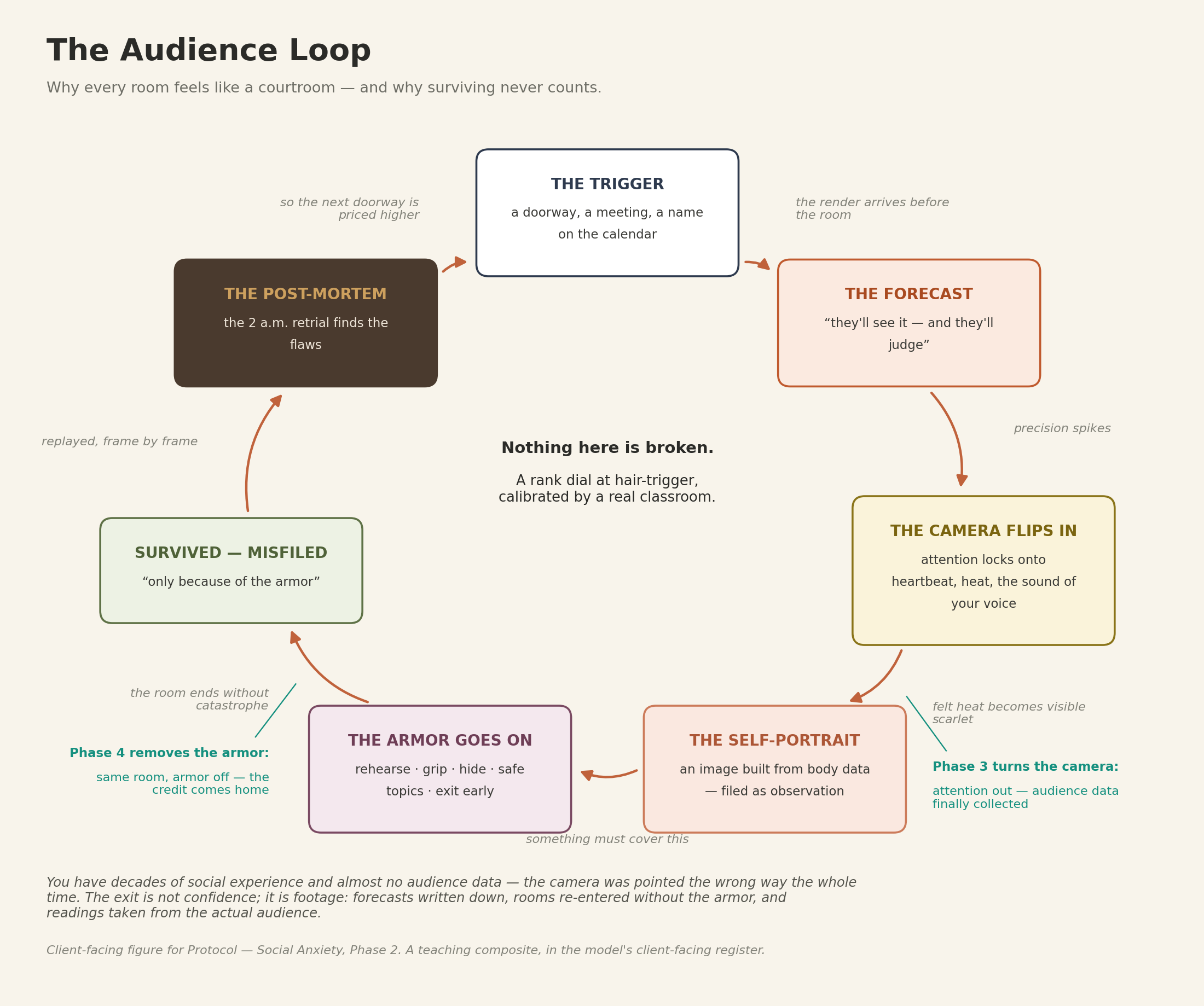
The loop's mechanics, the two intervention points (Phase 3 turns the camera; Phase 4 removes the armor), and the dignity line at the center. And the flag that governs all of it: "We will not be arguing you out of this, because the part of you that's certain doesn't read arguments. We're going to collect footage instead."
Phase 3 — Floor 2 first, because floor 2 is the gatekeeper
In this riser the gatekeeper runs two operations, and both get retrained before the armor comes off — experiments run with the camera still inward just generate more renders.
Turn the camera (attention). The discovery experiment, in session and then live: two short conversations, one with attention locked on self (monitor everything — the machine's default), one with attention deliberately out (their words, their face, the actual room), then compare anxiety, performance, and — the punchline — how much audience data came back. The client discovers they've been reading themselves for years and calling it the audience. Then situational attention training as a rep: out the door, attention out, every social entry a camera drill. This is not distraction and the difference is stated: distraction avoids data; the turned camera collects it.
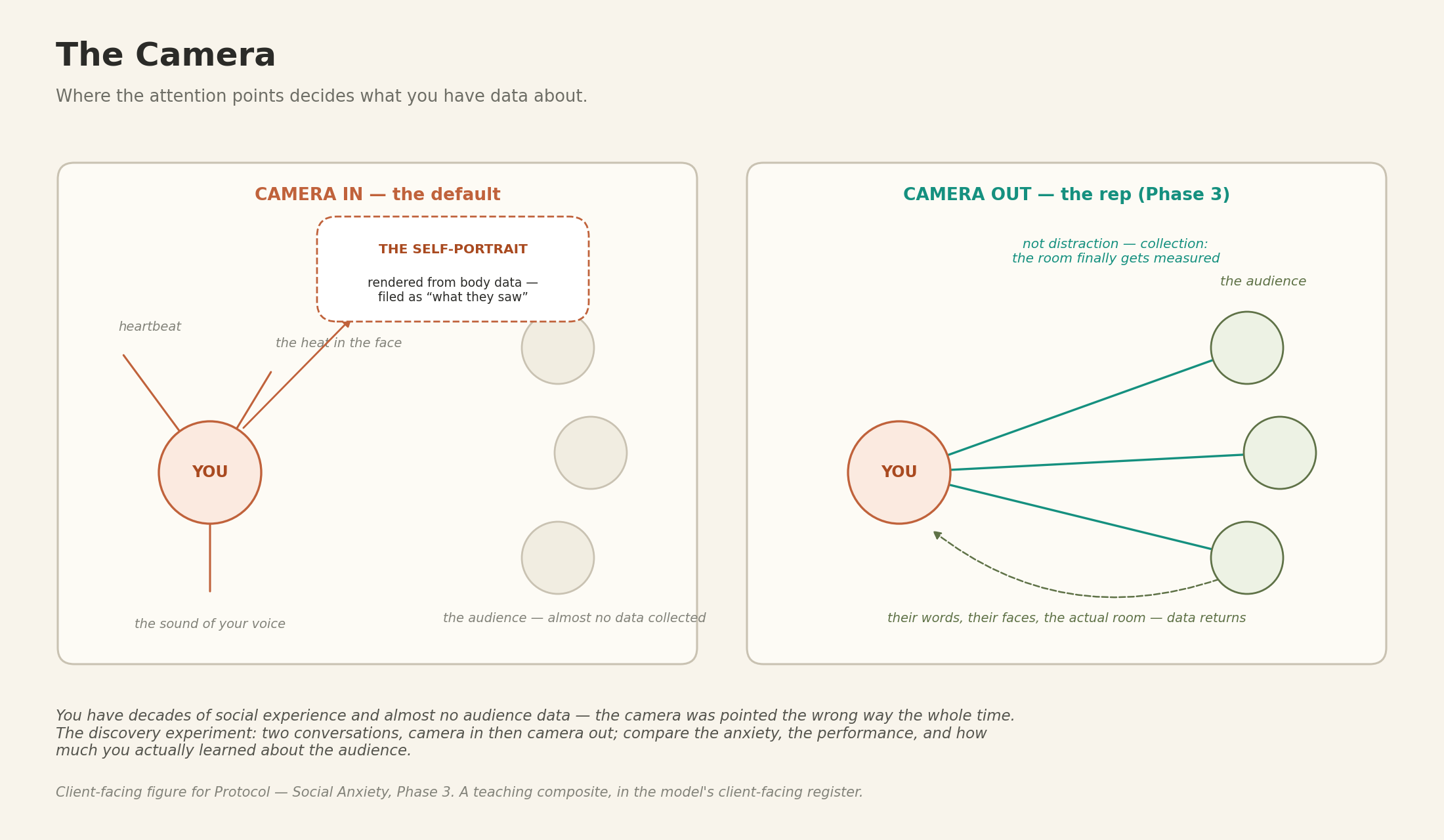
The discovery experiment, drawn — camera in versus camera out.
Close the courtroom (the post-mortem policy). The post-event trial is the gatekeeper's conviction that replaying the evening long enough will either fix it or at least price the damage accurately — cost-account it against its record (has the 2 a.m. retrial ever once returned a kinder verdict, or a useful one?). The replacement, not the ban: one structured reading, same night or next morning — what did I predict, what did I actually observe, what surprised me — written, two minutes, done. Anything after that is circling, and gets caught and named, not suppressed.
Deliverable: consent to the experiment. "We're testing the machine's forecasts about rooms. Your worth was never on the table."
Phase 4 — Interrupt the furnace (floor 5): the armor comes off
The chassis is the two-condition experiment (Wells and Clark's classic, run in the house format): the same social task twice, armor on versus armor off, with a written forecast before each (anxiety 0–10, "how badly it will show" 0–10, the machine's exact prediction in words) and a written reading after. The robust finding the client collects personally: armor off costs more for the first minutes and reads better — warmer, more present, more competent — and the anxiety peaks and falls faster without the monitoring. The gap between forecast and reading, in their own handwriting, is the treatment — evidence laid at the exact address where the code lives. Where a recording is possible, Phase 5 pairs it with footage.
Design rules, per Craske and the ledger: expectancy violation over habituation — each experiment is built to test a stated prediction, sized so the machine actually shows up (comfortable experiments teach nothing), varied across rooms and armor items rather than climbed like a ladder, and run to the read-out, not to the anxiety's exit. The furnace's counterattack is named in advance, move by move, so the client can catch it: the filter audited weekly (what warmth arrived that never made it into memory?), the reinterpret logged next to the reading it attacks ("they didn't notice this time" gets written down and dated, so its record can be checked), the provoke caught live (the self-deprecation that fishes, the "was that okay?" that solicits — Joiner's reassurance-seeking, pinned, is this move's social form), the quiet avoid and withdraw-effort (attending in body while participation stays home — present at the party, absent from it) tracked in the contact sampling. Session metric (§6.2): if nothing surprised the client, nothing changed — an experiment that merely confirmed expectations was sized wrong; resize and rerun.
Graduation, when the armor experiments have their legs: test the core forecast directly. Deliberate, small, visible imperfection — the obvious question asked, the mild disagreement filed, the mediocre joke told, the pause taken without apology, the keys dropped — against the machine's flat prediction that visible flaw equals status collapse. What the readings return, almost every time: the audience's deadband is enormous. People barely register, forget in minutes, and warm to the human one. The client's dial was calibrated for a courtroom; the world is mostly a bus stop.
Phase 5 — Supply the readings (footage and the dimmer)
With the camera turned and the armor loosening, feed the starved instruments actual data:
- Footage, run properly. Video (or audio) feedback is the single most direct correction this condition allows — clients systematically overestimate how visible the anxiety is, and the tape disagrees with the render. The procedure matters: predict first, in operational terms ("the shake will be visible the whole time," "the pause will last five seconds"), brief the client to watch as a stranger would (not hunting the felt moments — the felt version is the render under review), then compare tape to forecast, line by line. Where video is infeasible: trusted-observer ratings, the therapist's own structured read-back, audio for the voice the client is sure everyone hears breaking.
- The visibility experiments. For the blush, the sweat, the tremble: measure it. Confederates where the setting allows, honest co-experimenters otherwise ("ask three people afterward what they noticed"). The machine has been pricing a symptom no one has ever actually surveyed.
- The dimmer is the covert experiment. The therapy relationship runs its quiet disconfirmation here as everywhere: an audience that sees the blank, the blush, and the fumble, week after week, and doesn't grade. Watch for the furnace eating it — "you're paid to be nice" is this riser's version of the depression protocol's move, and it gets named gently and then used: an honest read-back from a person with no stake in politeness is footage too. Where a group format exists, it is this phase's natural amplifier — eight live audiences, all collecting data.
Phase 6 — The ignition scene, if Phase 1 found one
Where a floor-6 trace is underneath — the read-aloud that went wrong, the cafeteria, the parent's public corrections, the year of being the new kid — the experiments lift the rooms of the present and leave a pilot light burning in that one. The tell: Phases 3–5 restore function, but a dateless flinch persists, or one class of trigger stays hot (authority, laughter, being watched writing), or the encapsulated sentence surfaces intact — I am the one who gets laughed at. The trace needs activation-plus-mismatch: the scene revisited while regulated, the meaning re-metabolized with the adult's data in the room (imagery rescripting lineage — Hackmann, Wild, Clark), within scope and supervision, or by referral until licensure. Updating one scene here routinely moves rooms Phases 4–5 never touched — the model's account of why: the rooms were all being priced by that one classroom.
Phase 7 — Consolidation up the building
Now floor 3 writes, because footage exists for the sentences to describe: the client states the revised model in their own words, against their own ledger of forecasts-versus-readings — never the therapist's testimony, which this machine files under politeness. Floor 1 re-authors: the person whose story was the awkward one becomes the one whose machine priced every room as a courtroom, and who walked back in and read the actual verdicts — made, not found, and said out loud. Where floor-8 water is in play — worth priced in performance, likability as solvency, the imagined jury staffed by the culture's graders — it gets named and renegotiated explicitly, or the riser rebuilds with the next promotion, wedding season, or feed refresh. And the rank dial gets its legal channels listed and scheduled — real competence built where it matters to them, opinions filed in public at survivable stakes, the places they're counted on — because a dial this sensitive goes quiet when it's fed, not when it's lectured.
Phase 8 — Relapse as forecast, not failure
Real rooms occasionally go badly — the joke lands wrong, the interviewer is cold, the rejection is actual — and the model expects the machine to claim total vindication and says so in advance. The ending includes a written flare protocol: size the event honestly (one room, one evening, one audience — an n of 1 laid against the whole ledger, and grief allowed where something real was lost); the fast re-entry rule — one ordinary experiment inside the week, before avoidance re-compounds, because the machine consolidates its win in the gap; and the client's personal early-warning signature, named while well (the declines creeping back "just this once," rehearsal returning before calls, the post-mortems lengthening, the phone screened). Booster sessions are named as maintenance, not failure. Close by reviewing the baseline numbers — the LSAS, the contact sampling, the armor count — as the story of the treatment.
Two therapist-side rules, all phases
- Never argue with the verdict. Reassurance is doubly poisoned in this riser, because the therapist is an audience: "you seemed fine to me" gets filed under paid politeness, and each defeated argument logs as proof that even the professional case was weak. The answer is always footage and experiments, never testimony. And watch the room itself: therapy can become the one audience the client doesn't avoid — the safest armor yet. The session exists to route data in from the world, not to substitute for it.
- Match the tempo, and watch the transfer rule. All the armor off at once is flooding with better branding — the removal is graded even though the framing is honest about the destination. And conquering this riser doesn't touch the others: expect the same machinery in new costumes — dating after work rooms are won, authority after peers, the pen that still freezes when someone watches the signature — and expect the sibling risers from the same house (perfectionism, over-preparation, the workhorse who can't be seen resting), and say so before they report in.
Pin targets
| Lead | For | Status |
|---|---|---|
| Salkovskis 1991, behaviour in the maintenance of anxiety | safety behaviors as the disconfirmation blocker — the chassis claim | PINNED metadata (PDF in ILL transit) |
| Craske et al. 2014, Behaviour Research and Therapy | expectancy violation — Phase 4's design rules | PINNED |
| Kube et al. 2019, Psychological Medicine | cognitive immunization — the reinterpret move | SUPPORTIVE — not settled. Two experimental studies (2019); a 2024 replication from the same group failed on one manipulation. Cite as evidence for the move, not proof of it. |
| Swann & Read 1981; Swann et al. 1992 | self-verification — confirming audiences sought; the provoke move | PINNED |
| Joiner & Metalsky 2001 | reassurance-seeking — the provoke move's social form | PINNED |
| Clark & Wells 1995 (in Heimberg et al., Social Phobia) | self-focused attention; the observer-perspective image; the cognitive model | unpinned |
| Wells et al. 1995 | the armor-on/armor-off experiment — Phase 4's chassis | unpinned |
| Rapee & Heimberg 1997 | the audience-representation model — the render claim's second parent | unpinned |
| Video feedback (Harvey et al. 2000; Warnock-Parkes et al. 2017) | Phase 5's footage procedure | unpinned |
| Imagery rescripting (Wild, Hackmann & Clark 2007/2008) | Phase 6 | unpinned |
| Mayo-Wilson et al. 2014, Lancet Psychiatry network meta-analysis | individual CT's standing — why this build order | unpinned |
| Liebowitz 1987 | LSAS — the running instrument | unpinned |
| Gilbert, social rank theory | the rank dial's readings | unpinned (shared with Depression) |
| Social anxiety–alcohol comorbidity (Buckner et al.) | Phase 0's alcohol gate | unpinned |