Protocols › Protocol — Panic
Protocol — Panic
Protocol19 August 2026. Filed in Clinical Tools beside the Decision Aid and the other protocols; sibling to Protocol — Health Anxiety (same floors, faster clock). Honesty label, in the appendix spirit: made, not found. This is a model-derived reorganization of components that existing panic treatments have tested separately — Clark's catastrophic-misinterpretation model, the Barlow/Craske panic-control lineage, interoceptive exposure, and the safety-behavior literature (Salkovskis). The sequence is the model's contribution (gates → policy → summons → repatriation → ignition → consolidation → relapse plan), and the sequence has no outcome data of its own. Written by a counseling student; runs under supervision; composes with, never replaces, program training and site protocols. Companions: floor-notes/Floor 7 — Body and Interoception, floor-notes/Floor 2 — Metacognition, floor-notes/Floor 5 — Scripts and Behavior, the furnace (§2.3), and the Salkovskis, Craske, and Kube pins in the ledger.
The formulation in one line
Panic presents on floor 3 (the verdicts: heart attack, suffocation, madness, public collapse), runs its engine on floor 7's ordinary noise, takes its orders from floor 2 (a body-scanning policy), executes on floor 5 (escape and a growing armor kit), is sometimes ignited from floor 6 (the first attack itself, or the family's cardiac story), sits in floor-8 water where bodies were emergencies — and the treatment follows the building, not the complaint.
The model's distinctive reading
Three claims organize everything below.
Panic is a false alarm about the alarm. The calibration gate fails at speed: the machine reads its own alarm output — the racing heart, the tight chest, the swimming head — as evidence of the catastrophe the alarm supposedly detected, and the loop closes in seconds: sensation → render (heart attack, now) → alarm floods the body → more sensation → certainty. Nothing in a panic attack is dangerous; every symptom is the alarm itself, misfiled as the fire. This is §2.1 at its fastest setting — the client is not perceiving a failing heart; they are perceiving the machine's render of one, painted over a healthy body in under a minute. The smoke-detector logic is worth honoring out loud: a detector built by evolution errs loud and early, because a hundred false alarms cost less than one missed fire — the equipment is magnificent; its threshold is set wrong.
The forecast is seconds long — and that is the treatment's advantage. Depression's dark forecast is global and slow to test; panic's is concrete, immediate, and due now: "if this continues, I will die / faint / go mad within minutes." A forecast that specific can be subpoenaed. The catastrophe has a due date, and the due date has passed hundreds of times — but escape keeps filing each survival under rescued instead of false alarm, so the record never converts. Bring the sensations to the table on purpose, hold the exits shut, and the forecast has to testify: this protocol's engine is the summoned attack that fails, in the room, on schedule.
Escape is prepayment with compounding interest. Every early exit, avoided highway, skipped workout, aisle seat, carried water bottle, benzodiazepine-in-the-pocket, pulse check, and safe-person tether is the machine collecting its toll — and each payment confirms the danger's reality and widens the alarm's jurisdiction. Agoraphobia is the annexation in progress: the alarm claiming the mall, then the highway, then the checkout line, until life fits inside the safe radius. The five moves in panic costume: avoid (places, exertion, caffeine, sex, horror films — anything that raises the pulse), filter and reinterpret (survivals credited to the escape, the pill, the lucky bench — "if I hadn't sat down, it would have happened"), provoke (the scan that manufactures its own evidence — checking the heart raises the heart), and withdraw effort (the life shrunk to the radius). Where the feared catastrophe is public collapse, the rank gauge co-signs the loan — fainting in the meeting is priced as social death — and the repatriation of Phase 5 has to visit those rooms too.
Phase 0 — The gates (run first, and never fully retired)
The calibration gate, literally and once. Panic's somatic vocabulary overlaps real medicine, so appropriate medical workup runs first — cardiac where indicated, thyroid, anemia, asthma, arrhythmia, and the mimics worth ruling out per the physician's judgment — complete, and then closed, per the health-anxiety rule: one good workup is due diligence; serial workups are checking with a copay. The protocol cannot start while investigations are pending — every open investigation is an open fuel line to the furnace.
Interoceptive clearance. Phase 4 deliberately induces the feared sensations, so its exercise menu is cleared with the physician where any real condition exists — cardiac conditions, epilepsy, asthma and COPD, pregnancy, migraine — and adapted rather than abandoned (a body with a real limit still owns every sensation outside it). Supervision signs off on the menu before the first summons.
Substances audit, both directions. Caffeine, stimulants, cannabis, and alcohol withdrawal all manufacture floor-7 signal and can carry the whole presentation — audit before formulating. And the benzodiazepine question is named early, without moralizing: a PRN benzo in the pocket is chemical armor — survivals get credited to it, and the drug can blunt the very learning the summons exists to produce. Scheduling and tapers belong to the prescriber, always; the protocol's job is to notice the accounting and route the question, not to touch the dose.
Routing. Panic attacks inside PTSD belong to that protocol (the attack is a match firing, not a freestanding riser); panic that serves a senior health-anxiety pattern (the fear is disease over time, not catastrophe this minute) routes to Protocol — Health Anxiety; the reversed dial (psychosis, mania) diverts per the Decision Aid; depression and risk get the standard screens. Agoraphobic range sets the logistics — a housebound start begins at the front door, and the protocol travels.
Phase 1 — Locate and formulate (the riser profile)
Two sessions of ordinary listening, Appendix A machinery with a body filter. The sorting questions:
- "Tell me about the first one." Where, and what was life doing that month — first attacks cluster at load (sleep debt, grief, stimulants, the brutal quarter), and the story usually contains the ER visit, the clean EKG, and the sentence someone said that either closed the case or opened it ("it's just anxiety" closes nothing).
- "What exactly does the body do, and what does it mean when it does?" The specific channel and its verdict — heart → dying; breath → suffocating; head → stroke, madness, losing control; legs and vision → collapsing in front of everyone. Each channel gets its own summons in Phase 4, and the verdict is the forecast, verbatim.
- "What do you carry, and where won't you go?" The armor kit (water, pills, phone, the aisle seat, the exit map, the safe person) and the annexation map, drawn honestly — including the subtle tolls: the declined invitation "because parking is hard," the gym quietly dropped.
- "How often do you check the body, and has the checking ever once found a fire?" Surfaces floor 2's scanning policy and starts its cost accounting a phase early.
Baseline the furnace in numbers, because the numbers are the outcome measures: attack log (frequency, duration, peak intensity), PDSS, the avoidance map's item count, the armor inventory, scans per day, caffeine load. These are the story of the treatment, told at the end.
Phase 2 — Teach the client the machine
Client-facing telling, in the model's images, and the dignity move comes standard: nothing here is broken. The alarm is the best piece of equipment the client owns — built to err loud and early, because for the animals that built it, a hundred false alarms cost less than one missed fire. This machine pulled the alarm once under real load, then filed the alarm itself as the emergency, and it has been detecting its own detector ever since. Then the claims that reorganize everything, stated flat:
Nothing in a panic attack is dangerous — every symptom is the alarm, read as the fire. And: the catastrophe has had hundreds of due dates, and escape has taken the credit for every no-show.
Name the prepayment while it's on the table: the toll paid at every exit ramp — the early leavings, the avoided highways, the pocket pharmacy — is the machine charging protection money against a fire that was never lit, and each payment is filed as proof the protection worked.
Draw the loop for the session:
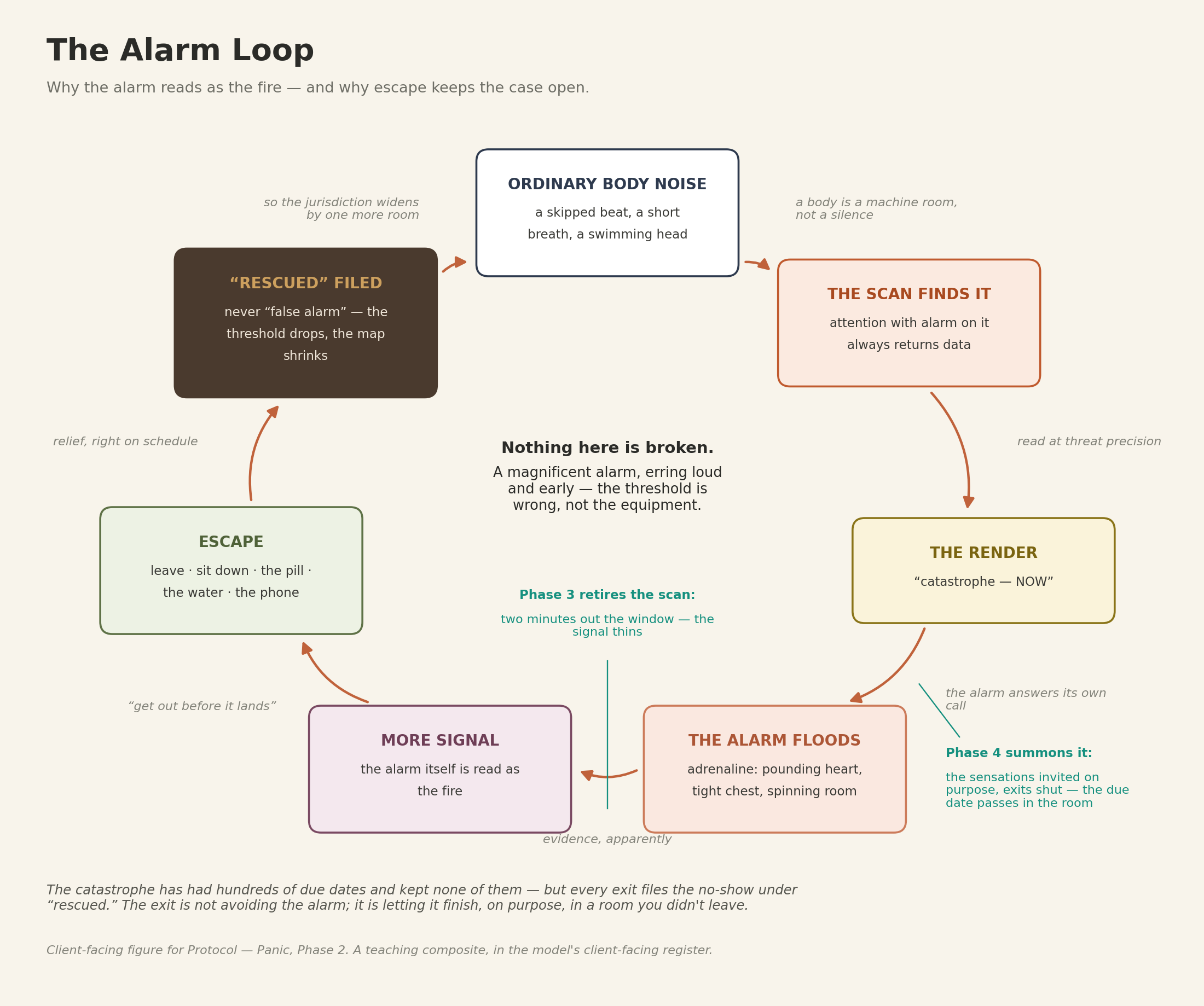
The loop's mechanics, the two intervention points (Phase 3 retires the scan; Phase 4 subpoenas the sensations), and the dignity line at the center. And the flag that governs all of it: "We will not be arguing you out of this, because the part of you that's certain doesn't read arguments. We're going to summon it on purpose, in here, and let it show you what it actually is."
Phase 3 — Floor 2 first, because floor 2 is the gatekeeper
The scanning policy must be re-described before the summons is possible — otherwise Phase 4 is experienced as arson. Targets: monitoring catches it in time and the skipped scan is the one that kills me. Moves:
- Cost accounting — what has the surveillance actually bought, in caught emergencies versus lost years? The client audits their own record: thousands of scans, zero fires, and a life re-routed around the alarm.
- The scan manufactures its evidence — demonstrated live, not argued: two minutes of attention on the heart (it speeds, it pounds, it skips — attention with alarm on it always returns data) versus two minutes of attention out the window (the body thins to background). The checking isn't detection; it's the signal generator.
- The deadband — a body is a machine room, not a silence: hearts skip beats, chests twinge, vision sparkles on standing, breath shortens on stairs. The goal is not certainty (no body offers it) but a deadband — a range of bodily weather that passes unexamined, the same range every healthy body runs on.
Deliverable: consent to the summons. "We're testing the alarm, not your heart. Your physician already tested your heart — that case is closed."
Phase 4 — Interrupt the furnace (floor 5): the summons
Interoceptive exposure, run in the house format as forecast experiments — each exercise chosen to counterfeit the client's feared channel, then run through the six steps (named prediction → confidence rated → written down, before → smallest real summons → compare out loud → "how many times before the rule revises?"):
- Heart channel: stair sprints, jumping jacks, running in place — the pulse driven to the forecast number on purpose.
- Breath channel: sixty seconds of hard hyperventilation; breathing through a cocktail straw.
- Head channel: spinning in the chair; head between the knees and up fast; staring at a point.
- Unreality channel: fluorescent light, a wall stared at, the own hand watched until it estranges.
Design rules, per Craske and the ledger: expectancy violation over habituation — the exercise is sized so the machine actually shows up (a summons the alarm ignores teaches nothing), run past the peak rather than to the first flinch, with no armor on the table (the water bottle, the phone, the propped door — out), varied in order, context, and dose rather than climbed like a ladder, and repeated across settings: clinic, then parking lot, then home, alone. The furnace's counterattack is named in advance, move by move: the reinterpret ("it was safe because we were in your office" → so the parking lot, the home, the solo run; "I knew it was coming" → so unsignaled variants, dose chosen by coin flip), the filter (survived summons uncounted → the written ledger holds them), the subtle avoid (half-effort hyperventilation, braced spinning — coached to full effort, warmly), and the provoke caught live (the between-trials scan re-running the policy Phase 3 retired). Session metric (§6.2): if nothing surprised the client, nothing changed — a flat trial that confirmed expectations was sized wrong; resize and rerun.
The model's prediction is told in advance, health-anxiety style: anxiety rises first. Prepayment has been declined; the system is sitting in sensations it has always bought its way out of. The rise is not deterioration — it is the alarm finally allowed to finish its arc and be read to the end.
Phase 5 — Supply the readings: repatriation (floor 5 into the world)
With the alarm subpoenaed and failing in the room, the annexed territory comes back:
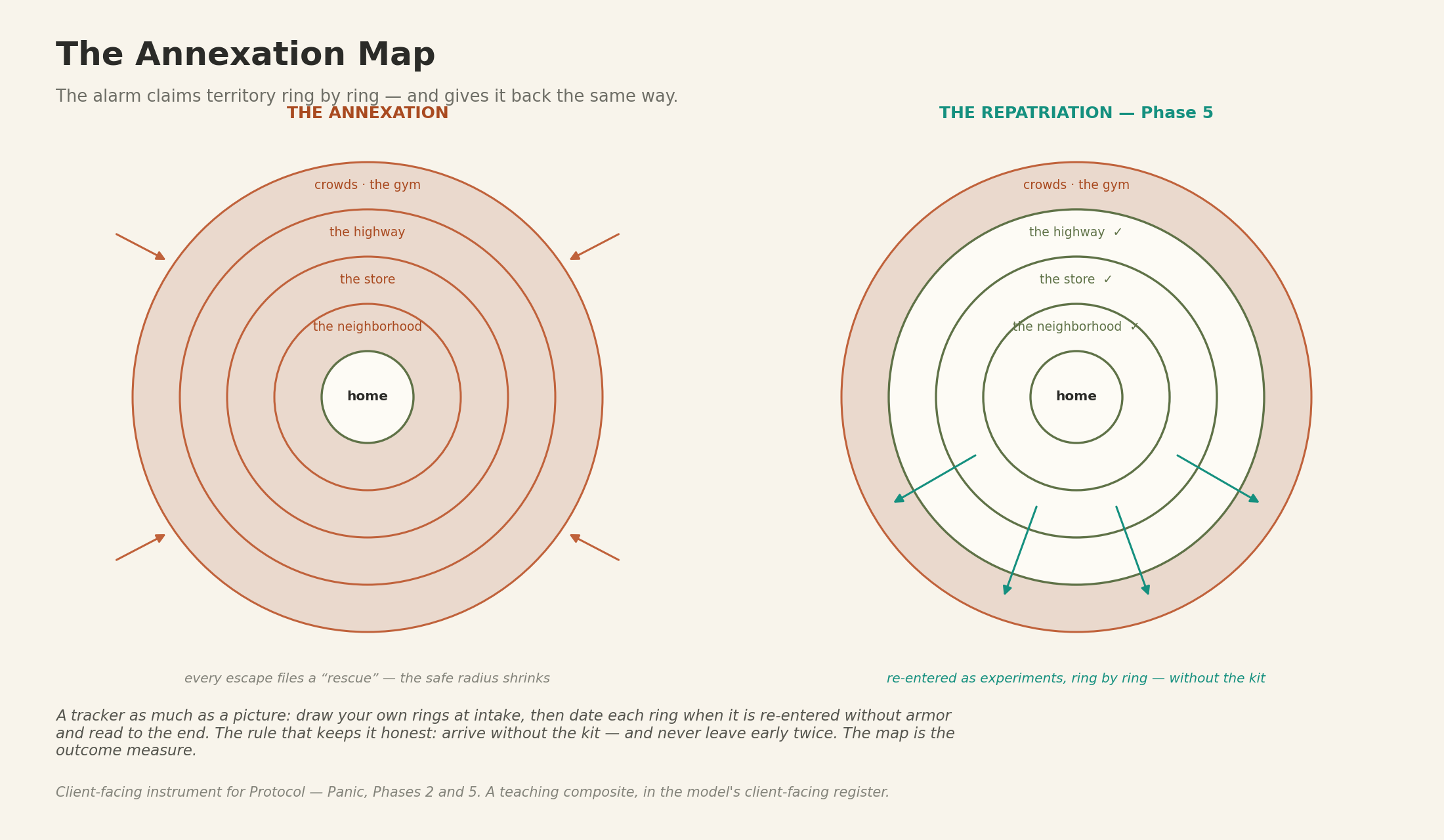
The annexation map — drawn at intake, then dated ring by ring as territory returns without the kit.
- The map, re-entered as experiments. The mall, the highway, the checkout line, the meeting — each with a written forecast and a reading, each run to the read-out rather than to the first urge to leave. The rule that keeps re-entry honest: arrive without the kit. Armor retires one item at a time, two-condition style — the drive with the water bottle and the drive without, forecasts attached — so the credit for every survival lands on the body, not the bottle.
- The tether, unwound. The safe person is enlisted, briefed on the model, and scheduled out: accompanied trial, then phone-available trial, then solo — because "I survived it because you were there" is the dimmer's version of the water bottle. Where the catastrophe was public collapse, the solo trials deliberately visit peopled rooms — the rank gauge gets its own readings.
- Exertion reclaimed. The gym, the run, the stairs, sex — the body's full range re-legalized, framed as interoceptive exposure with a life attached. Caffeine, where medically cleared, runs as the graduation summons: the machine's old accomplice, drunk on purpose, read to the end.
- Rescue rituals audited. Breathing techniques deployed during attacks are armor in disguise — the survival gets credited to the technique, and the alarm never gets read to the end. Slow breathing may live in the day as hygiene; it does not ride along on the summons.
Phase 6 — The ignition scene, if Phase 1 found one
Where a floor-6 trace is underneath — the first attack that meant my body betrayed me in front of everyone; the actual medical event; the father's heart attack at the age now approaching; the childhood bedroom where a parent was carried out — the summons quiets the loop but leaves a pilot light. The tell: Phases 4–5 succeed, the map reopens, and a dateless dread of the body persists, or the riser relights each year on the anniversary, or at the milestone age. The trace needs activation-plus-mismatch — the scene revisited while regulated, the meaning re-metabolized on the adult's data — within scope and supervision, or by referral until licensure. Anniversary and age-milestone relights are named in advance as forecasts, not omens.
Phase 7 — Consolidation up the building
Now floor 3 writes, because the ledger exists for the sentences to describe: the client states the revised model of their body in their own words, against their own false-alarm count — hundreds of due dates, zero fires, and a summons record in their own handwriting. Floor 1 re-authors: the person whose body was a bomb becomes the person who summoned the explosion on purpose, weekly, and read it to the end — made, not found, and said out loud. Where floor-8 water is in play — the house where bodies were emergencies, the family that narrated every twinge, the culture of cardiac dread — it gets named, or the riser refills with the next headline. And the alarm gets its legal channels: real fitness built on purpose, real medicine on schedule through the designated channel — the body used hard and serviced properly, not surveilled.
Phase 8 — Relapse as forecast, not failure
Attacks revisit — under sleep debt, illness, grief, a stimulant miscount — and the model says so in advance: the old prior is outcompeted, not erased (§6.2's two regimes), and load re-raises the gain. The ending includes a written flare protocol: an attack is a reading, not a relapse — ride it to the end where it stands, because the alarm only re-annexes territory that gets evacuated; the standing rule never leave early twice (one bought exit is weather; two is the toll booth reopening — re-run the room within the week); the early-warning signature, named while well (the map quietly shrinking, the water bottle back in the bag, the scans creeping up, the aisle seat requested again); and the door back — booster summons named as maintenance, not failure. Close by reviewing the baseline numbers as the story of the treatment.
Two therapist-side rules, all phases
- Never argue with the verdict. Anatomy lectures are reassurance in a lab coat — the machine doesn't attend hearings, and "but could it be my heart this time?" answered twice becomes the session's compulsion. The answer is always the summons, never the verdict. And when the attack arrives in session — invited or not — the therapist's own steadiness is the dimmer's data: a clinician who sits easy inside the client's worst minute is disconfirmation no argument can deliver, and one who reaches for rescue confirms the fire.
- Match the tempo, and watch the transfer rule. Clear the channels one at a time and check them all — a conquered heart with an untested head leaves the alarm a spare room. And conquering this riser doesn't touch the others: the same machinery returns in new costume — health anxiety's slow-motion version, worry's future tense — and the siblings share a hallway; say so before they report in.
Pin targets
| Lead | For | Status |
|---|---|---|
| Salkovskis 1991, behaviour in the maintenance of anxiety and panic | escape and safety behaviors blocking disconfirmation — the chassis claim | PINNED metadata (PDF via ILL) |
| Craske et al. 2014, Behaviour Research and Therapy | expectancy violation — Phase 4's design rules | PINNED |
| Kube et al. 2019, Psychological Medicine | cognitive immunization — the reinterpret move | SUPPORTIVE — not settled. Two experimental studies (2019); a 2024 replication from the same group failed on one manipulation. Cite as evidence for the move, not proof of it. |
| Clark 1986, Behaviour Research and Therapy | catastrophic misinterpretation of bodily sensations — the loop | unpinned |
| Barlow; Craske & Barlow, panic control treatment | the interoceptive package this protocol reorganizes | unpinned |
| Nesse, the smoke-detector principle | Phase 2's dignity telling | unpinned |
| Antony et al., interoceptive exercise batteries | Phase 4's menu | unpinned |
| Shear et al. 1997 | PDSS — the running instrument | unpinned |
| Benzodiazepines and exposure outcome (Marks / Westra lineage) | Phase 0's chemical-armor flag | unpinned |
| Caffeine challenge studies (Charney lineage) | Phase 5's graduation summons | unpinned |