Protocols › Protocol — Addiction
Protocol — Addiction
Protocol19 August 2026. Filed in Clinical Tools beside the Decision Aid and the other protocols. Honesty label, in the appendix spirit: made, not found. This is a model-derived reorganization of components that existing addiction treatments have tested separately — motivational interviewing (Miller & Rollnick), relapse prevention (Marlatt & Gordon), mindfulness-based relapse prevention and urge surfing (Bowen, Witkiewitz), cue-exposure work read through inhibitory learning, contingency and community-reinforcement lineages, and twelve-step facilitation as ecology. The sequence is the model's contribution (gates → riser profile → the re-addressing → gatekeeper → armor and replacement → the crest witnessed → ignition → consolidation → the lapse pre-written), and the sequence has no outcome data of its own. The scope line, stated before anything else: severity decides the venue. Moderate-to-severe substance use disorder belongs in specialty and medical care, and this protocol is the psychological engine inside that care, not a substitute for it. Withdrawal medicine is medicine. A student's lane is the gates, the formulation, the education, and the readings — under supervision, with the medical partnership standing. Companions: floor-notes/Floor 6 — Procedure and Emotion, floor-notes/Floor 7 — Body and Interoception, floor-notes/Floor 3 — Propositional Beliefs, the furnace (§2.3), Protocol — The Self-Story (Low Self-Esteem) (the shame riser runs through this one), and the Craske, Kube, and Joiner pins in the ledger.
The formulation in one line
Addiction presents as floor 5 behavior, but the engine is a floor-6 procedure — a relief move trained to reflex — running on floor 7's alarm chemistry, defended by floor 3's verdicts (I can't cope without it; I'm broken anyway), concealed by floor 4's templates, soaked in floor-8 water that both markets the substance and damns the user — and the treatment interrupts the procedure while re-addressing the forecast that runs it, because the craving is a prediction, and predictions update from evidence, not argument.
The model's distinctive reading
Three claims organize everything below.
Craving is a forecast, not a measurement. The craving does not read the body's need; it predicts relief — with the precision cranked to maximum by a learning system that recorded relief once and promoted the recording to law. The machinery's tell is the wanting/liking split: wanting and liking run on different circuits, and in addiction they come apart — the machine can want at full volume what the person barely likes anymore. Most clients have already noticed this, privately, and it is the most underused fact in the room: the forecast says this will be wonderful, and the record says it stopped being wonderful years ago. That gap is the treatment's front door.
Use is prepayment. The distress has not arrived; the machine forecasts it as unsurvivable and pays early — the drink before the party, the hit before the feeling finishes forming. Every early payment files the record the feeling was unsurvivable and the escape saved me, which is exactly the evidence the forecast needed, and the loop trains itself tighter. And prepayment has a second cost the machine never invoices: the crest never gets witnessed. A craving is a wave — it rises, peaks, and falls on its own schedule — and escaping at the peak files it as rising forever. The one fact about cravings the machine keeps from its owner is that they crest, and the whole middle of this protocol exists to let the client watch one do it.
The shame furnace is the second engine. Lapse → verdict (weak, broken, hopeless) → the verdict is itself intolerable → use to escape the verdict → fresh evidence for the verdict. The abstinence-violation effect is the furnace at full heat: one drink becomes a bender not through chemistry alone but through the sentence pronounced between the first drink and the second. This is why the protocol treats the morning after a lapse as the highest-leverage moment in the riser, and pre-writes it — Phase 8 is not an appendix here; it is a load-bearing wall built in week one.
Phase 0 — The gates (medicine first, and no arm-twisting ever)
Withdrawal medicine is medicine. Alcohol and benzodiazepine withdrawal can kill; opioid withdrawal resets tolerance and loads the overdose gun for the relapse the statistics predict. Severity assessment and any detoxification run in medical hands, on medical instruments, before this protocol asks anything of anyone. Never improvised.
Medication for addiction is treatment, and the protocol says so plainly. Buprenorphine, methadone, naltrexone, acamprosate — evidence-backed, guideline-standard, and never framed as "substituting one drug for another" in this room. The don't-prescribe-your-own-cure rule cuts both ways: the prescriber's lane is respected, and so is the client protected from the floor-8 voice (sometimes wearing a recovery-culture costume) that shames the medication that is keeping them alive.
Overdose safety, practically. Naloxone in the house and in writing where opioids are anywhere in the picture — for the client, for the family — handled as fire-extinguisher logic, not prophecy.
Risk, fully. Suicide screening at the depression protocol's standard, monitored, safety-planned where indicated, crisis resources in writing (in the US, 988) — and the Joiner pin stands close here: intoxication is acquired capability's accelerant, and the combination of a bad night and a lowered barrier is exactly what the assessment exists to see coming.
Co-occurring conditions run concurrently. The depression, the trauma, the anxiety risers get treated alongside, not after — "come back when you're sober" is a door this protocol does not own. Sequencing decisions belong to supervision and the medical partner; the refusal to abandon is the protocol's own.
Ambivalence is data, not resistance. The machine holds two accurate ledgers — what the use costs, and what the use does for them — and the protocol reads both out loud, without flinching at the second. Nobody's arm gets twisted, because twisted arms manufacture counterarguments (the machine defends what gets attacked), and because the never-argue rule is not a technique here; it is the treatment. Motivational interviewing is this gate practiced as a discipline.
Ecology. The environment is the pathogen rule: the house full of bottles, the using network, the paycheck-Friday routine — ecology work is treatment, not preamble. And the behavioral addictions (gambling first among them) run the same loop minus the pharmacology; the protocol transfers with the medical gates swapped for financial ones.
Phase 1 — Locate and formulate (the riser profile)
The five questions, and then the inventory that matters most in this riser: the job the use performs, mapped by floor. Floor 7: what alarm does it quiet — the withdrawal itself, the anxiety, the insomnia? Floor 6: is it the only emotion-regulation procedure ever installed — what else has ever worked, even once? Floor 4: is it the only social lubricant, the membership fee for the only belonging on offer? Floor 1: how much identity has it annexed — who is the client in their own story without it? The treatment cannot evict a tenant that is holding up the roof until something else holds the roof; the profile finds out what the roof is resting on.
The rest: substance, dose, pattern, and route, honestly; the trigger inventory (people, places, times, paydays, and the internal states — hungry, angry, lonely, tired); the concealment map (who knows what — floor 4's second job); the lapse history read as data (what preceded each, what the verdict said after); and the craving diary begun in week one — intensity, duration, trigger, and what happened next — because the crest data collects itself, and Phase 5 will need it. Baselines: AUDIT or DAST, a craving measure, the shame verdicts verbatim, and the life map — what the use has annexed, drawn honestly.
Phase 2 — Teach the client the machine
Client-facing telling, in the model's images, and the dignity move leads: the loop is learning, not weakness — the machine did exactly what reinforcement machinery is built to do with a reliable relief signal, and nobody chooses their first molecule of relief. Then the two tellings that reorganize everything:
The forecast telling: the craving is not your body reporting need — it is your machine predicting relief, with the confidence knob broken off at maximum. And your own records disagree with it: wanting and liking are different circuits, yours have come apart, and you noticed years before anyone said it out loud.
The crest telling, drawn:
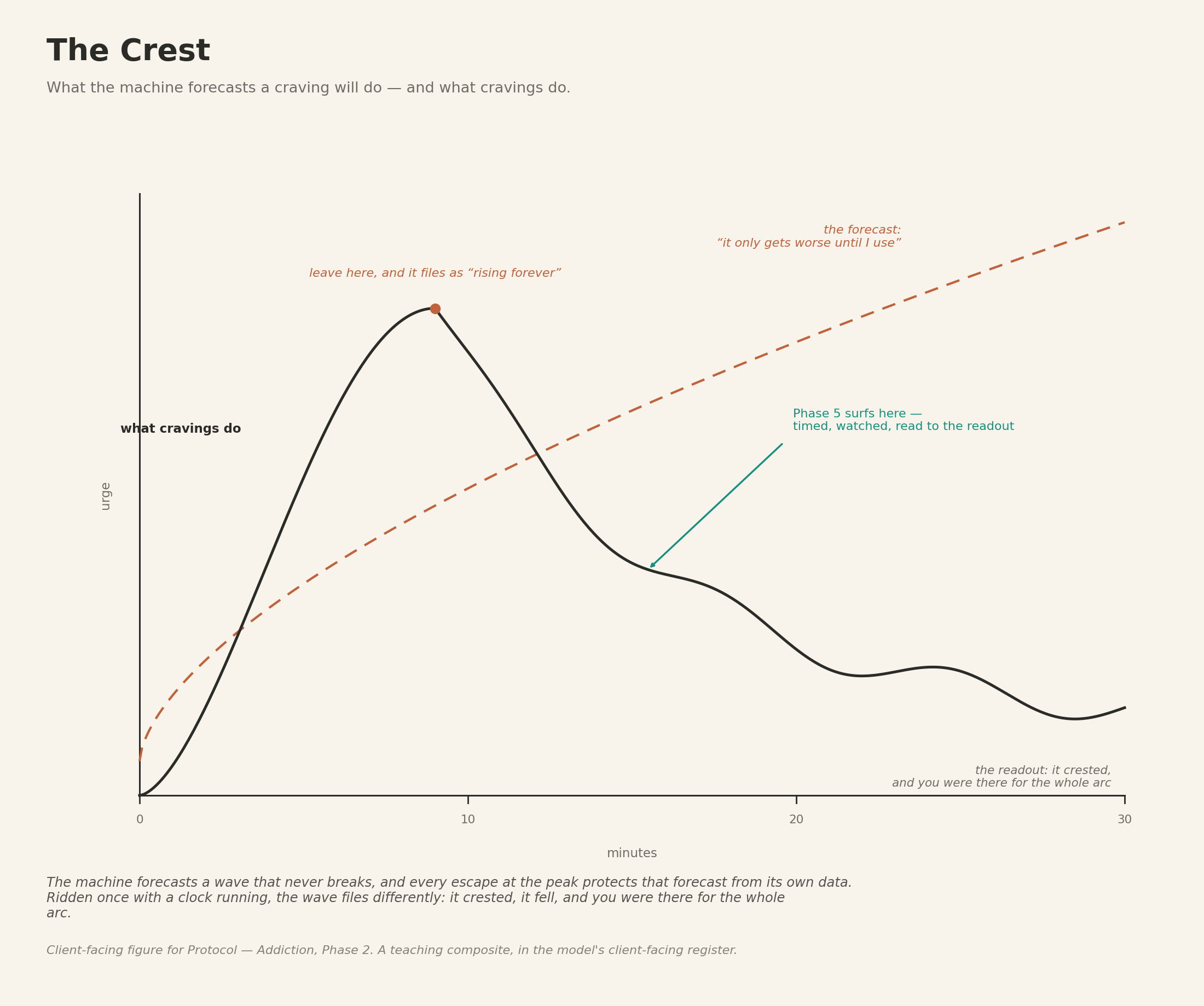
What the machine forecasts (rising forever) versus what cravings do (rise, crest, fall) — and why leaving at the peak is the one move that keeps the forecast unfalsified.
Draw the loop for the session:
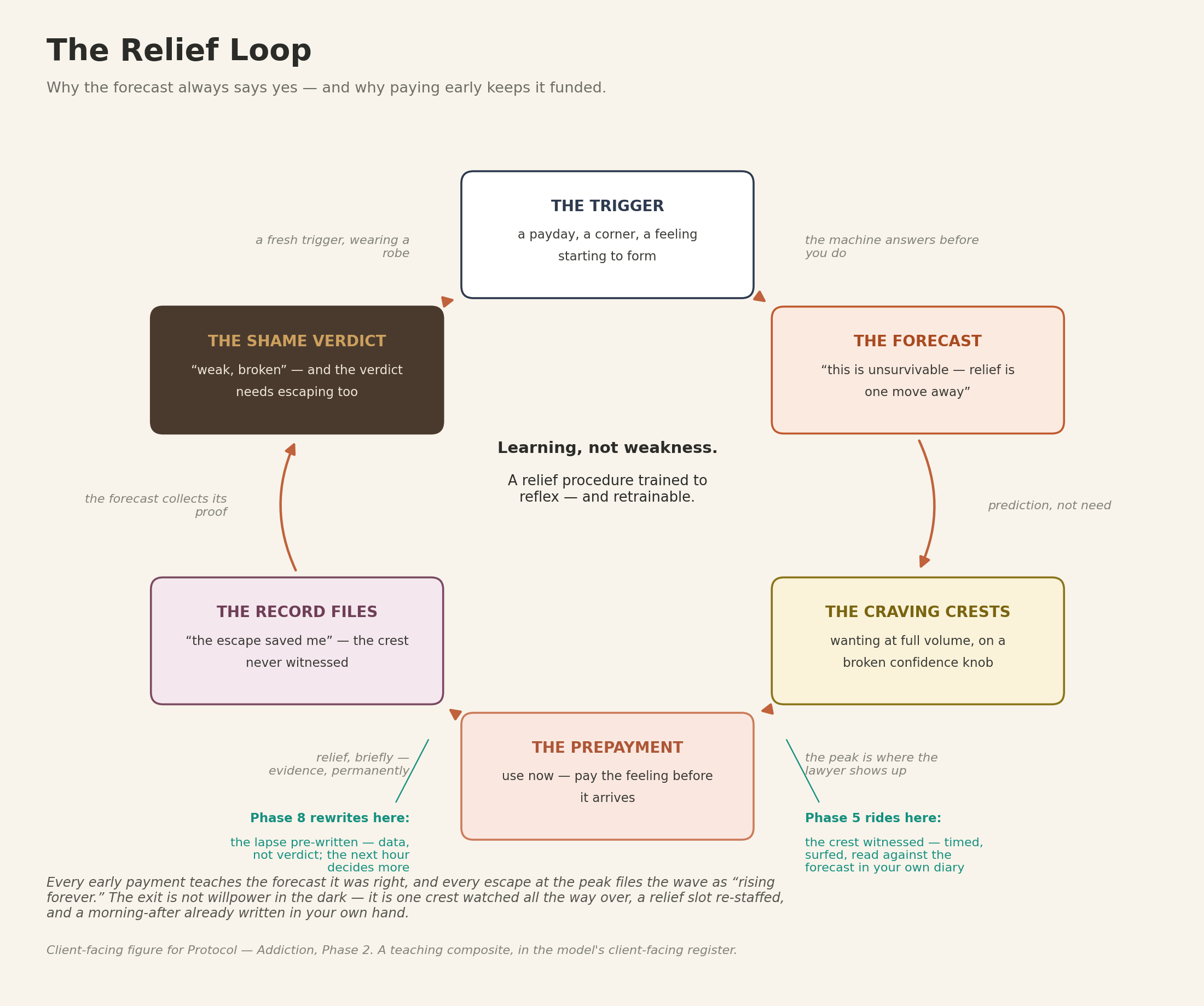
The loop's mechanics, the intervention points (Phase 5 rides the crest; Phase 8 pre-writes the morning after), and the dignity line at the center. And the flag: "If this sounds like an excuse factory, it isn't. The machinery explains the pull; the hands are still yours. Both of those are true at once, and this whole treatment lives in the space between them."
Phase 3 — Retire the gatekeeper's rules (floor 2)
The press secretary does its most specialized work in this riser, and it gets named:
- The permission machine. One won't hurt. I've earned it. I'll start Monday. I'm fine now — that was the old me. Everyone's having one. These are not conclusions; they are the machine's lawyer filing motions, and they arrive precisely timed to the crest. The client learns to recognize the voice by its timing rather than its content — a suddenly reasonable argument for using, arriving during a craving, is the craving.
- The deadband, re-taught. Not every discomfort is a summons. The machine has been reading every internal wobble as a job for the substance; the readings phase will re-teach what ordinary weather feels like un-medicated.
- Postponement, adapted. The decision is never argued with at the peak; it is scheduled — twenty minutes, past the crest — because the decision made on the far side of the wave is usually a different decision, and either way the client learns who was talking.
Phase 4 — Interrupt the furnace, and re-staff the procedure (floor 5, floor 6)
- Stimulus control, without shame. The bottles leave the house; the routes change; the apps go. This is not weakness and the protocol says so: it is the perimeter that gives the retraining room to run — scaffolding, on a schedule, like the pain protocol's pacing.
- The counterattack, named in advance. Filter (sober days uncounted — "white- knuckling doesn't count"; the ledger counts them); reinterpret ("I only made it because nothing bad happened this week"); provoke (the fight picked on day six — the machine manufacturing a justification; named gently when it appears); withdraw effort ("I'm broken anyway" — the self-story riser, treated as such); and prepayment everywhere, caught at the calendar and the doorway.
- The slot re-staffed. A floor-6 procedure cannot be deleted, only outcompeted. The relief slot gets new tenants installed before the old one is fully evicted — the run, the shower ritual, the call, the meeting, the twenty hard minutes of anything embodied — drilled while calm so they are reachable while not, on the grounding-to-fluency rule. Expect substitution and read it out loud when it appears (the phone, the food, the spending): the slot is advertising its vacancy, which is information, not failure.
Phase 5 — Supply the readings (the crest, witnessed)
- Urge surfing is the house reading in this riser. The craving attended as sensation — located, described, timed — ridden with the surprise metric running: forecast written before (unbearable, and it will not stop until I use), reading compared after (peaked at nine minutes; fell on its own; I was there for it). One witnessed crest outweighs a month of argument, and the craving diary from Phase 1 makes the pattern undeniable in the client's own handwriting.
- Cue exposure, within scope and supervision. The feared conviction I cannot be near it and not use gets tested at negotiated dose on Craske's rules — expectancy violation, varied contexts, run to the readout — built from the trigger inventory, sized to be survivable and real.
- The dimmer. Concealment is the disorder's second skin, and the reversal is ladder-first: one safe person, one true sentence, forecast and read. The recovery room — twelve-step, SMART, the men's group, whichever fits the client's water — is named as dimmer infrastructure: the room where the shame dies in accurate company, where disclosure is the currency rather than the cost. Offered as ecology, never mandated; the model cares about the mechanism, not the brand.
Phase 6 — The ignition scene (the live trigger, with the crest ridden)
The emblematic trigger met at full formality, planned like an expedition: the paycheck Friday navigated, the bar walked past, the wedding attended sober with exits pre-planned, the first anniversary weathered — dose negotiated, support named, the crest ridden to the readout in the field. The phase's standing rule: never white-knuckle blind — always watch the crest. Endured-with-eyes-open files as evidence; endured-with-eyes-shut files as luck. The tell that the address is changing: a craving survived on purpose leaves a different record than one out-suffered — and the crests start arriving pre-shrunk, because a forecast audited in public loses its nerve.
Phase 7 — Consolidation up the building
Floor 3 retries the verdicts against the accumulating ledger: I can't cope without it meets the diary's witnessed crests and the re-staffed slot's service record. Floor 1 re-authors — the addict becomes the one whose machine learned a relief loop, and who retrained it — with one honest caution the model insists on: recovery identity is load-bearing scaffolding for many, and it can also annex the whole book; the protocol permits it as a chapter and protects the other chapters. Floor 4 audits the roster honestly: some of the friendships were the substance's friends, and the grief for them is real and gets its accompaniment; the dimmer's new company gets deposited into. Floor 8 gets named — the culture that pours at every ritual and damns every casualty, the industry's engineering, the family's script — because half the shame was learned in that water. And the life gets repatriated on the calendar: sobriety is the evacuation; the repatriation is the treatment.
Phase 8 — The lapse, pre-written (relapse as forecast, not failure)
Built in week one, refined throughout, and carried in writing — because the morning-after is the highest-leverage moment in the riser and the machine plans to own it. The card says, in the client's own words, something with this spine: a lapse is the old procedure firing under load — data, not verdict. The next hour decides more than the last one did. The furnace will offer "broken"; the ledger says otherwise. Call [name]. Eat, sleep, and come to the next session with the diary filled in. The abstinence-violation effect is taught by name in advance so it fires defused. The early-warning signature is named while well: the meeting quietly skipped, the phone screened, the route drifting past the old corner, the HALT states stacking, sleep fragmenting. The family gets briefed on the same card — their panic is a furnace input, and their steadiness is treatment. Boosters are maintenance. Close on the ledger — the witnessed crests, the repatriated map — as the story of the treatment.
Two therapist-side rules, all phases
- Never argue with the verdict — and never fight the ambivalence. Motivational interviewing is this rule practiced as a discipline: both ledgers read out loud, the client's own discrepancy doing the work, the machine never handed an attacker to defend against. The shame verdicts are not debated either; they are outlived in accurate company and retried on evidence, in that order. And the clinician's face at the disclosure of a lapse is the single most-read data point in the treatment: composure without collapse, and the card run as written.
- Match the tempo, and watch the transfer rule. Withdrawal timelines, medication effects, and post-acute weather set the tempo as much as psychology does — the medical partner's counsel governs. Expect the machinery in adjacent costumes: the relief procedure re-appearing as the phone, the food, the spending, the work; the same forecast in each, worked per the Decision Aid's loop. Sleep never waits its turn — it is relapse's quartermaster. And expect success to open grief: the years, the marriage, the version of themselves the use cost — it arrives when the noise stops, and it gets scheduled room.
Pin targets
| Lead | For | Status |
|---|---|---|
| Craske et al. 2014 | expectancy violation — the cue-exposure design rules | PINNED |
| Kube et al. 2019 | expectation persistence — the reinterpret move | SUPPORTIVE — not settled. Two experimental studies (2019); a 2024 replication from the same group failed on one manipulation. Cite as evidence for the move, not proof of it. |
| Joiner | acquired capability — the risk assessment's frame | PINNED |
| Sleep block (Riemann; Espie; Harvey) | the quartermaster claim; the junior module | PINNED (ledger) |
| Berridge & Robinson | incentive sensitization — the wanting/liking split | unpinned |
| Marlatt & Gordon 1985 | relapse prevention; the abstinence-violation effect | unpinned |
| Bowen et al. (MBRP trials) | urge surfing — Phase 5's outcome base | unpinned |
| Miller & Rollnick | motivational interviewing — rule 1's discipline | unpinned |
| Witkiewitz & Marlatt 2004 | relapse dynamics — Phase 8's model | unpinned |
| Sinha | stress-induced craving — the load claim | unpinned |
| Volkow et al. | prefrontal/dopamine circuitry — the veto's biology, held lightly | unpinned |
| McLellan et al. 2000 | addiction as chronic condition — the booster logic | unpinned |