Protocols › Protocol — The Self-Story (Low Self-Esteem)
Protocol — The Self-Story (Low Self-Esteem)
Protocol19 August 2026. Filed in Clinical Tools beside the Decision Aid and the other protocols. This is the drawer's transdiagnostic protocol: it treats a process, not a diagnosis. It runs two ways — standalone, where the presenting complaint is the verdict itself (chronic worthlessness, the inner prosecutor, a life priced down) without a full syndrome; and as a module inside any other protocol when its process is found load-bearing (the depression that lifts and leaves the verdict standing; the social anxiety whose feared exhibit is the defective self; the perfectionism running every riser's armor). The model's whole argument is that it treats mechanisms rather than labels — this protocol is that argument, on paper. Honesty label, in the appendix spirit: made, not found. A model-derived reorganization of components tested separately — Fennell's low self-esteem model, Swann's self-verification program (pinned, twice), the expectation-persistence work (Kube, pinned), compassion-focused therapy's stance. The sequence is the model's contribution and has no outcome data of its own. Written by a counseling student; runs under supervision; composes with, never replaces, program training and site protocols. Companions: floor-notes/Floor 1 — Narrative, floor-notes/Floor 4 — Relational Templates, floor-notes/Floor 2 — Metacognition, the furnace (§2.3), and the Swann, Kube, and Joiner pins in the ledger.
The formulation in one line
The self-story presents as a floor-1 verdict (not enough — defective, unlovable, less-than) enforcing floor-3 sentences daily, defended by floor-5 treaties (the rules for living: perform, please, hide), prosecuted by a floor-2 officer (the inner critic as policy), cast through floor-4 templates (a supporting cast selected to confirm it), usually written on floor 6 (the scenes where a child concluded correctly from terrible data), soaked in floor-8 water (meritocracy, comparison feeds, the family's worth-currency), and taxing both dials at once — and the treatment follows the building, from the oldest floor down.
The model's distinctive reading
Three claims organize everything below.
The self-story is a forecast engine, not a fact archive. I am not enough presents as a description and operates as the building's master prior: it predicts (rejection, failure, exposure), prices (what may be asked for, what treatment is deserved, which rooms are for people like this), and pre-pays (the applications not sent, the person not approached, the sentence at the meeting not said). Fennell's bottom line, in the model's terms: the oldest verdict in the building — written early, by a child, from a child's data — running the whole house from a floor nobody visits. This is §2.1 at the identity level: the client is not perceiving a lesser self; they are perceiving the machine's render of one, updated nightly.
The machine prefers coherence to comfort — the story defends itself. The pinned Swann program is this protocol's spine: people seek and keep feedback, partners, and situations that confirm their self-view — even a negative one — because a predicted world outranks a kind one; confirmation files as safety, disconfirmation as error. So the praise bounces and the criticism sticks (Kube's immunization running at the identity level: the compliment re-explained before it lands — politeness, pity, they don't really know me), the cast gets selected for agreement (the partner who confirms you're lucky to have them; the friends who need you small), and the furnace runs the full set: filter (the wins deleted nightly), reinterpret (the promotion explained away), provoke (the fishing for criticism, the self-deprecation that begs correction and files the correction as pity — Joiner's pin), and withdraw effort at the identity level (not for people like me — the rooms never entered, compiling the undefeated record).
The treaties produce the competence and confiscate the credit. The rules for living — Fennell's machinery, the model's floor-5 treaties — are the deals a child signed with the verdict: IF I am perfect / always pleasing / never needing / invisible, THEN the defect stays covered. They work, which is the trap: they build real competence, real likability, real reliability — and every success is credited to the rule, never the self (they only value me because I overdeliver; drop the mask and watch). The armor accounting from every riser in this drawer, run on a whole life: decades of evidence, all filed under the disguise. The dignity move is structural: the story was made, not found — a rational archivist concluding correctly from the sources available (the contempt, the comparisons, the chaos, the absence) — and the error isn't the child's arithmetic; it's that the archive stopped accepting submissions. Treatment is re-opening the file: not affirmations (argument, and the machine doesn't attend hearings), but engineered anomalies the archive has to log.
Phase 0 — The gates (run first, and never fully retired)
Routing and mood. Where a full depressive syndrome is present, Protocol — Depression leads (its gates are heavier) and this protocol runs as its module; risk screens at that standard regardless, because chronic worthlessness is a load-bearing wall of suicidality — the mattering dial's readings are taken seriously here, every time.
The accurate-history gate. Some archives contain atrocities. Where the verdict was installed by abuse, the scenes belong to Protocol — PTSD's machinery and this protocol composes with it rather than running experiments over an unfiled wound. The sorting question: is the archive's problem bad inference from bad treatment (this protocol) or unmetabolized scenes still timestamped NOW (that one first, or both, sequenced by supervision)?
The pattern-scope note. Where the self-story runs with pervasive instability — identity diffusion, self-harm, frantic relational weather — the picture may be a personality-level architecture with its own standard of care (DBT-informed work, longer arcs, specialist referral). This protocol serves; it does not substitute.
The attention differential. One presentation in this drawer's orbit routinely arrives with an ADHD diagnosis attached: the serial starter — focus deep and intact inside any chosen project, but a history of abandoned vehicles, each launched on a fresh forecast of recognition (this one gets me seen) and dropped when that forecast dims. That kinetics can be valuation, not attention: the rank machinery steering, with the mattering dial wired through it. Sort it honestly, in both directions. Hyperfocus never rules ADHD out — interest-driven attention is a classic feature of the real condition — and the two co-occur freely: a childhood of ADHD verdicts (careless, behind, wasted potential) is exactly the soil this protocol's archive grows in, so the diagnosis can be right and the pattern still running on top of it. The discriminating questions: were the low-stakes mechanics broken in childhood, before any recognition motive existed (lost items, evaporated homework, drift mid-conversation)? Does necessary tedium hold when the prize is still believed? And what does the mind wander to — anything at all (attention), or the next audience (the story)? Formal assessment is the assessor's lane; this protocol's lane is the forecast the projects serve — and where the pattern is the story's, the recognition forecast gets named, written down, and tested like every other verdict in this drawer. (Stimulant response settles nothing either way; stimulants sharpen everyone.)
The cultural calibration. Floor 8 before floor 1: in some waters self-effacement is ordinary dignity, humility is currency, and the "confident" target this protocol's literature assumes is itself a cultural artifact. Norm to the client's culture (the one-page's discipline): treat the suffering — the prosecutor, the priced-down life — never the culture's manners.
Phase 1 — Locate and formulate (the riser profile)
Two sessions of ordinary listening, Appendix A machinery with an identity filter. The sorting questions:
- "When is the earliest you remember already believing it?" The verdict's birthday, and the floor-6 scene-map around it: the report card at the kitchen table, the comparison sibling, the parent's face, the schoolyard. Most clients can date the verdict to single digits — which is itself the first mismatch, said gently: who did the research?
- "What are the rules — what must you always do, and never do, so it doesn't show?" The treaties, itemized and written: the perfectionism, the pleasing, the invisibility, the self-sufficiency ("never need"), the pre-emptive joke. Phase 4 needs the list.
- "What does the voice say when you win? When you rest? When someone loves you?" The prosecutor's filings caught verbatim — the filter and reinterpret moves in the client's own vocabulary, which become Phase 3's exhibits.
- "Who confirms it — and who would be confused if you changed?" The Swann map, floor 4: the cast audited for verification contracts — the partner, the boss, the friend group, the family seat — because Phase 4's experiments will wobble some of these, and the profile should know which in advance.
Baseline in numbers: Rosenberg Self-Esteem Scale, a one-week prosecutor count (self-critical hits per day, sampled), the rules list, the asking-count (requests made per week — this number is usually near zero and its rise is an outcome), pleasure/mastery sampling.
Phase 2 — Teach the client the machine
Client-facing telling, in the model's images, and the dignity move is the telling: the story was made, not found — and it was made by a good archivist working from terrible sources. A child in that house, with that data, drawing that conclusion, was doing honest science; the failure isn't in the inference — it's that the file closed early and the archive stopped logging anomalies, decades ago. Then the claims that reorganize everything, stated flat:
The story is a forecast, not a fact. The evidence has been curated, not collected. And: your competence is real, and the story has been billing it to the disguise.
Name the prepayment: a life priced by the verdict — the asks never made, the rooms never entered, the love half-received through the armor — is prepayment at the largest scale this drawer treats, and the ledger of it (started gently in Phase 1's asking-count) is treatment material, not an indictment.
Draw the loop for the session:
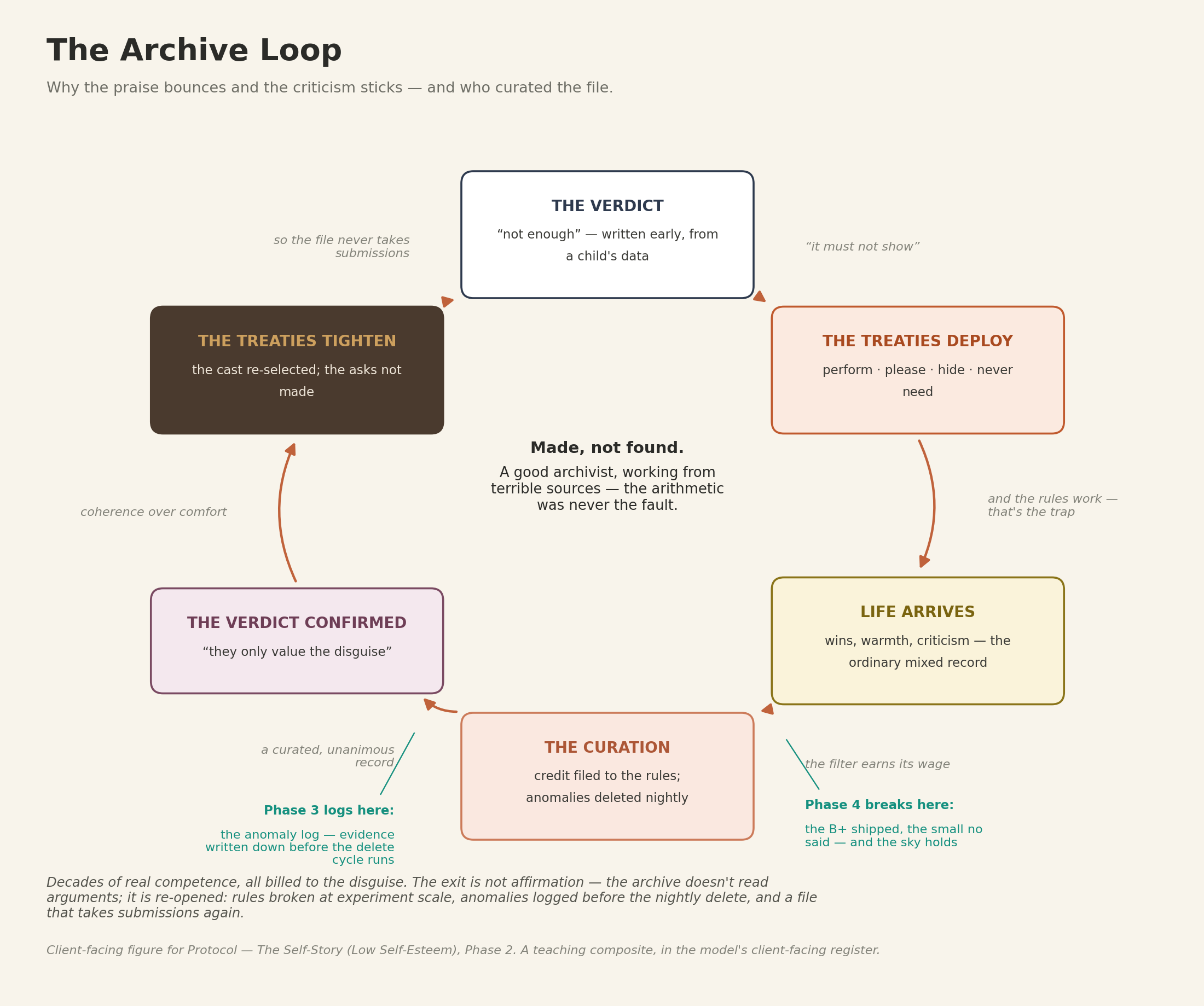
The loop's mechanics, the two intervention points (Phase 3 retires the prosecutor's filings; Phase 4 breaks the treaties at experiment scale), and the dignity line at the center. And the flag: "We will not be arguing you into liking yourself — the part of you that keeps the file doesn't read arguments, and affirmations are arguments in a warmer font. We're going to re-open the archive and let it log what actually happens."
Phase 3 — Floor 2 first, because floor 2 is the prosecutor
- The critic's job description. The inner prosecutor is a policy, not a truth-teller, and the policy has a function the client can name: pre-empt others' contempt by getting there first; whip the performance that keeps the treaty; enforce the humility that once kept a child safe at a table. Honor the function — it was protection — then audit the contract: is the whip producing what it promises?
- Cost accounting — the motivation audit. The charter says self-criticism maintains standards; the record says the client's best work happens despite the prosecutor, not because of it, and the whip's actual yields are procrastination, hiding, and the flinch. Run it as data: a week of output under the ordinary regime, read honestly; then Phase 5's compassion trial as the two-condition comparison.
- The double-standard instrument, in writing. The friend test run formally: the client's own situation, transposed onto a named friend, verdict written — then the two verdicts laid side by side. The gap is the finding: the client owns a working standard of fairness and exempts exactly one person from it.
- The anomaly log. Fennell's positive-data log with the model's rationale stated plainly: this is not affirmation, it is counting — evidence the filter would delete, written down before the nightly delete cycle runs. Three entries a day, however small, logged like lab data. The prosecutor will call it cheating; the response is the flag from Phase 2 — we're re-opening the archive, and archives log.
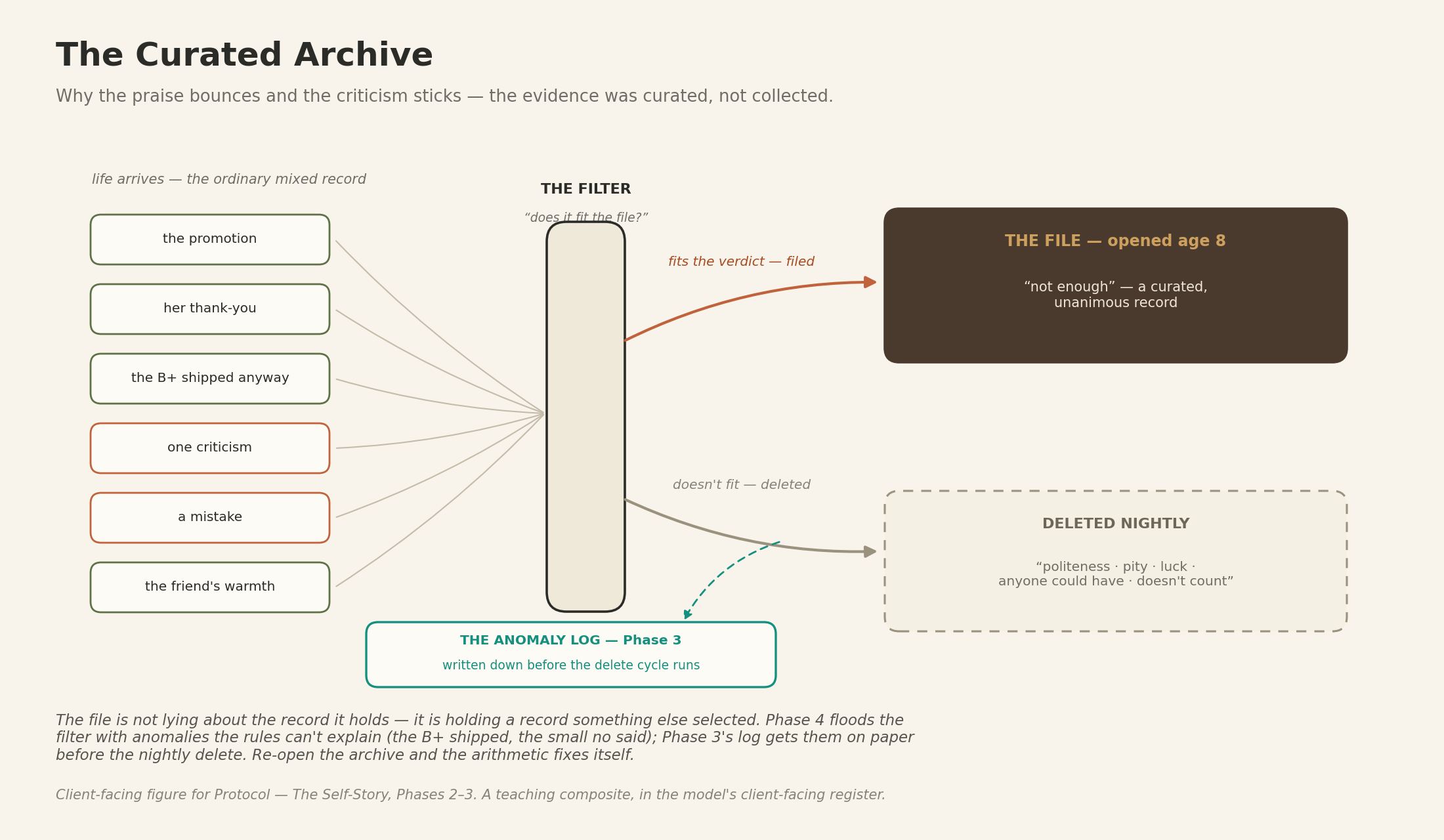
The curated archive — the filter, the file, the bin, and where the log intercepts.
Deliverable: consent to the experiment. "We're testing the treaties, not your worth. Your worth was never on the table — that's the finding the file has been blocking."
Phase 4 — Interrupt the furnace (floor 5): the treaties tested
The rules for living, broken at experiment scale, six-step format (prediction named → confidence rated → written before → smallest real test → compared out loud → "how many times before the rule revises?"):
- The perfectionist ships the B+ draft, on schedule, unpolished — forecast: exposure, contempt, the end of the reputation — and reads what actually returns.
- The pleaser says the small no: "I can't this week" — forecast: the warmth withdraws — and counts what actually withdraws (the depression protocol's fawn experiment, run here for its identity payload).
- The self-sufficient one asks — for help, for a preference, for the window seat — forecast: burden, resentment, the debt called in.
- The invisible one takes space: the comment at the meeting, the disagreement voiced, the compliment answered with only "thank you" — no deflection, no repayment installment.
- The joker files a sincere sentence before the punchline.
The design rules as everywhere (Craske, pinned): sized so the machine shows up, varied across rooms and rules, run to the read-out. The finding, collected personally: the sky holds. The warmth mostly doesn't withdraw — and where it visibly increases, the reading is written twice, because the armor was manufacturing the very distance it blamed on the defect. The counterattack named in advance: reinterpret ("they were being polite"), filter (the log holds it), provoke caught live (the fishing, the audience-selection — the Swann move made visible: notice whose verdict you polled), and the cast wobble handled honestly: some relationships are invested in the old contract, and a partner who punishes the B+ draft or the small no is a finding — handled with care, supervision, and sometimes couples work, never with a unilateral demolition mid-protocol.
Session metric (§6.2): if nothing surprised the client, nothing changed.
Phase 5 — Supply the readings (the dimmer, the body, the water)
- The dimmer is the master experiment. The story's deepest clause is if they really knew me, they'd leave — so being accurately seen without contempt is the disconfirmation nothing else can substitute for. The therapy relationship runs it weekly (and the furnace will eat it on schedule: "paid to care" gets named and used, as everywhere). Then the ladder outward, one rung at a time per the one-page's rule — safest person, not the most important: one true thing shown, forecast, read. Shame dies in accurate company; the protocol engineers the company.
- The body's vote. The prosecutor is somatic — the flinch, the collapsed posture, the held breath — and the compassion stance runs as a two-condition experiment, not a vibe: two weeks of deliberate self-compassion practice (the tone the client would use with the named friend, applied on schedule) against the forecast "I'll go soft; the standards will collapse" — output and mood both read. The strong finding in the literature and usually in the ledger: standards survive; the flinch doesn't.
- The water metered. Floor 8 runs an IV drip into this riser: the comparison feeds, the metric dashboards, the family gatherings priced in achievements. The feed audit runs like the caffeine audit — dose counted, two-week reduction trial, mood read — and the family table gets named for what it is: the water the story was written in, revisited annually.
Phase 6 — The ignition scenes, if Phase 1 found them (it usually did)
This riser nearly always has scenes — the verdict has a birthday, and often an address. Where experiments move behavior but the verdict re-asserts dateless ("I know it's not true, but it's true" — the exact tell of a floor-6 prior under a floor-3 insight), the scenes need activation-plus-mismatch: revisited while regulated, the child's conclusion honored as the best available science of an eight-year-old — and formally retired on the adult's evidence; the report card re-read by someone who now knows what a child is; the comparison re-tried with the full record in. Within scope and supervision, or by referral until licensure; where the scenes are abuse, Protocol — PTSD leads. The update this phase writes is the one Phase 7 consolidates: the sources were wrong, and the archivist was never the defect.
Phase 7 — Consolidation up the building
Now floor 1 writes — and in this protocol that is the home floor, so the re-authoring is the centerpiece, not the epilogue: the old bottom line and the new one both written, in the client's words, from the client's ledger. The new one is deliberately modest and evidenced — not I am amazing (a forecast the machine would rightly refuse) but I am ordinary in the way everyone is ordinary: worth not on trial today — made, not found, and said out loud. The treaties renegotiate into preferences: excellence chosen, kindness chosen — same behaviors, opposite contract, because chosen excellence can ship a B+ on a tired week without a constitutional crisis. The cast gets its honest accounting: which relationships renegotiated, which are outgrown, which seats at which tables get taken differently now. The desert move runs at full depth — the readings were real; deserved was forged. And both dials get their legal channels: mattering fed by contribution and contact done visibly, as themselves; rank fed by real competence owned in daylight, with the reference class swapped from the feed to the field.
Phase 8 — Relapse as forecast, not failure
The old story re-asserts under load and in the old rooms — and the model says so in advance: the file re-opens in the building where it was written, so the parents' kitchen at Thanksgiving, the reunion, the performance review will each re-run the render, on schedule. The written flare protocol: the sentence rehearsed (that's the old forecast; the ledger says otherwise); the anomaly log resumed same day; one deliberate rule-break inside the week; the asking-count checked. Early-warning signature named while well: the apology creep, the deflected compliments, the asking-count falling, the feed hours rising, the B+ drafts polished at midnight again. Booster sessions are maintenance, not failure. Close by reviewing the numbers — the Rosenberg arc, the prosecutor count, the asking-count — as the story of the treatment.
Two therapist-side rules, all phases
- Never argue with the verdict — and be careful with praise. Affirmation is this riser's classic malpractice: the compliment gets immunized on contact, and — Swann's own data — disconfirmation delivered too warm, too fast, too soon reads as unsafe (the therapist who likes me is a therapist who doesn't know me), and the client who feels misread leaves. Titrate warmth to tolerance; let the ledger do the praising; be the one audience whose accuracy the client cannot impeach — seen precisely and kept anyway is the dimmer's whole cargo.
- Match the tempo, and watch the transfer rule — and don't prescribe your own cure. The one-page's third discipline lives in this protocol: if striving saved you, the temptation is to hand this client the climb — but the climb is usually their treaty already, running at full tension. The process outlives syndromes: the depression lifts, the anxiety quiets, and the verdict waits — which is why this module runs wherever the drawer finds it load-bearing, and why its costume changes (perfectionism at work after the pleasing retires at home) are forecast before they arrive.
Pin targets
| Lead | For | Status |
|---|---|---|
| Swann & Read 1981; Swann et al. 1992 | self-verification — the story defends itself; the cast; the flight risk | PINNED |
| Kube et al. 2019 | immunization at the identity level — why praise bounces | SUPPORTIVE — not settled. Two experimental studies (2019); a 2024 replication from the same group failed on one manipulation. Cite as evidence for the move, not proof of it. |
| Joiner & Metalsky 2001 | reassurance-seeking / criticism-fishing — the provoke move | PINNED |
| Craske et al. 2014 | expectancy-violation design rules | PINNED |
| Fennell 1997; 1998 | the bottom line; rules for living; the anomaly log — the chassis | unpinned |
| Rosenberg 1965 | the running instrument | unpinned |
| Gilbert, compassion-focused therapy | Phase 5's stance and its evidence | unpinned |
| Neff, self-compassion program | Phase 5's two-condition trial | unpinned |
| Orth & Robins, self-esteem trajectories | development and prognosis — background | unpinned |