Protocols › Protocol — Chronic Pain
Protocol — Chronic Pain
Protocol19 August 2026. Filed in Clinical Tools beside the Decision Aid and the other protocols. Honesty label, in the appendix spirit: made, not found. This is a model-derived reorganization of components that existing pain treatments have tested separately — pain neuroscience education (the Moseley & Butler lineage), pain reprocessing therapy and its attention retraining (Ashar, Schubiner), graded activity and graded exposure for fear-avoidance (Vlaeyen), the CBT-for-pain and acceptance outcome bases, and the operant pacing tradition (Fordyce). The sequence is the model's contribution (medical gate closed → riser profile → the re-addressing → gatekeeper → armor → readings → ignition → consolidation → flares as forecast), and the sequence has no outcome data of its own. The scope line, stated before anything else: this protocol treats nociplastic pain — pain produced by a protection system running at the wrong gain — and it begins only after a physician has done the sorting. It is not a workup, it never overrules one, and a student runs it under supervision with the medical partnership standing for the duration. Companions: floor-notes/Floor 7 — Body and Interoception, floor-notes/Floor 3 — Propositional Beliefs, floor-notes/Floor 5 — Scripts and Behavior, the furnace (§2.3), and the Craske, Kube, and Sterling pins in the ledger.
The formulation in one line
Chronic pain presents as floor 7 and is floor 7 — but the engine is a forecast, not a damage report: a protection verdict issued at maximal precision from minimal signal, held in place by floor 3's fragility sentences, enforced by floor 5's guarding armor, patrolled by floor 2's flare-forecasting sentry, soaked in floor-8 water that equates hurt with harm — and the treatment closes the medical file once, honestly, and then re-addresses the forecast, because this is the one riser in the drawer where the model's central claim is true all the way down to the tissue.
The model's distinctive reading
Three claims organize everything below.
The pain is real, and it is a forecast. All pain — every pain anyone has ever felt — is produced by the brain's protection system; the body sends signals, and the system decides what they mean and whether to sound the alarm. In acute injury the alarm tracks the damage and the system works as designed. In nociplastic pain the alarm has come loose from the tissue: the injury healed on schedule, and the forecast did not — the system now predicts damage from signals that no longer carry it, renders the prediction as pain, and the render is fully real, produced by the same machinery that produces every real pain, at the wrong address. Hurt and harm have come apart. Nothing about this is imaginary, exaggerated, or weak, and the protocol says so in the first session, because the client has usually spent years being told the opposite in both directions — it's all in your head from one office, degenerative changes from another — and both sentences feed the machine.
Protection is the engine. The armor manufactures the evidence that keeps the forecast funded. Guarding and bracing change how the body moves until movement becomes genuinely harder. Rest deconditions until ordinary load produces extraordinary signal. Scanning turns the gain up — attention aimed at a sensation with fear in the lens amplifies exactly what it monitors. Avoidance shrinks the life until the map itself testifies to fragility. And the prepayment move runs everywhere: the outing declined before the pain arrives, the brace worn in case, the day pre-canceled — the cost paid early, which teaches the forecast it was right without ever letting it be tested. Every braced movement files "survived because I was careful." The boom-bust cycle closes the loop from the other side: the good day overspent, the crash, and the crash filed as proof.
The verdict does not yield to the fact sheet. Explaining pain is the ignition key, not the engine. The machine updates from safety experienced during the feared signal, not from argument — the same rule as everywhere in the drawer, at its most literal: the reading that retrains the system is attention aimed at the sensation through the lens of safety while the body is doing the feared thing. Somatic tracking is the reading; graded return is the experiment; the surprise metric is the readout. The fact sheet's job is to make the experiment possible — to give the client a hypothesis worth testing against my spine is crumbling — and then the experiments do what facts cannot.
Phase 0 — The gates (the medical file: opened once, thoroughly, then closed)
Medical sorting is the physician's lane, and it comes first, completely. Red flags — progressive neurological deficit, bowel or bladder change, unexplained weight loss, fever with spinal pain, significant trauma, cancer history, age-atypical onset — belong to medicine, and this protocol does not begin until a physician has determined that the presentation is nociplastic or nociplastic-dominant. Then the file closes, on the panic protocol's rule: it re-opens for genuinely new symptoms, never for louder versions of the assessed ones — because a file that re-opens on volume is a checking ritual with a stethoscope, and the health-anxiety machinery will run it.
The three mechanisms, sorted honestly. Nociceptive pain reads real ongoing tissue trouble; neuropathic pain reads damaged signal wiring; nociplastic pain is the alarm at the wrong gain. Mixed pictures are the norm, not the exception — an arthritic knee can carry a nociplastic amplifier on top of its arthritis — and the protocol treats the nociplastic share while medicine manages the rest. Where pain is tracking live damage, the forecast is accurate, and aiming this protocol at it would gaslight a working alarm. That is the reason the gate is absolute.
Mood and risk. Depression screening at the depression protocol's standard, because the comorbidity is the rule and the suicide risk in chronic pain is documented and real — screened plainly, monitored, safety-planned where indicated, crisis resources in writing (in the US, 988). The Joiner pin stands behind the assessment.
Opioids and dependence. Where opioids are in the picture, the prescriber holds the taper lane and every decision in it; this protocol works alongside, never freelances, and treats the fear inside a taper (the forecast I cannot survive without it is a forecast, and it gets the same respect and the same testing as every other). Where use has crossed into a use disorder, Protocol — Addiction joins the case.
The compensation context, named without contempt. Litigation, disability determination, and workers' compensation build real contingencies into the field. The protocol names them as formulation data — competing forecasts about what recovery costs — and never as a character verdict.
Deconditioning and comorbidity. Where disuse is severe or the medical picture is loaded, the graded return runs in partnership with physical therapy — the protocol supplies the engine and the address; the PT supplies the dosing expertise.
Phase 1 — Locate and formulate (the riser profile)
The five questions, asked in the model's order. WHERE does the problem live? (Floor 7 is the engine; floors 3, 5, and 2 are its staff — and the profile maps each: the verdicts, the armor, the sentry.) WHAT'S THE LEVER? (How available is protection, not damage as a hypothesis — glass or concrete? Years of scans and diagnoses harden it; one honest "your imaging is common in pain-free people" from a trusted physician softens it.) WHAT'S THE OBSTACLE? (Fear of movement; the fragility identity annexing floor 1; the invisible-illness battles — the years of not being believed, which make the forecast framing arrive as one more disbelief unless the dimmer work runs first.) WHAT ARE THE CONDITIONS? (Does the client feel believed in this room? Nothing proceeds until yes.) WHAT'S AT STAKE? (The life the pain has annexed — named concretely, because its return is the outcome measure that matters.)
The inventory: the pain's map and history, with the healing-time honesty (tissue heals on biological schedules; pain that outlives them by years is telling you about the alarm, not the tissue); the protection inventory — guarding, bracing, rest rules, gadgets, the canceled list; the flare forecasts verbatim (if I lift that, I'm done for a week); the boom-bust signature; the workup history counted and closed; the verdicts written down in the client's words (my spine is crumbling; I'll end up in a wheelchair; my body is broken) — they are Phase 5's targets. Sleep logged; Protocol — Insomnia is the junior module here as everywhere, and pain-sleep runs both directions. Baselines: pain intensity and interference (BPI), catastrophizing (PCS), movement fear (TSK), and the life-shrinkage map, drawn honestly.
Phase 2 — Teach the client the machine
Client-facing telling, in the model's images, and the dignity move leads: the pain is real — all of it, every time, produced by the same protection system that produces every pain — and the system is not broken; it is doing protection's job with a wrong forecast. The smoke-alarm telling: after a real fire, a good alarm gets recalibrated toward caution; yours now reads toast as fire. The render line, from the paper's spine: the body sends signal; the system renders meaning; you feel the render. Hurt is the render; harm is the tissue; they can come apart, and in you they have.
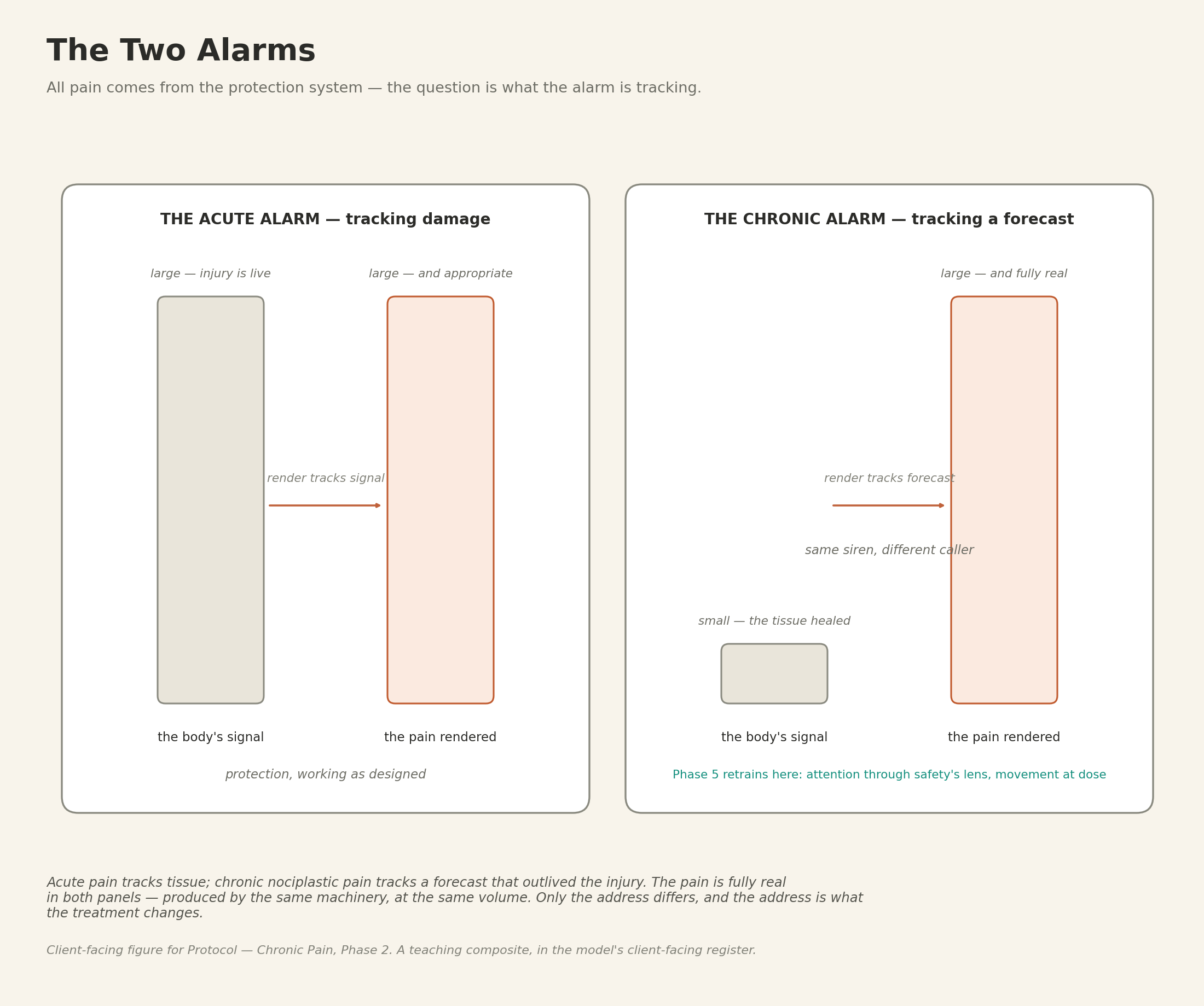
The two alarms — acute pain tracking damage, and the chronic alarm rendering a forecast after the tissue has healed. Same siren, different caller.
Then the claims that reorganize everything, stated flat: the pain is a protection verdict, not a damage report — and protection verdicts revise on evidence of safety, which we can manufacture on purpose.
Draw the loop for the session:
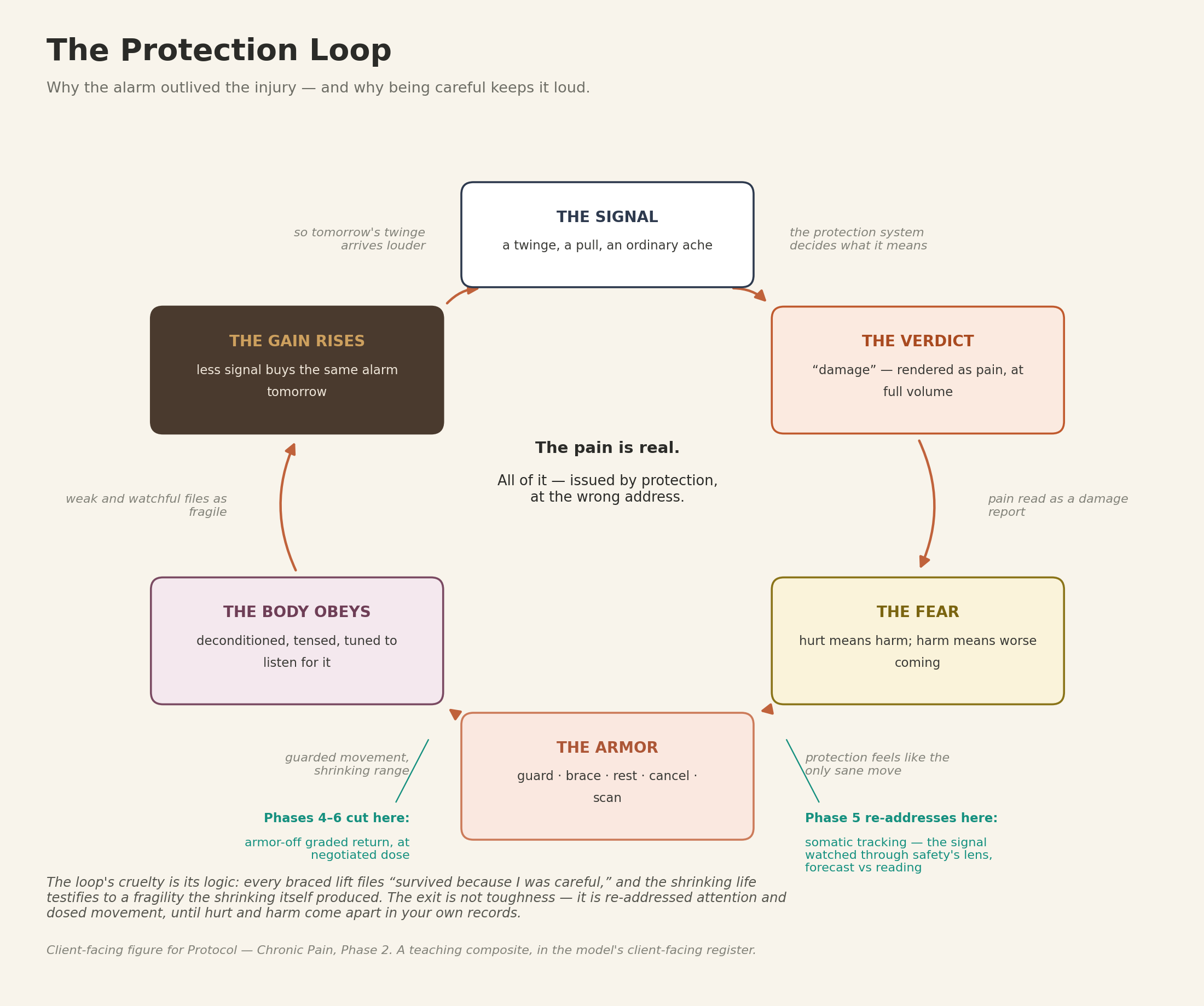
The loop's mechanics, the intervention points (Phase 5 re-addresses the verdict; Phases 4 and 6 retire the armor that feeds it), and the dignity line at the center. And the flag, stated before it is needed: "If any of this lands as 'it's in your head,' we stop and repair — the claim is the opposite. It is in your protection system, which is as physical as bone, and it is the only place any pain has ever lived."
Phase 3 — Retire the gatekeeper's rules (floor 2)
The sentry work, in pain's costume:
- The flare forecaster, audited. Catastrophizing is floor 2 running disaster film in advance — this twinge is the disc going; this flare means the good months were a fluke. The two-minute test adapts intact: did the forecasting change the reading, or just turn the gain up while the day disappeared? Forecast accuracy gets a ledger of its own — the predicted wheelchair has a no-show record the machine never audits.
- The scanning policy. Body-scanning is attention with fear in the lens, and it amplifies what it monitors — the deadband gets re-taught: sensation is not summons; checking feeds the gain. The health-anxiety machinery is this riser's first cousin, and where symptom-googling and reassurance loops run, that protocol's rules apply verbatim.
- The circling policy. Why me, what did I do, what did they miss — the orbit that feels like problem-solving and functions as avoidance of the one project that updates anything. Named now, replaced by Phase 5's readings.
Phase 4 — Interrupt the furnace (floor 5, the armor)
The armor retires by experiment, never by decree, in the house six-step format (prediction named → confidence rated → written before → smallest real trial → compared out loud → "how many times before the rule revises?"): the brace left home, the cushion ritual skipped, the guarded lift done at negotiated load, the stairs taken, the sitting-through survived. Craske's rules as everywhere — expectancy violation, varied contexts, run to the readout. Two pain-specific structures get named to the client in advance:
- The boom-bust trap and the pacing trap, both. Boom-bust is provoke-and-crash: the good day overspent until the crash re-files fragility. Pacing is the honest floor under it — activity dosed by plan, not by pain — and pacing can quietly become the armor, a permanent ceiling wearing a clinical name. The protocol's rule: pacing is scaffolding, and scaffolding comes down on a schedule the experiments set.
- The counterattack, named in advance. Filter (good days uncounted — "just a good day"); reinterpret ("survived because I was careful" — answered by variation and armor-off trials); prepayment (the pre-canceled plans — caught at the calendar, where it is visible); withdraw effort (the life shrunk to the safe rooms — annexed territory gets repatriated early, because morale is treatment and the map is the outcome).
Phase 5 — Supply the readings (floor 7, and the verdicts)
- Somatic tracking — the reading itself. Attention aimed at the sensation, on purpose, through the lens of safety and curiosity: located, described in sensation words (pressure, heat, band, wave — never damage words), watched while it moves, wobbles, breathes. Run first at rest, then during graded movement — which is the engine: activation-plus-mismatch, the feared signal present while the system's own attention files "safe." The surprise metric is the readout, run out loud: forecast written before (it will spike and stay), reading compared after (it rose, wandered, dropped — it behaved like weather, not like damage).
- The verdicts retried on the accumulating ledger. My spine is crumbling meets the imaging honesty, the no-show record, and the lift that happened; floor 3 revises on evidence, in the six-step format, at the tempo evidence permits.
- The emotional lane, opened honestly. Suppressed load runs the gain up — stress physiology and the furnace's held charge are amplifier inputs, and in this population the anger file (at the injury, the system, the years) is usually full and usually unopened. The dimmer work applies: one safe person, one true sentence, ladder-first. And the therapy relationship carries the first disconfirmation this riser needs: an authority who believes the pain is real while believing it can change. Both halves, said plainly, early, and kept.
Phase 6 — The ignition scene (the feared movement, at full formality)
The centerpiece the earlier phases built toward: the client's emblematic feared movement — the bend, the lift, the run, the full workday, the long drive — met at negotiated dose, with the new address spoken during the signal (loud, and safe — protection, not damage), tracking running, armor off, repeated across sessions until the machine files it. Design rules: chosen with the client from the flare-forecast list (the movement the verdict says is impossible carries the most updating power per repetition); dosed to be survivable and real; debriefed in the six-step grammar. The tell that the address changed: pain that arrives without fear arriving with it — and then, on the timeline the outcome literature describes and the protocol promises honestly (often, not always), intensity following precision downward: the alarm quieting once nobody answers it as fire.
Phase 7 — Consolidation up the building
Floor 3 retries the fragility sentences formally against the ledger. Floor 1 re-authors: the broken one becomes the one whose alarm learned the war was over — and the sick-role identity is dismantled gently, because it was annexed, not chosen, and it organized years of life. Floor 8 gets named: the family's model of illness, the workplace's economy of visible injury, the culture's hurt-equals-harm equation, the medical odyssey itself — the years of "nothing is wrong with you," re-sentenced honestly as everything was real, and the address was different. The repatriated life gets lived in, on the calendar, at increasing load — because a quiet alarm in a shrunken life is half a result, and the map is the measure. The flare protocol is written now, while things are good.
Phase 8 — Flares as forecast, not failure
Flares will come — stress, sleep debt, weather, anniversaries of the injury, ordinary overload — and the model says so in advance: a flare is the alarm re-checking under load, not the injury returning. The written flare card, three rules: the medical file stays closed for old symptoms (new symptoms see the physician; louder old ones see the protocol); move within days — the perimeter only re-annexes evacuated ground, so the gentlest version of normal life resumes on a named date; run one tracking session — the reading, not the scan. Early-warning signature named while well: the brace quietly returning, the calendar thinning, the googling resuming, sleep fragmenting. Boosters are maintenance, not failure. Close on the baselines — the PCS and TSK arcs, the map re-expanded — as the story of the treatment.
Two therapist-side rules, all phases
- Never argue with the verdict — and never argue with the pain. The pain's reality is conceded in full, first, forever; one flicker of "it's not that bad" or "it's psychological" switches the dimmer off for good in a population that has been disbelieved for years. The address is what gets tested — by experiment, on the client's own ledger, never by debate. And the clinician's own conviction is data read at maximal precision: hedged, apologetic delivery of the forecast claim reads as doubt, and the machine files doubt as danger.
- Match the tempo, and watch the transfer rule. Dose by the window, not the ambition — a crash after an oversized experiment funds the fragility verdict for months. Expect the machinery in adjacent costumes: the same protection logic in the health anxiety, the perfectionism, the relational guarding — one system, many dialects, worked per the Decision Aid's loop. Sleep never waits its turn. And expect grief when the alarm quiets — the lost years arrive for mourning exactly when the system finally has room for them; schedule the room.
Pin targets
| Lead | For | Status |
|---|---|---|
| Craske et al. 2014 | expectancy violation — Phases 4–6 design rules | PINNED |
| Kube et al. 2019 | expectation persistence and immunization — the reinterpret move | SUPPORTIVE — not settled. Two experimental studies (2019); a 2024 replication from the same group failed on one manipulation. Cite as evidence for the move, not proof of it. |
| Sterling (allostasis) | prediction-first physiology — the render claim's frame | PINNED (paper) |
| Joiner | the risk assessment's frame | PINNED |
| Sleep block (Riemann; Espie; Harvey) | the junior module | PINNED (ledger) |
| Ashar et al. 2022, JAMA Psychiatry | pain reprocessing therapy RCT — Phases 5–6's nearest outcome base | unpinned |
| Moseley & Butler, Explain Pain lineage | Phase 2's telling; hurt-vs-harm | unpinned |
| Vlaeyen & Linton 2000 | fear-avoidance model — the loop's clinical lineage | unpinned |
| Woolf 2011 | central sensitization — the gain claim's mechanism | unpinned |
| Kosek et al. 2016 (IASP) | the nociplastic category — Phase 0's sorting | unpinned |
| Sullivan et al., PCS; Kori et al., TSK | the running instruments | unpinned |
| Fordyce | operant tradition — boom-bust, pacing, and the pacing trap | unpinned |
| Lumley & Schubiner (EAET) | the emotional lane's outcome base | unpinned |