Protocols › Protocol — Prolonged Grief
Protocol — Prolonged Grief
Protocol19 August 2026. Filed in Clinical Tools beside the Decision Aid and the other protocols. Honesty label, in the appendix spirit: made, not found. This is a model-derived reorganization of components that existing grief treatments have tested separately — complicated grief treatment (Shear; the strongest RCT base in this drawer's neighborhood), the cognitive-behavioral model of prolonged grief (Boelen), the exposure and behavioral-activation lineages, the dual-process model (Stroebe & Schut), and the continuing-bonds literature. The sequence is the model's contribution (the time gate → riser profile → the re-addressing → gatekeeper → the two armors → deliberate encounters → ignition → the bond revised → waves as forecast), and the sequence has no outcome data of its own. The scope line, stated before anything else: this protocol refuses to treat grief that is simply grief. Mourning is not a disorder, most people complete it with accompaniment and time, and the time gate below is diagnostic law, not a suggestion. A student's lane is the gates and the accompaniment; the confrontation work at the center runs under supervision. Companions: floor-notes/Floor 4 — Relational Templates, floor-notes/Floor 6 — Procedure and Emotion, the furnace (§2.3), Protocol — Depression (the differential), Protocol — PTSD (the two-files rule), and the Craske, Kube, and Joiner pins in the ledger.
The formulation in one line
Prolonged grief presents as sorrow that will not move, but the engine is floor 4 — a relational template still issuing predictions for a person the world no longer contains — kept unrevised by floor 5's twin armors (avoidance of the absence, and ritual proximity to the presence), policed by floor 2's betrayal gatekeeper (updating is abandoning), narrated by floor 1 as a story that cannot be told to its end, in floor-8 water that schedules mourning and then punishes both the fast and the slow — and the treatment lets the template meet the evidence at a survivable dose until the forecast revises, which is not forgetting; it is filing.
The model's distinctive reading
Three claims organize everything below.
Grief is the update; prolonged grief is the update refused. The template encoded the person at the deepest layer the machine has — will be there, will answer, will come home — and the encoding ran for years or decades at maximal precision, confirmed daily. Death deletes the person from the world but not from the predictor. So every reminder is a collision: the machine renders presence, the world returns absence, and the pang is the prediction error — the love's machinery meeting the fact. Healthy mourning is thousands of these collisions, each one filing a little of the revision, which is why it hurts in waves and why it slowly changes. Prolonged grief is the collisions prevented: the error fires and updates nothing, so year three hurts like week three — gone from the world, undiminished in the forecast. The machine's cruelest feature here is its most loyal one: it keeps predicting the person because it learned them so well.
Both armors serve the same refusal. The obvious armor is avoidance — the room unentered, the photographs boxed, the name unspoken at dinner, the grave unvisited — which starves the update of evidence. Its opposite twin is the shrine — the room unchanged, the voicemail replayed nightly, the texts still sent, the place still set — which feeds the template's still here forecast directly. The model reads both as one move: protecting the template from the revision. This is the reading that reorganizes the clinical picture, because the family usually attacks one armor while the client holds the other, and both sides are right about the other's armor and wrong about the mechanism — and because the treatment for both is the same: dosed, deliberate contact with the evidence.
The gatekeeper's verdict is betrayal, and it is never argued with. If I stop grieving, I abandon them. If the pain fades, the love fades. Healing is forgetting. The client is not failing to accept the death; they are refusing to file it, because filing feels like performing the death themselves — a second killing, done by their own hand. The protocol's answer is never argument; it is the experiment: test what filing actually costs the love. The finding — run, never promised — is the treatment's deepest result: the bond survives the update. Love does not need the wrong forecast. What comes out the far side is not absence of relationship but a revised one: the person carried, instead of expected.
Phase 0 — The gates (the calendar first, and the heaviest risk work in the drawer)
The time gate, absolute. Acute grief is not a disorder at any intensity. The diagnostic lines are stated honestly — DSM-5-TR's prolonged grief disorder requires twelve months (six for a child's bereavement); ICD-11 draws it at six — and this protocol does not open before the client's own tradition and calendar have been read, because floor 8 sets mourning's tempo differently across cultures and the manual's clock is not the only clock. Before the line: accompaniment, practical help, normalization, and no protocol — pathologizing normal mourning is the specific harm this gate exists to prevent. The protocol begins where mourning has demonstrably stalled: the acute picture unchanged, the life unreclaimed, the criteria met.
Risk, at this drawer's maximum. Suicide screening at the depression protocol's full standard, with one addition specific to this riser: reunion ideation — I just want to be with them — asked about plainly and sorted carefully, from passive longing through intent, because the spectrum is real and the sorting is not optional. Thwarted belongingness is this riser's native weather, and the Joiner pin stands directly behind the assessment. Means safety, escalation thresholds pre-agreed, crisis resources in writing (in the US, 988).
The depression differential, named. Prolonged grief's pain is yearning-shaped and person-shaped — it points at someone. Depression's is verdict-shaped and self-shaped — it points at the client. They co-occur freely, and where both are present both get treated, Protocol — Depression alongside, sequencing per supervision.
The two-files rule. Where the death was violent, sudden, or witnessed, two files exist: the scene and the absence. The unfiled scene blocks access to the unfiled loss — you cannot mourn a person while the machine is still mid-emergency about how they died — so Protocol — PTSD's machinery runs first or alongside, and the imagery of the death is handled under its treaty rules, not this protocol's.
Circumstance honesty. Suicide bereavement carries its own weather — the shame, the anger that feels forbidden, the endless why — and its own supports, named and offered. The ambivalent or estranged relationship complicates the template with an unfinished quarrel: grief for a person one also raged at files slowly, and the protocol makes room for both truths without forcing a verdict. Caregiver relief-guilt — the exhale after a long dying, prosecuted by the client as a crime — gets the desert move early.
The medication boundary. No medication treats grief. Comorbid depression's pharmacology is the prescriber's lane, routed as always.
Phase 1 — Locate and formulate (the riser profile)
The five questions, and then the inventory this riser needs:
- The template's contents. Not just who died but what the template held: the only witness to the client's history, the organizer of every holiday, the one who called first, the person whose imagined verdict still runs the client's decisions. The treatment must know what offices the dead held, because Phase 7 redistributes them.
- The death, at headline resolution. Told with the PTSD protocol's handle rule where it runs hot: labeled, not opened, the client holding the depth control from minute one.
- The two-armor inventory. What is avoided (rooms, dates, songs, people, the grave) and what is enshrined (the untouched closet, the replayed voicemail, the still-active phone plan) — collected without a flicker of judgment, because both lists are love's handwriting.
- The betrayal verdicts, verbatim. Moving on means he didn't matter. If I laugh, I've forgotten her. These are Phase 3's targets and Phase 6's experiment.
- The calendar. Anniversaries, birthdays, the diagnosis date, the date itself — mapped in advance, because Phase 8 plans them and ambush is the alternative.
- The ecology. Who else is grieving, how the family's armors interlock, and what the world did — the casseroles that stopped at month two, the friends who crossed the street, the workplace's three days of leave: floor 8's mourning deadline, named as water, not as the client's failure.
Baselines: PG-13 or ICG, PHQ-9 with the item-9 follow-up standing, sleep log, and the life-shrinkage map — what the loss has annexed, drawn honestly.
Phase 2 — Teach the client the machine
Client-facing telling, in the model's images, and the dignity move leads: the pang is not a malfunction and not a verdict that you are stuck — it is the love's machinery meeting the fact, which is the update trying to happen. The predictor telling: for thirty years your machine learned him — his tread on the stairs, his side of the bed, the pause before he answered — and it learned him so well that it still renders him. Death removed him from the world; nothing has yet removed him from the forecast. That collision you feel at the supermarket is the machine doing the only thing it knows: predicting the person it loved, and meeting the aisle where he isn't.
Then the claims that reorganize everything, stated flat: grief is the update arriving in waves — and the waves are survivable, and they crest. The pain is not the enemy of the love; the pain is the love, doing accounting.
Draw the loop for the session:
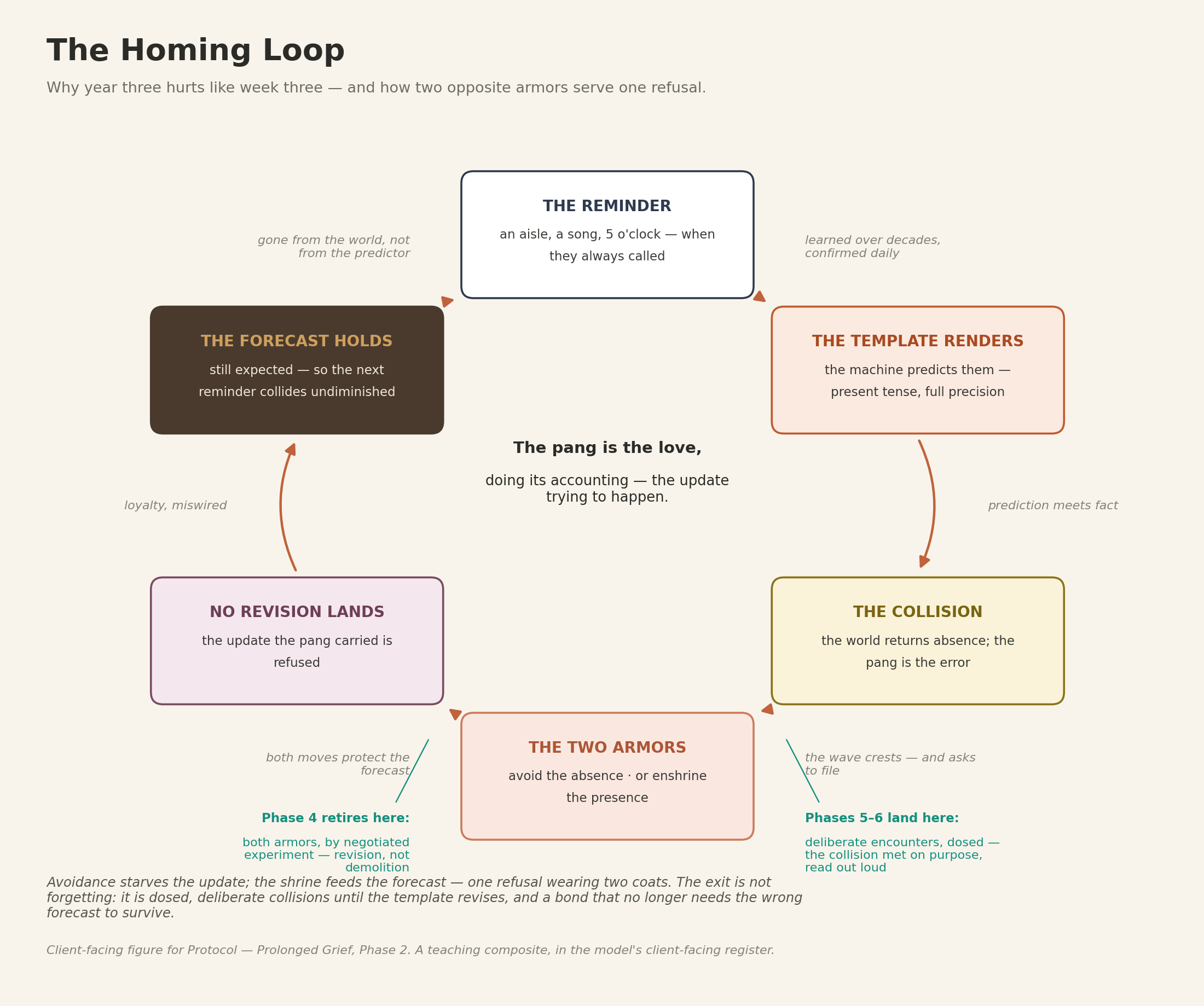
The loop's mechanics, the two armors feeding the same refusal, the intervention points (Phase 4 retires the armors; Phases 5–6 let the collisions land), and the dignity line at the center.
And the honest curve, drawn beside it:
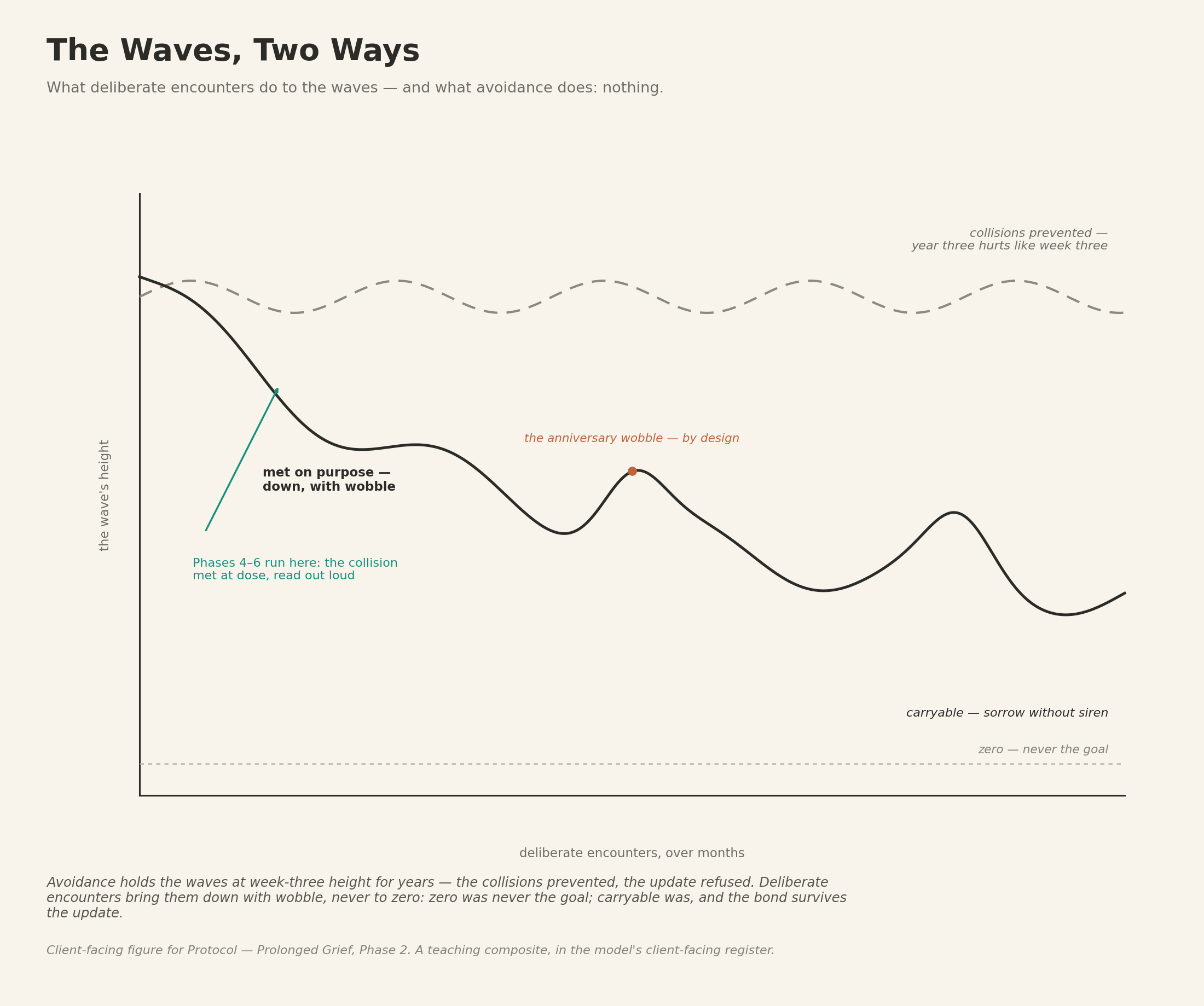
What deliberate encounters do to the waves over time — down, with wobble, never to zero — and what avoidance does: nothing. Zero was never the goal; carryable was.
The flag, which in this protocol is a promise: "Nothing in this room forgets them. Filed is not erased — filed is carried instead of expected. If any of this ever lands as 'get over it,' we stop and repair, because the aim is the opposite: a bond that no longer needs the wrong forecast to survive."
Phase 3 — Retire the gatekeeper's rules (floor 2)
- The betrayal gatekeeper, named — never debated. Updating is abandoning is the riser's load-bearing belief, and it is treated as Phase 6's experiment, not tonight's argument. For now it is surfaced, written verbatim, and honored as what it is: loyalty, miswired.
- The counterfactual circling. If I'd made him go to the doctor — if I'd called that morning — why didn't I see it — the orbit that feels like duty and functions as avoidance, circling the loss instead of entering it. The depression protocol's two-minute test transfers whole: has any lap of this orbit ever produced anything but the same sentence at higher volume? The guilt gets sorted honestly: the rare accurate remainder is handled with the moral-injury logic — accurate sizing, amends where any exist, meaning — and the rest gets the desert move: the loss was real; deserved was the forged signature.
- The wave protocol, taught early. For the ambushes — the aisle, the song, the handwriting on an old list — the deadband work: the wave crests; ride it where it found you, or postpone the full visit to a chosen hour, but do not build a life around never being found.
Phase 4 — Retire the two armors (floor 5, the furnace)
Both armors retire by negotiated experiment, never by decree, in the house six-step format (prediction named → confidence rated → written before → smallest real trial → compared out loud → "how many times before the rule revises?"):
- The avoidance armor: the room entered, the box opened at dose, the name said at dinner, the photograph returned to the shelf, the grave visited — smallest survivable first, ladder upward.
- The shrine armor, revised at dose: the voicemail kept but not replayed nightly; the closet sorted one shelf at a time, with chosen keepings; the place at the table sometimes filled. Revision, not demolition — the protocol distinguishes ritual that serves the bond from ritual that serves the forecast, and the client makes the call, item by item.
- The oscillation legitimized. The healthy rhythm alternates — hours in the loss, hours in the life — and neither is a betrayal of the other (the dual-process finding, pinned below). The good hour gets counted on purpose, because the furnace's filter discards it as disloyalty.
- The counterattack, named in advance. Filter (the laugh uncounted, the good day reclassified as forgetting); reinterpret ("I only coped because I stayed busy"); provoke (the fight on the anniversary — the furnace manufacturing familiar weather); withdraw effort (the invitations declined until they stop coming — the world's evidence of continued life, evacuated); prepayment (the future losses pre-grieved, the new closeness refused because it too will end — named when it appears, because it is the template generalizing its wound).
Phase 5 — Supply the readings (the deliberate encounter)
The house reading, in this riser: the collision run on purpose, at chosen dose, with the surprise metric out loud. Forecast written before: I will not survive the photo album. Reading compared after: I wept for ten minutes; I showed my daughter the fishing picture; I laughed once; the wave crested and I was still at the table. Craske's rules as everywhere — varied, repeated, run to the readout.
And the telling as filing: the death's story told start to finish, aloud, repeatedly — Shear's revisiting, read by the model as the same engine as everywhere in the drawer, activation-plus-mismatch: the loss contacted while the present's evidence (a steady witness, a living room, a life still running) is in the room, until the story acquires a date and can be told without the siren. The dimmer carries its usual load: grief spoken in accurate company, ladder-first — the safest person, not the most important — because the floor-8 deadline taught the client that their grief is too much for people, and that forecast needs data too.
Phase 6 — The ignition scene (the heaviest door, and the true sentence)
The centerpiece: the heaviest avoided thing, met at full formality — the grave unvisited for three years, the closet, the restaurant, the song played through, the ashes finally addressed — planned like an expedition, dosed to be survivable and real, with the true sentence said out loud in the place: gone. Said while the love is also in the room, which is the entire design — the template meeting the fact at maximum signal, with the witness steady and the window held. Where the unsaid is the weight, the imaginal conversation runs here (Shear's tool, under supervision): the goodbye the death never allowed, the apology, the answer imagined honestly — not séance, rehearsal: floor 6 completing a procedure it was never allowed to finish. The tell that the filing took: the memory becomes visitable at will — sorrow without siren, the PTSD protocol's tell, transferred whole because the machinery rhymes: filed is not forgotten; filed is when it gets a date on it and stops being tonight.
Phase 7 — Consolidation: the bond, revised
The template is revised, never deleted — and the protocol says so in exactly those words, because this phase is what the betrayal gatekeeper predicted could not exist. Continuing bonds, on updated terms: the internal relationship rebuilt as counsel rather than expectation — what would she say carried deliberately, the birthday toast kept on purpose, the nightly voicemail retired by choice. The offices redistributed honestly: who organizes the holidays now, who gets called first, who witnesses — some offices go to the living, and some the client learns to hold alone, and the grief for each redistribution is legitimate. Floor 1 re-authors: the story told to its end and past it — widow, widower, the one who lost — permitted as a chapter, protected from annexing the book. Floor 8 honored: the tradition's mourning forms used where they serve (the yahrzeit, the ofrenda, the anniversary mass — the cultures that institutionalized deliberate encounters solved half this protocol centuries ago). And the life re-entered on the calendar, because the person cannot come back, and the client can.
Phase 8 — Waves as forecast, not failure
Waves forever, by design — and the model says so in advance: grief is not a task that completes; it is a tide that changes. The honest curve from Phase 2 is re-drawn at termination with the client's own data on it: down, with wobble, never to zero, and zero was never the goal. The calendar pre-planned: anniversaries met deliberately — the protocol's rule of thumb: meet the date before it meets you. The flare card: the wave protocol, one deliberate encounter within the week (evacuated ground re-annexes), the safe person's number, and the reminder in the client's own hand that a hard month is the tide, not the treatment failing. New losses will re-open this file and old ones — named in advance as the machinery working, not the work undone. Boosters at the hard dates. Close on the baselines — the PG-13 arc, the map re-expanded, the offices redistributed — as the story of the treatment.
Two therapist-side rules, all phases
- Never argue with the verdict — and never compete with the dead or hurry the love. The betrayal belief is tested by experiment, never debated at the whiteboard. The dead are spoken of with the client's own reverence, by name, in the tense the client chooses. And the therapist's face is data at maximal precision: any flicker of discomfort at tears reads as your grief is too much — the exact floor-8 sentence that built the armor — so composure here is not neutrality; it is the disconfirming evidence, delivered weekly.
- Match the tempo, and watch the transfer rule. Mourning has no deadline and the protocol has phases anyway; the tension is managed out loud, with the client holding the calendar. Expect the machinery in adjacent costumes: the pre-grieving of the living, the goodbye-avoidance at every airport, the new closeness kept at arm's length because it too will end. And expect the update to open old files — the mother lost at twelve arrives when the husband is finally mourned, because the machine files losses in the same drawer — the transfer rule at its gentlest and deepest, and it gets room, not a referral reflex.
Pin targets
| Lead | For | Status |
|---|---|---|
| Craske et al. 2014 | expectancy violation — the encounter design rules | PINNED |
| Kube et al. 2019 | expectation persistence — the reinterpret move | SUPPORTIVE — not settled. Two experimental studies (2019); a 2024 replication from the same group failed on one manipulation. Cite as evidence for the move, not proof of it. |
| Joiner | thwarted belonging; reunion-ideation assessment | PINNED |
| Sleep block (Riemann; Espie; Harvey) | the junior module | PINNED (ledger) |
| Shear et al. 2005; 2014 (JAMA; JAMA Psychiatry) | complicated grief treatment RCTs — the nearest outcome base | unpinned |
| Prigerson et al. | PGD criteria; PG-13 — the time gate and the instrument | unpinned |
| Boelen et al. 2006 | CBT model and trial — the loop's clinical lineage | unpinned |
| Stroebe & Schut 1999 | dual-process model — the oscillation legitimized | unpinned |
| O'Connor, The Grieving Brain | gone-but-also-everlasting — the predictor claim's flag | unpinned |
| Klass, Silverman & Nickman | continuing bonds — Phase 7's frame | unpinned |
| Bonanno | resilience trajectories — the time gate's science | unpinned |
| Jordan & McIntosh | suicide bereavement — the circumstance gate | unpinned |