Library › A Unified Clinical Model of Psychotherapy
A Unified Clinical Model of Psychotherapy
The mechanism, the map, and the moves — predictive processing for the working therapist
The design draws on predictive processing, a framework for how brains use prediction. It is a lens, not a validated treatment. What you are actually doing here is a written behavioral experiment.
CourageLoop is a notebook with arithmetic. It is not a therapist, not a treatment, and not a substitute for one. If you are in crisis, use the resources below.
A Unified Clinical Model of Psychotherapy
The mechanism, the map, and the moves — predictive processing for the working therapist
Daniel Frenkel · Counseling student (independent) · August 2026 · Working paper, v1
Abstract
Psychotherapy comprises several hundred named approaches built on contradictory theories, and its most replicated finding — that bona fide therapies produce roughly equivalent average outcomes while the alliance outpredicts technique — sits unexplained beside the everyday clinical experience that specific methods matter for specific problems. This paper argues that predictive processing resolves the contradiction and yields a working clinical model. If a person is a structure of predictions held with varying confidence, then psychopathology is a prediction that has stopped updating, and every therapy, whatever its vocabulary, is an attempt to restart the update. Three additions make the frame clinical rather than theoretical. First, a map: the floors of the self, ordering psychological structure from verbal narrative down to bodily prediction, which locates where a stuck prior lives and which interventions can reach it — with observable in-session signs for finding the floor. Second, the stakes: mattering and standing as the priors a social animal defends hardest, which explains why the defended cases resist disconfirmation. Third, an operationalization: five formulation questions, a toolbox of prediction-error experiments, and a crosswalk showing how the major modalities' signature techniques resolve into a small set of shared mechanisms. The account explains mechanically why the alliance predicts outcome — safety re-weights corrective evidence that was arriving all along — and why Rogers' (1957) sufficiency claim holds locally for relational priors. The mechanism is stated as a testable proposal rather than an established finding, converging with independent formulations (Villiger, 2025; Solms, 2021).
Keywords: psychotherapy integration · predictive processing · common factors · therapeutic alliance · case formulation
A note on tools. I used an AI assistant across this project — for literature search and for drafting and revising passages. The model is mine: the floors, the stakes, the five questions, the clinical framework. Every source cited here was located and checked by me rather than taken on the assistant's word, and more than one passage reads as it does because the assistant was wrong and I caught it. I stand behind the claims in this paper. Where it is wrong, that is mine too.
1. The Problem This Model Solves
There are, by most counts, several hundred named approaches to psychotherapy. They disagree about almost everything: what causes suffering, what a session should contain, where to point attention, and what counts as a cure. And the strange, persistent finding is that they work about equally well. When bona fide therapies are compared head to head, the differences are small and inconsistent — the Dodo bird verdict, after the creature in Alice who declares that everybody has won and all must have prizes. (That verdict is contested at the edges — some specific disorders show specific-treatment advantages, a live debate Part 7 returns to — but the central tendency is strong enough across the field to demand an explanation.) What reliably predicts outcome is not the brand but the alliance, the therapist, and the client's expectancy that change is possible (Wampold & Imel, 2015).
That pattern is usually treated as the field's embarrassment. It is actually its most important clue. If wildly different methods produce similar results, they are probably reaching the same underlying machinery by different doors.
This model names the machinery. The brain is a prediction engine; psychological structure is built out of predictions held with varying confidence; and every therapy, whatever its vocabulary, is an attempt to change a prediction that has stopped updating. What a working clinician needs from that idea is not the neuroscience — it is the five questions it generates. Where does the stuck prediction live? What would actually change it? What is defending it? Under what conditions can the change happen? And what is at stake for the person underneath? The rest of this document is an answer to each, ending with a toolbox and the boundaries of the model's competence. For the reader who wants the practical payoff first, Part 6.7 states plainly what this changes about a session.
2. The Engine
Four ideas carry everything: the brain predicts, precision decides what counts, the furnace manufactures confirmation, and the narrator confabulates. Each one changes what you do in a room.
2.1 The brain predicts
The intuitive model of the mind is a camera with a thinker attached: the senses take in the world, the picture is passed upward, and a reasoning self looks at the finished image and decides. Predictive processing inverts that. The brain is not waiting to be told what is out there; it is generating the scene in advance and correcting it where the world pushes back. Higher regions send predictions downward; lower regions send back only the difference between prediction and arrival. That difference — prediction error — is the only genuinely new information in the system.
A prediction here is not a guess. A guess is conscious, held loosely, and checked against experience. A prediction is none of these: it is built below awareness, delivered as fact, and is the experience. You do not compare your prediction with reality; your prediction is what arrives as reality, trimmed where the data disagree. The one-word text reads cold in the reading, not after it. The look across the table does not get decoded; the contempt is simply seen. A batter cannot literally react to a hundred-mile-an-hour pitch — by the time the retina's news reaches the cortex, the ball has moved another ten feet — so he hits the ball his model renders at the predicted present, because there is no other ball available to him. You do not see your living room and then recognize it. You predict it, and the seeing is the prediction. The prediction is what you experience; usually it is also what is there; and when it is not, Part 2.3 shows how it can be made to be.
This is not a fringe idea — it runs from Rao and Ballard's predictive coding through Friston's free-energy principle to the book-length treatments of Clark, Hohwy, Seth, and Barrett (Rao & Ballard, 1999; Friston, 2010; Clark, 2016; Hohwy, 2013; Seth, 2021; Barrett, 2017) — and its clinical consequence is decisive: if perception and thought are built from predictions, then a person's psychology is a structure of predictions, and changing a person means changing what they predict.
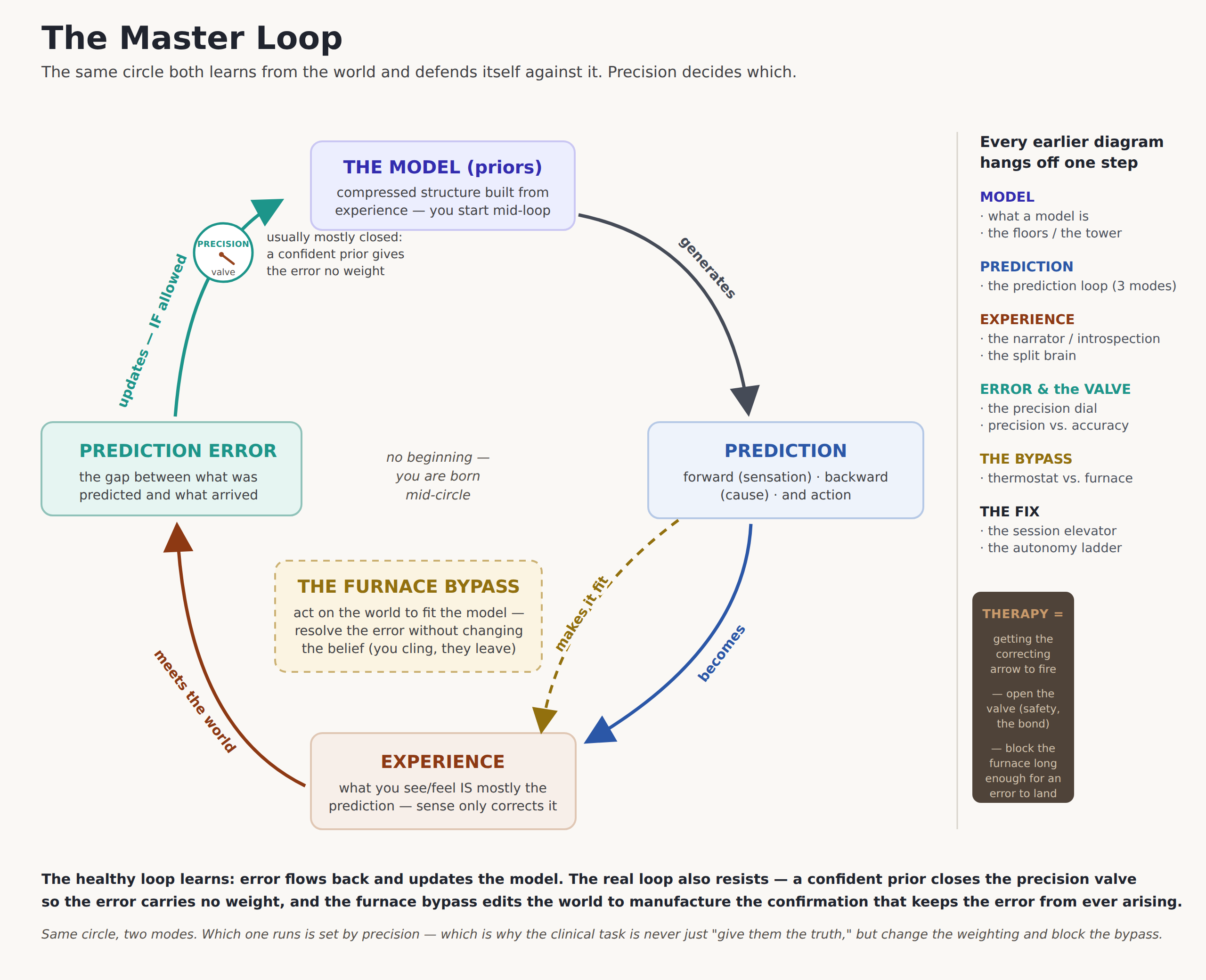
The master loop. A model generates a prediction; the prediction meets the world; the gap flows back and — if it is allowed to — updates the model. The same circle both learns from the world and defends itself against it.
The loop has two modes. In the healthy mode, error flows back and the model learns. In the defended mode, the same circle protects itself: a sufficiently confident prior refuses the error, or reaches out and acts on the world to manufacture the evidence that confirms it. Every interesting feature of psychopathology, and every difficulty in treating it, lives in the difference between those two modes.
2.2 Precision: the dimmer
Not all prediction errors are treated equally. The brain weights each signal by its estimated reliability — its precision — and updates more in response to signals it trusts. When a prior and incoming evidence disagree, the outcome lands nearer whichever is narrower and more confident. The narrower bet wins, whether or not it is correct: precision is narrowness, and narrowness is bargaining power.
The field's own name for this weighting is gain. The household gain control is a dimmer switch, and that is this paper's image for it: precision is the dimmer on every incoming signal.
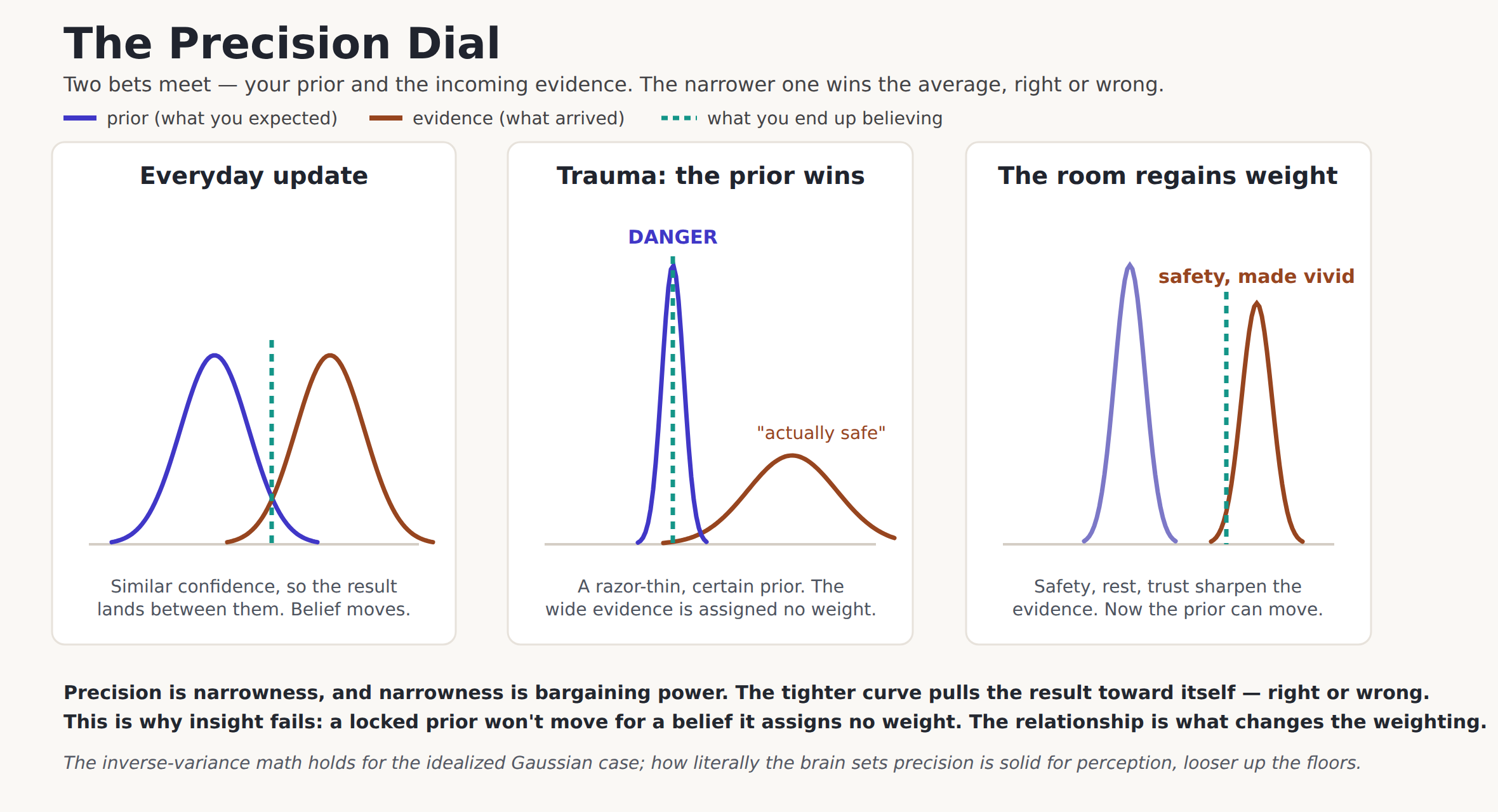
The precision dial. When prior and evidence disagree, the result lands nearer the narrower distribution. In trauma, a razor-thin "danger" prior assigns the wide "actually safe" evidence almost no weight.
So the first task is rarely to supply a new belief; the person has usually heard it. The task is to change the weighting — lower the precision on the locked prior, raise it on the disconfirming evidence — so that an error which has been arriving all along is finally allowed to count. As Part 5 argues, what does most of that re-weighting is not a technique. It is the relationship.
This also dissolves a distinction clinicians use constantly. Big T and little t trauma are sorted by the size of the event. This model sorts by what happened to the prior — and on that axis they are not two injuries but two installation routes. A single event of sufficient magnitude installs a maximally confident prior in one pass; it has a date, and the prior stays bound to the context that taught it. Chronic adversity installs the same prior by deposition: errors individually too small to force a rewrite, accumulating until the belief is load-bearing. No date, because there was no event.
The routes differ in what they leave a clinician to work with. A single-trial installation has a memory to reactivate. A deposited prior does not — the clinician who goes looking for the event will not find one — and the only route is repeated disconfirming experience over time. It is also why deposited priors so often present as personality rather than injury, and are never brought in as trauma at all.
One discipline belongs here, before anything else in this document is used: first ask whether the prior is actually miscalibrated. Some predictions are accurate reads of a punishing present — the partner who really does meet disclosure with contempt, the workplace that really does punish weakness, the marginalized client whose expectation of rejection is a rational summary of lived experience. The model's business is with beliefs the world has stopped endorsing. Mistaking a calibrated prior for a stuck one insults the client, and treating it can be worse than useless; Part 6 returns to this as an operational rule before any experiment is run.
The dial fails in two directions, and both matter clinically. Trauma is the prior held too tightly. The opposite failure — incoming noise granted the weight of signal — saturates the world with false significance: the stranger's glance, the number on the receipt, the song on the radio all seem to be about you. That is the predictive account of psychosis as aberrant salience (Kapur, 2003; Corlett, Frith, & Fletcher, 2009), and it has a boundary consequence this model takes seriously in Part 7: a framework built to loosen over-tight priors is not a license to treat a condition where the dial is failing in the other direction.
2.3 The furnace: the belief that heats the room
There is a second, more active way a prior protects itself, and in the consulting room it is the more important one. There are only two ways to kill a prediction error: update the belief, or create a world in which it is true. A man walks into a room that is, by any thermometer, comfortable — 70 degrees — and feels cold. Not believes: feels. What a person feels is never the room alone; it is the gap between the room and what he came in expecting, and he came in expecting 100, because the rooms that trained him ran hot. So he does what cold people do: he reaches for heat. He asks again. He tests. He accuses. And the room warms — with real irritation, real weariness, real distance — until it reaches the temperature he came in certain of. The error is resolved. The belief is never touched. And from the inside it does not feel like avoidance; it feels like the world confirming what you already knew.
The setting is worn, not held. It rides where such instruments get mounted — on the upper back: the one place on a body that its own eyes never see and its own hands cannot reach. It was fastened there in childhood, by the house he grew up in, the way anything gets fastened to a child's back — by hands that were not his, at a height he could not check — and settings hold long after the hands that set them are gone; holding a setting without further instruction is what a thermostat is for. Two properties of the mounting organize everything downstream. Everyone standing behind him can read the number — the partner, the colleagues, the clinician, all fluent in a setting its owner has never once seen directly. And every hand in the world can reach it except his own.
The setting varies from person to person, and its height is the severity axis. One person's dial sits at 80: the rooms he heats are never comfortable, but they are bearable, and people mostly stay — colleagues who find him exhausting without being able to say why, a marriage that is neither warm nor over. Another's sits at 150, and rooms empty almost as fast as he enters them; the confirmation arrives in weeks instead of years, and feeds the pattern that much faster. The mechanism is identical at every height — only the number differs — which is why the same formulation serves the difficult colleague and the client whose every relationship has burned down by the third month, and why this should be read as a dial, not a diagnosis.
Where does a high setting come from? Sometimes from a house that ran hot always — and sometimes from a house that ran warm and then, without warning, did not. The second is the crueler teacher. A child raised at a constant 100 has a simple learning problem; a child raised in real warmth that could turn without notice learns something worse — that calm is not evidence — which is why, decades later, the good weeks update nothing. And a setting learned that way has a behavioral signature of its own, one that looks like a sixth move and is not: he pays the predicted harm in advance. The worry that rehearses the blow all week; the good news that cannot be enjoyed, because enjoying it is the setup for a fall; the vigilance that will not stand down at night, because being ambushed is worse than never resting. Nothing here kills an error — no world is edited, no test is prevented, no evidence is discounted. The behavior manages the arrival: steady, self-administered misery, traded for never being caught off guard. Clinically the distinction earns its keep, because interrupting the furnace is the wrong tool — there is no furnace running. The target is the contrast itself: the capacity to be caught in a good state without pricing it as the drop's beginning. That is Part 2.2's dimmer, not the countermeasures below.
The furnace runs through five recurring moves. Every clinician has watched all of them:
- Provoke — pull the predicted response out of others. The jealous partner monitors, accuses, and suffocates until the other person, worn down, actually pulls away. I knew it.
- Avoid — never enter the situation that could disconfirm the fear. The job never applied for is a prediction never tested, and a prediction never tested never dies. This is why avoidance preserves fear indefinitely, and why exposure — the forced test — is its treatment.
- Filter — attend only to the fitting evidence. Ten people praise the talk; the one criticism is the only line carried home.
- Reinterpret — accept the disconfirming event, then re-describe it until it no longer counts. They were only being nice. - Withdraw effort — stop genuinely trying, guarantee the failure, then read the failure as proof.
Three different mechanisms hide under those five moves, and telling them apart matters because they call for different countermeasures. Provoke and withdraw effort are the furnace proper — behavior that acts on the world and manufactures a real confirming consequence; the counter is to interrupt the operant. Avoid manufactures nothing; it prevents the test, which is why its treatment is exposure rather than interruption. And filter and reinterpret change no facts at all — they are the Part 2.2 dimmer working defensively, evidence arriving and being discounted — which is why they answer to the precision lever (and to defusion-style moves) rather than to behavioral blocking. The five belong on one list because they serve one master, the prior's confidence; but a formulation that names which mechanism is running picks the right counter on the first try.
These are not character flaws or conscious strategies; they are the loop doing its ordinary job of reducing error by the most available route, and often the most available route is the world rather than the self. Bowlby described the clearest clinical case in 1969 without the vocabulary: an internal working model does not merely predict abandonment — it produces the distancing behavior that makes abandonment likelier (Bowlby, 1969).
How much of this does the person see? It varies, the three variations are three different patients, and each can be sorted by the sentence they are able to say. Some never notice they reached for the heat at all — I didn't do anything; I just asked a question. Most notice, and record it as a response to a room that was already cooling — I did it because she'd been distant for weeks. Notice that this second account is accurate from its second event onward: the checking, the tension, the leaving all happened, and in that order. The only error in it is the first cause, which is why it survives every fact-check aimed at it. And a few see the entire sequence, their own hand included — I know it's me, and it's happening anyway — and discover that seeing does not help: he can read the thermometer on the wall, agree the room is 70, and still be cold — the wall's number was never the one running the furnace. Knowing it does not change the temperature he feels. What protects the prior is not ignorance of the behavior. It is the causal story that keeps the evidence countable: as long as the heat is filed as the room's doing, every heated room remains an independent fact about rooms.
This is also why the pattern tightens rather than merely repeats. When the room reaches the setting, the system rests — but the rest is not neutral. The prediction has been confirmed, and a confirmed prediction is held more tightly than before. Each completed round is logged as evidence, and it cannot be discounted, because from where the person stands the furnace was never his — so the evidence raises the precision of the very prior that manufactured it. That is why the pattern reproduces across partners, jobs, and decades rather than exhausting itself, and why each round begins sooner than the last: the next partner's ordinary silence reads as distance in the second month instead of the eighth.
Watch where a completed round leaves the person, because it is what the clinic actually sees. The room is finally at the temperature he predicted, and in one narrow sense he is at rest — the waiting is over, and patients report the strange calm of it: at least now I know. But no one else could live at that temperature, and they have gone, and he is miserable — because they left, not because of the heat. So the misery itself is filed as evidence: they left, and look what it did to me. It goes in under people leave, never under what the heat cost. The suffering the furnace caused becomes the strongest testimony for the prior that fired it; the empty room is entered as proof, and the furnace is never charged.
One configuration deserves its own name, because not every defended prior is defended against the world. Sometimes the war is internal: two high-precision priors, incompatible, both refusing update — I must be truly seen to matter and being truly seen is how you get destroyed. A person cannot obey both, so the machinery builds a third thing that partially satisfies each: the man who works punishing hours "for" a family he thereby never has to be known by; the confession delivered as a joke; the request for help phrased so it must be refused. The dynamic tradition called this compromise-formation, and the model restates it without the metapsychology — a symptom can be the loop's best available solution to a pair of predictions, which is why it survives every argument aimed at either prior alone. Clinically: when a behavior looks irrational against the client's stated goal, stop asking which belief drives it and ask what two beliefs it simultaneously serves — and read stubborn ambivalence (the terrain MI works, Part 6.3) as this structure met in the wild, not weakness of resolve.
The practice implication is a rule worth memorizing: a corrective experience is necessary but not sufficient, because the client's own behavior may be quietly manufacturing the opposite evidence faster than you can supply the correction. Much of the real work is interrupting the furnace — inside the safety of the relationship, the structure of an exposure, or the discipline of a behavioral experiment — long enough for one genuine, unmanufactured error to land. And the mounting names what the relationship is for, before Part 5 argues it: a setting worn on the upper back is adjusted only from behind, by someone allowed to stand — steadily, and for a long time — in the one place he cannot watch.
2.4 The press secretary: what the client's "why" is actually worth
If the mind is built from prediction, the inner voice that explains — the part that says because — deserves a hard look. When you ask a client why they did something, the honest causes are usually below awareness: sleep, blood sugar, a buried association, a relational prior firing. The narrating part cannot see down there. What it can see is the behavior and the context, and it runs the same backward inference it uses to fill in a misheard word — producing the most plausible cause and delivering it with the fluency of fact. Nisbett and Wilson demonstrated this experimentally in the 1970s (Nisbett & Wilson, 1977); Gazzaniga's split-brain studies caught the left hemisphere sincerely narrating actions it did not initiate (Gazzaniga, 2011); Haidt's image of the press secretary names the general case (Haidt, 2012). The narrator is not lying. It has no sightline into its own causes, and some of the frosting on that mirror may be functional — Trivers argued we misinform the spokesman so the spokesman can persuade (Trivers, 2011) — which predicts the self-story will be least reliable exactly where the stakes are reputational: motives about standing, worth, and desire.
Four working rules follow for the room:
- Treat the client's explanation as data about the narrator, not a readout of the cause. It tells you what story the person can live with, which is diagnostic in itself.
- Read the outputs, not the source. Where time, money, and attention actually go is the revealed model, and it routinely contradicts the stated one.
- Track patterns, not incidents. A single episode is endlessly re-describable. What happens every time a topic arises is the model showing through.
- Watch for the reaction that is too big for the occasion. A model is invisible while it works — successful predictions cancel their own trace — and becomes legible only where reality violates it. The disproportionate flare of anger, shame, or panic is the most reliable pointer to a deep prior there is, because the size of the error is proportional to the confidence of the belief it just contradicted. Why did that land so hard? is not noise. It is the map talking.
A caution on stance, because these rules curdle if held wrong. Read cynically, they instruct systematic distrust of everything the client says — which would corrode the very epistemic trust this model treats as an active ingredient (Fonagy & Allison, 2014). The stance is curiosity, not suspicion. The narrative is honored as the client's real experience of themselves, and as genuine data, while not being mistaken for etiology; the formulation is built with the person, not about them. A therapist who treats the client as a specimen to be decoded has switched the dimmer off with his own hands.
This also locates much of what therapists actually do. The client is not only a witness to be interviewed; they are a process to be observed — together, in time, by both people in the room. And it is the first statement of the model's most counterintuitive practical claim: insight — the intellectual kind — is real, and it is the weakest lever on the shelf (Part 3 separates it from emotional insight, which is not weak at all). Why that is true is the business of the map.
3. The Map: The Floors of the Self
3.1 Eight floors
If a person is a structure of predictions, the predictions are not all one kind. Some are spelled out in words and available to reflection; some are wordless habits of the body laid down before language. The most useful map is vertical — a building, with the verbal near the top and the embodied near the bottom. It is a teaching device, not anatomy; the brain contains no tidy floors — and the stack is not the predictive hierarchy itself, whose levels are organized by scale and abstraction rather than by verbal versus nonverbal, with precision assigned dynamically rather than owned by any level. The floors are a taxonomy of content and format, correlated with that hierarchy but not identical to it. Held that way, the ordering is real and clinically indispensable, because it tells you where in a person a problem lives and therefore which kind of intervention has any chance of reaching it.
- Narrative — the binding story, the single "you" stretched across time.
- Metacognition — beliefs about your own mind: whether thoughts are facts, whether feelings are dangerous, whether change is possible.
- Propositional beliefs — the explicit convictions about self, others, world, future, and value.
- Relational patterns — the self-in-relation: what you expect from closeness, the template laid down by early attachment.
- Body and interoception — the felt boundary of the self and the constant inner read of the body's state.
- The cultural substrate — the language, categories, and norms absorbed before they could be weighed; not one belief among others but the medium the structure is built in (Sue & Sue, 2016).
Two honesty notes on the stack itself, because the numbering can claim more than the model means. Floor four straddles the building. Relational material has an explicit, sayable component that lives near floor three — I expect people to leave — and a procedural-emotional component, the internal working model proper, that runs at the depth of floor six; that split is why attachment work so often has to be experiential rather than conversational, and why the transference reaches what the questionnaire cannot. And floor eight is the deliberate exception to the whole scheme: a medium listed as a floor for teaching purposes. Culture is not the deepest layer but the water the reef of Part 4.6 stands in — present at every level at once, as master narratives on floor one, values on floor three, display rules on floor six, somatic idioms of distress on floor seven. It sits at the bottom of the list only because, like a foundation, it is the easiest thing to forget, and everything rests in it. And it is many waters rather than one: a single client stands in several cultural media at once — ethnicity, faith, class, profession, generation — and different floors may have been poured in different waters, which is why the same restraint can be ordinary dignity in one of a client's cultures and costly suppression in another, and why the substrate is assessed, never assumed (Part 7).
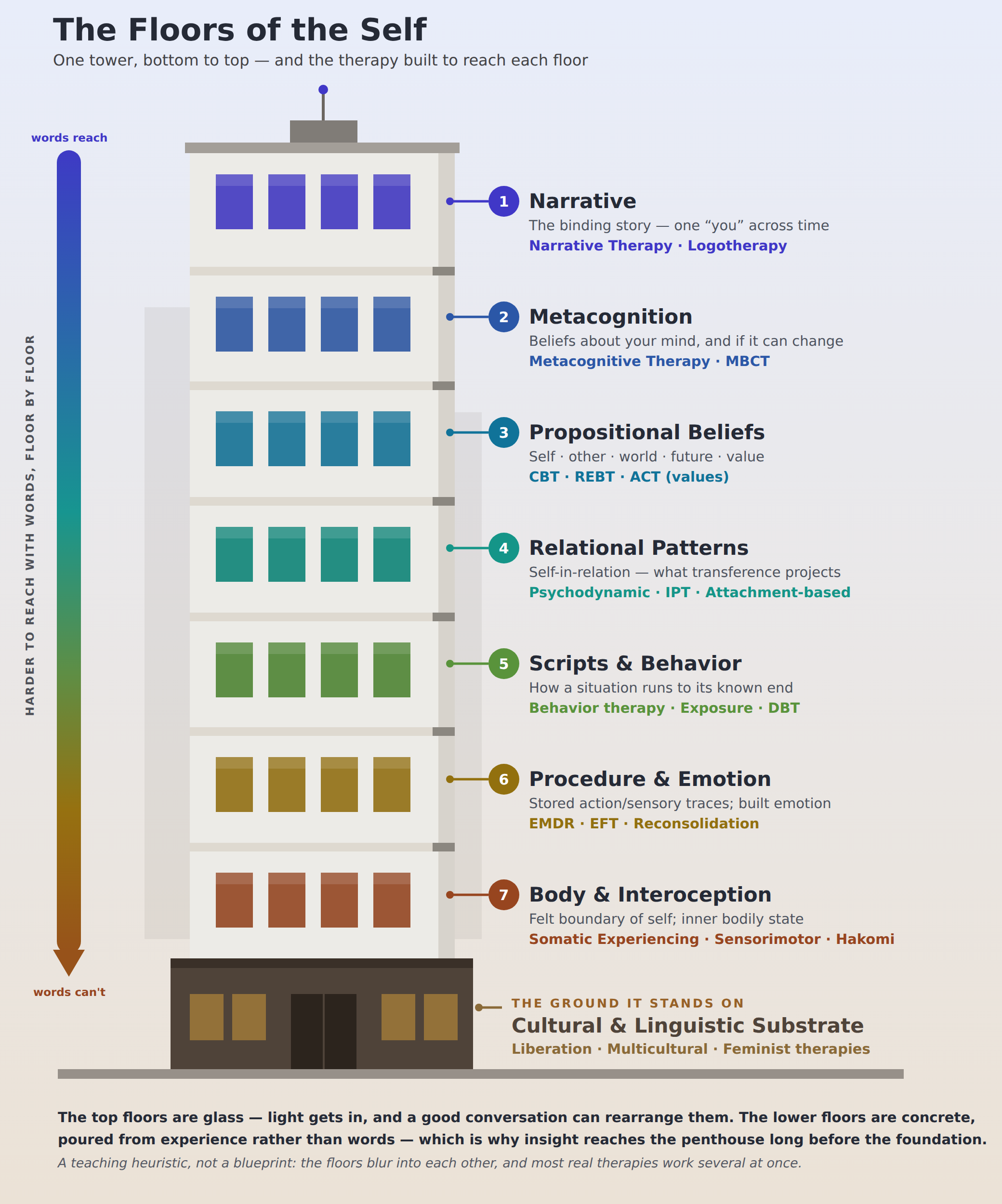
The floors, with the therapies built to reach each one. The upper floors are verbal and reachable by conversation; the lower floors are wordless and reached, if at all, through the body, behavior, emotion, and relationship. Note that the drawing renders the cultural substrate as the ground the tower stands on rather than a numbered floor — the honest placement, per the note above — and files relational patterns as a single floor for simplicity; the straddle lives in the text.
3.2 Glass and concrete
The single most useful thing the building shows is why depth matters. The top floors behave like glass: words reach them, and a good conversation really can rearrange them. The lower floors are concrete — poured from experience rather than argument. Usually the pour came early, before the verbal floors existed; but hold the axis precisely, because it is format, not age. A combat trauma at thirty installs a maximally confident bodily prior — concrete poured late — and it behaves exactly like the early kind, because what makes a floor hard to reach is the format of the operative representation and the confidence it is held with, not the year it was laid down. A bodily sense of threat, a relational expectation laid down at eighteen months, an emotion fused to a procedure just last year: these were never made of sentences, and sentences are a poor tool for moving them.
This is why a client can understand, in complete and articulate detail, exactly why they freeze when someone raises their voice — and freeze anyway. The understanding lives on floor three; the freezing lives on floor seven; and the elevator between them is slow and often broken. In engine terms it is the same fact stated twice: the deep priors are encoded in formats that words do not reach, were typically — though not necessarily — installed early, and are held, in the stuck cases that reach a clinician, with high precision; and words address the floor where the explanation lives rather than the floor where the prediction fires. (It is also why Part 2.3's third patient can watch his own hand reach for the heat and stay cold: the seeing runs on glass; the setting is poured lower.)
Two clarifications keep this claim from overreach, and both matter in front of a skeptical colleague. First, the barrier is the level of processing, not the medium of speech. A conversation reaches floor three when it trades propositions; the same conversation reaches the fourth and sixth floors when it is an experience — being met without flinching, surviving a rupture, disclosing and not being dropped. That is how a talking therapy touches concrete: not because the words argue the prior down, but because the exchange is itself the disconfirming event. Second, insight names two different things. Intellectual insight — the accurate explanation — lives on the glass floors and moves little below them. Emotional insight — the explanation arriving while the relevant floor is live and feeling — is not weak at all; it is a corrective experience wearing the grammar of understanding. The psychodynamic tradition has always drawn this distinction, and an interpretation that lands in the heat of the transference is an experiential intervention, not top-floor talk.
3.3 The elephant and the rider
Haidt's image compresses the same architecture into one picture (Haidt, 2006). The automatic mind is an elephant; conscious reasoning is a rider perched on top. The rider can see ahead, plan, and nudge — but the elephant is vastly stronger, and when they disagree, the elephant wins. Worse, the rider mostly serves the elephant, supplying after-the-fact justifications for what it has already decided. The rider is the verbal upper floors; the elephant is the embodied lower ones; and the rein connecting intention to movement is a precision ratio — the weight the deliberate goal commands relative to the weight the automatic prior commands — slack most of the time, which is why a stern talking-to changes so little. (Part 2.3's third configuration — I know it's me, and it's happening anyway — is this slack rein, met at the furnace.)
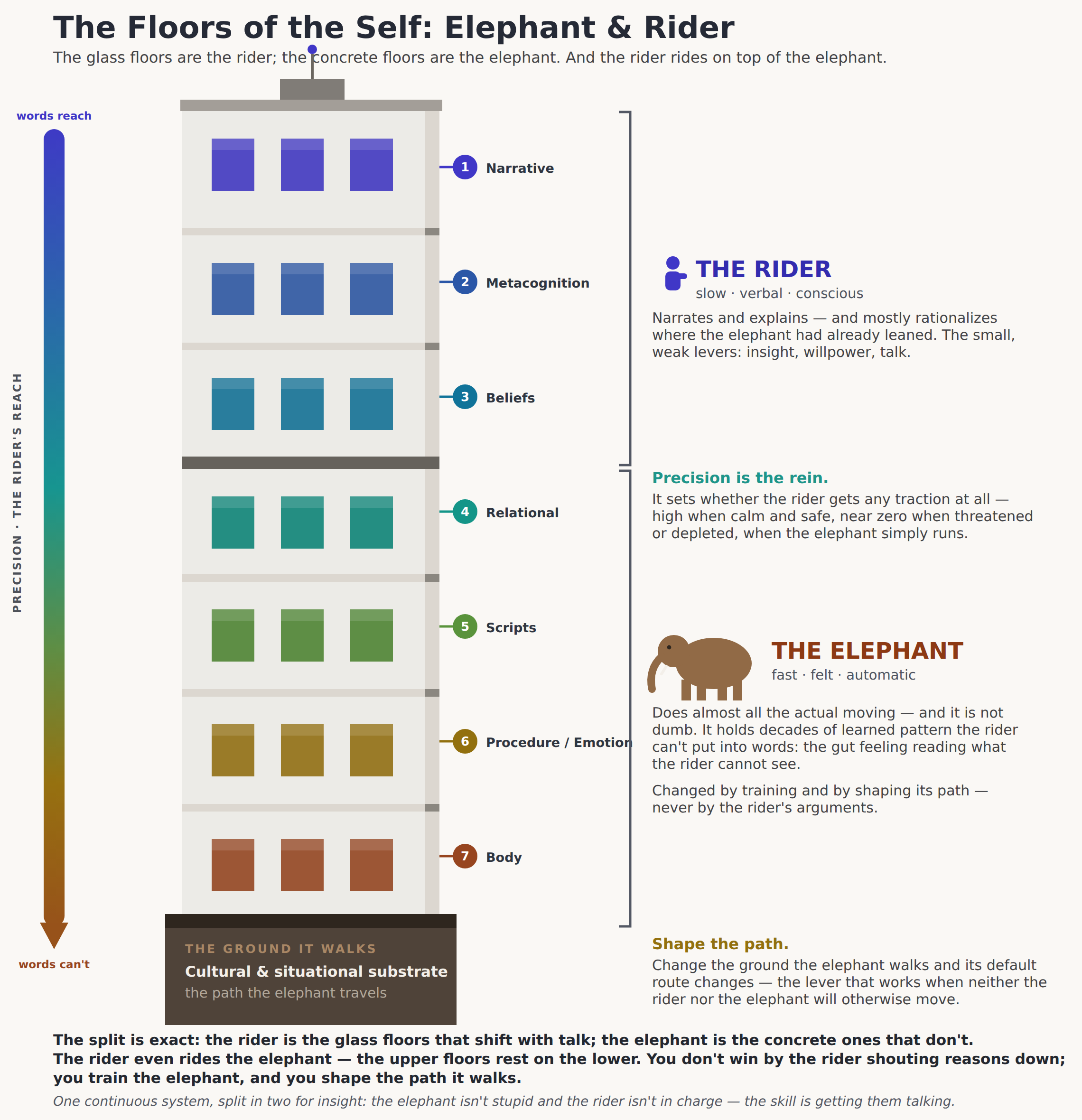
The rider is the verbal upper floors; the elephant is the embodied lower ones. The precision ratio is the rein, and the durable way to change behavior is less to argue with the rider than to shape the path the elephant is already walking. (A client-facing rendering — see the caution at the end of this section.)
Two levers follow, and they organize most of behavior change. Tighten the rein: the conditions that let a deliberate intention actually bias an automatic process are chiefly safety and trust — and note the direction, because the vocabulary can mislead: safety tightens the rein by lowering the precision of the automatic threat prior until the goal's signal can register, not by adding force to the rider. It is the same dimmer as Part 5 seen from the rider's seat, one mechanism and not two: quiet the elephant's certainty, and the rein you already had starts to answer. Shape the path: rather than fighting the elephant head-on, change the terrain it is walking — the environment, the cues, the contingencies, the bodily state — so the automatic process runs somewhere better on its own. Exposure, habit design, contingency management, and the down-regulation that has to precede any cognitive work are all versions of choosing the ground instead of pulling harder.
When a client knows what to do and cannot do it, that is not weakness of will. It is the ordinary architecture, and saying so — your understanding is real, and it lives on a different floor than the reaction — is itself often the first de-shaming intervention of a therapy.
3.4 A therapy for every floor
The map earns its keep by sorting the catalogue of therapies by where each tradition's signature move lands — which is not the claim that a therapy owns a floor. Narrative therapy and logotherapy work the top floor. Metacognitive and mindfulness-based approaches work the second — changing the relationship to thought rather than its content. CBT and REBT work the third. Psychodynamic, interpersonal, and attachment-based therapies work the fourth, where the transference is the assessment. Behavioral methods, exposure, and skills training work the fifth. EMDR, emotion-focused therapy, and reconsolidation-based methods reach the sixth. Somatic and sensorimotor approaches work the seventh. The liberation, feminist, and multicultural therapies work the substrate the whole building stands in.
Two cautions keep this from becoming a caricature. Every serious therapy reaches across several floors, and the best clinicians move up and down the building within a single session. And the map does not by itself settle the common-factors debate — it tells you where a problem lives, which is the necessary first question either way.
3.5 Finding the floor in the room
The map is only useful if you can locate a client on it. In practice the floor announces itself through a small set of signs, none of which requires new instruments:
- Accurate insight that changes nothing. The clearest single indicator. If the client's understanding is genuinely correct and the pattern persists untouched, the problem lives below the floor the words are reaching. Stop supplying better explanations and change channels.
- The body answers first. If the reaction arrives as sensation — heat, constriction, numbness, the stomach drop — before or without words, you are on floors six and seven, and the work starts there. (Hold this sign as a fact about the speed and format of access, not proof of a pre-conceptual bedrock — on the constructionist account the felt sense is already concept-shaped; what the sign tells you is which channel is live, and that is all the formulation needs; Seth, 2021.)
- The every-time pattern. A problem that reproduces across partners, jobs, and decades, indifferent to circumstance, is almost always a floor-four relational template running, not a floor-three belief about the current situation.
- It shows up with you. When the pattern arrives in the therapy relationship itself — the client managing you, testing you, going compliant or opaque — the fourth floor has walked into the room, which is an opportunity, not an obstruction.
- The disproportionate reaction (from Part 2.4). The too-big response points at the floor where a high-precision prior just got contradicted. Follow the flare, not the topic.
- The client's own verbs. "I believe" and "I tell myself" sit high; "I always end up" sits in the scripts; "I just shut down," "my chest closes" sit low. People routinely tell you the floor in their phrasing before they can tell you the problem.
- Evidence flips them rather than moves them. You deliver a well-aimed piece of disconfirming evidence and the client does not soften — they swing to the opposite extreme and hold it just as hard. He was all bad; now he is all good. Then it reverses, often within the session. The tell arrives earlier than the flip does: listen for counter-evidence being explained away to circumstance — he was under pressure, she was having a bad week — which is what holds a position at the extreme while it lasts. This is not resistance and it is not bad aim. It is a client for whom the question has only two available answers, and more evidence will keep producing swings rather than movement. The work is to make somewhat a real answer before any further evidence is worth delivering.
- The story that starts at event two. “She got distant, so I checked.” An account that is accurate from its second event onward — the checking, the tension, the leaving all happened, and in that order; the only error in it is the first cause. Don't fact-check it; ask what the hours before the first event were like. (This is Part 2.3's most common patient, heard in the wild.)
- Your own pull. The floor announces itself in the therapist too: the drowsiness, the urge to lecture, the sudden carefulness that arrives with one client and no other is frequently their relational template registering on you — the fourth floor read from the other chair (Part 6.5 develops this instrument).
The locator grid in Decision Map — Locating the Floor maps each of these signs to the floor it points at, and the text procedure Decision Aid — Locating the Floor walks the whole sequence — gates, locate, formulate, act, loop.
3.6 The same structure, found five times
A fair objection is that the floors are invented — a tidy scheme imposed on a mess. The strongest answer is that independent research traditions, working on different problems, kept carving the same structure: Janoff-Bulman's shattered assumptions (world benevolent, world meaningful, self worthy); Beck's cognitive triad (self, world, future); Bowlby's internal working models (the availability of the other, the worthiness of the self); Young's schema domains; Kelly's personal constructs (Janoff-Bulman, 1992; Beck, 1976; Bowlby, 1969; Young, Klosko, & Weishaar, 2003; Kelly, 1955). When trauma research, depression research, attachment research, and personality research converge on models of self, other, and world — with the relational template as a distinct and unusually durable layer — the convergence is evidence that something real is being carved. One honest discount: these traditions share a broadly cognitive-schematic paradigm, so part of their agreement is family resemblance rather than fully independent discovery (Young's schema therapy is an explicit extension of Beck's model — lineage, not convergence); the weight comes from their differing targets — trauma, mood, attachment, personality — landing on the same self/other/world coordinates. The traditions found the content structure — self, other, world, with the relational template unusually durable. The vertical ordering is this model's own proposal, not a finding they validate: what they corroborate is the coordinates, and the arrangement by depth and reachability is offered on this model's account, to be judged by whether it sorts interventions correctly.
4. The Stakes: Belonging, Mattering, and Rank
4.1 The social animal
Why should connection matter so much that a self withers without it? The short, honest version of the deep answer: for our species, survival and reproduction ran through other people — bonds, alliances, reputation, inclusion — so the highest-stakes predictions a human brain makes are social ones, and the priors about connection and standing are held more tightly and defended harder than any others (Hamilton, 1964; Trivers, 1971). Nothing in the consulting room requires more evolutionary theory than that one sentence. The evolutionary case is not developed here, and the clinical argument does not depend on it.
What the clinic does need is the mismatch point: these drives were calibrated for bands of at most a few dozen and are now running in an environment they were never built for. The 9 p.m. email that ruins an evening is a status threat registering as bodily danger, because in a small band, disapproval from someone who mattered could end in exile. The phone delivers a reference class of eight billion, curated for the top tail, to machinery built to track standing among fifty. Much of what presents as pathology is sound ancient equipment running in the wrong world — a sentence many clients experience as the first non-insulting account of their suffering they have heard.
4.2 Two gauges, not one
Here the model needs a distinction it cannot do without, because the clinical leverage lives in it. The social need is double, and the two components are tracked by different gauges. (Gauges, deliberately: the precision dial of Part 2.2 is a different instrument doing a different job — a dial is set; a gauge is read.)
Mattering — being included, wanted, needed by particular people — is tracked by the sociometer: self-esteem functioning as a monitor of relational value, moving with inclusion and exclusion (Leary, Tambor, Terdal, & Downs, 1995; Baumeister & Leary, 1995). Rank — standing, position, comparative worth — is tracked by a hierometer function, calibrating status pursuit to where one sits (Anderson, Hildreth, & Howland, 2015). One caution to own before leaning on the split: these are two functions of substantially one self-regard system, not two separate organs — Mahadevan, Gregg, and Sedikides (2019) found self-esteem tracks both status and inclusion, with narcissism the marker that isolates status-tracking. So the two are correlated in daily life and dissociable in principle — enough to open the therapeutic move below — but they are not cleanly separable gauges, and the clinical claim rests on mattering being the more reachable function, not a wholly separate one.
One refinement inside the mattering gauge, because the clinic keeps finding the seam. The gauge takes two readings that correlate in daily life and dissociate in the consulting room: belonging — admission; being in, having a place at the table — and mattering proper — significance; being needed by particular people, such that one's absence would register in someone's actual week. The retiree welcomed everywhere and needed nowhere has belonging intact and mattering starved; the caregiver on whom an ailing parent depends utterly has mattering intact and belonging starved. Joiner's instrument keeps the two apart for good reason — thwarted belongingness and perceived burdensomeness are separate factors, separately measured (Van Orden et al., 2010) — and the repair menus differ: admission is repaired by entry and proximity, significance by responsibility and being depended on, and prescribing one to a client starving for the other reliably fails — the retiree sits in the new club feeling useless; the outsider volunteers endlessly and stays lonely. The distinction changes nothing in the argument that follows, since both readings live on the reachable side of the rank divide, but it buys one of the most useful formulation questions in this Part: is this client starving for a seat, or for a reason to be at the table?
Notice what Joiner's interpersonal theory of suicide actually says. It names two conditions of suicidal desire: thwarted belongingness and perceived burdensomeness (Joiner, 2005; Van Orden et al., 2010). Both live on the mattering gauge, not the rank gauge — one from each reading: thwarted belonging is the admission side gone dark, and burdensomeness is the significance side gone negative. (These two generate suicidal desire; whether desire becomes a lethal act is gated by a third factor the model must never fold into mattering — acquired capability, the lowered fear of death and habituated tolerance of pain that makes an attempt possible — which is why means restriction — which acts on access, a lever separate from mattering — is first-line, and why lethality is governed by the risk protocol, not by this lens.) They'd be better off without me is a sociometer reading gone negative — a relational-value computation concluding one's presence subtracts — not a statement about position. The rank side is not missing from suicidology, and it should be named rather than elided: O'Connor's integrated motivational–volitional model runs on defeat and humiliation — rank injuries — with entrapment as the motor driving them toward ideation (O'Connor & Kirtley, 2018). But notice where that model puts the mattering variables. In the IMV, thwarted belonging and perceived burdensomeness sit as moderators on the path from entrapment to ideation — not the engine, but the joint at which a clinician can actually intervene. Both gauges are in the literature; rank tends to be the driver, and mattering the part you can reach. And Case and Deaton's account of the despair epidemic is, read closely, not "these men are low-status": the institutions that dissolved — marriage, church, union, the job that put a man in a room with the same people every day — were the institutions that made people matter to specific others (Case & Deaton, 2020). Rank fell as a consequence. The despair tracked the mattering.
The clinical consequence deserves to be stated as bluntly as it lands in supervision: you cannot hand a client rank in fifty minutes, and they can smell it when you pretend rank doesn't matter. But mattering is local, concrete, and reachable from a consulting room. Rank you cannot confer — but you can change the arena, so a client earns standing where their competence is legible (the reference-class move of Part 6); that is not the same as conferring rank by fiat, which they would rightly distrust. If the injury were rank, the therapist would be nearly helpless before a structural problem. Because the desire-driving component runs through mattering — and because the client's estimator is usually running on an over-tight prior that lets rank stand in for the whole gauge ("my value is my rank") — the work is tractable: shift weight toward the more reachable input — inclusion and mattering — repair it directly, and recalibrate the reference class the rank component is fed. Part 6 gives each of those as a concrete move.
One more piece completes the picture. A client whose suppression keeps them from ever being seen except in performance has arranged a life in which being valued can never register as evidence — whatever arrives is credited to the performance, not the person. That is the relational furnace: the wall built to be worth keeping is what makes it impossible to feel kept. The estimator is not broken. It is starved.
4.3 Two routes to standing
Status is not won one way. The primary literature distinguishes dominance — rank taken through force and fear, the older primate route — from prestige — rank freely conferred in recognition of value, earned through demonstrated competence or embodied virtue (Henrich & Gil-White, 2001; Cheng, Tracy, Foulsham, Kingstone, & Henrich, 2013).
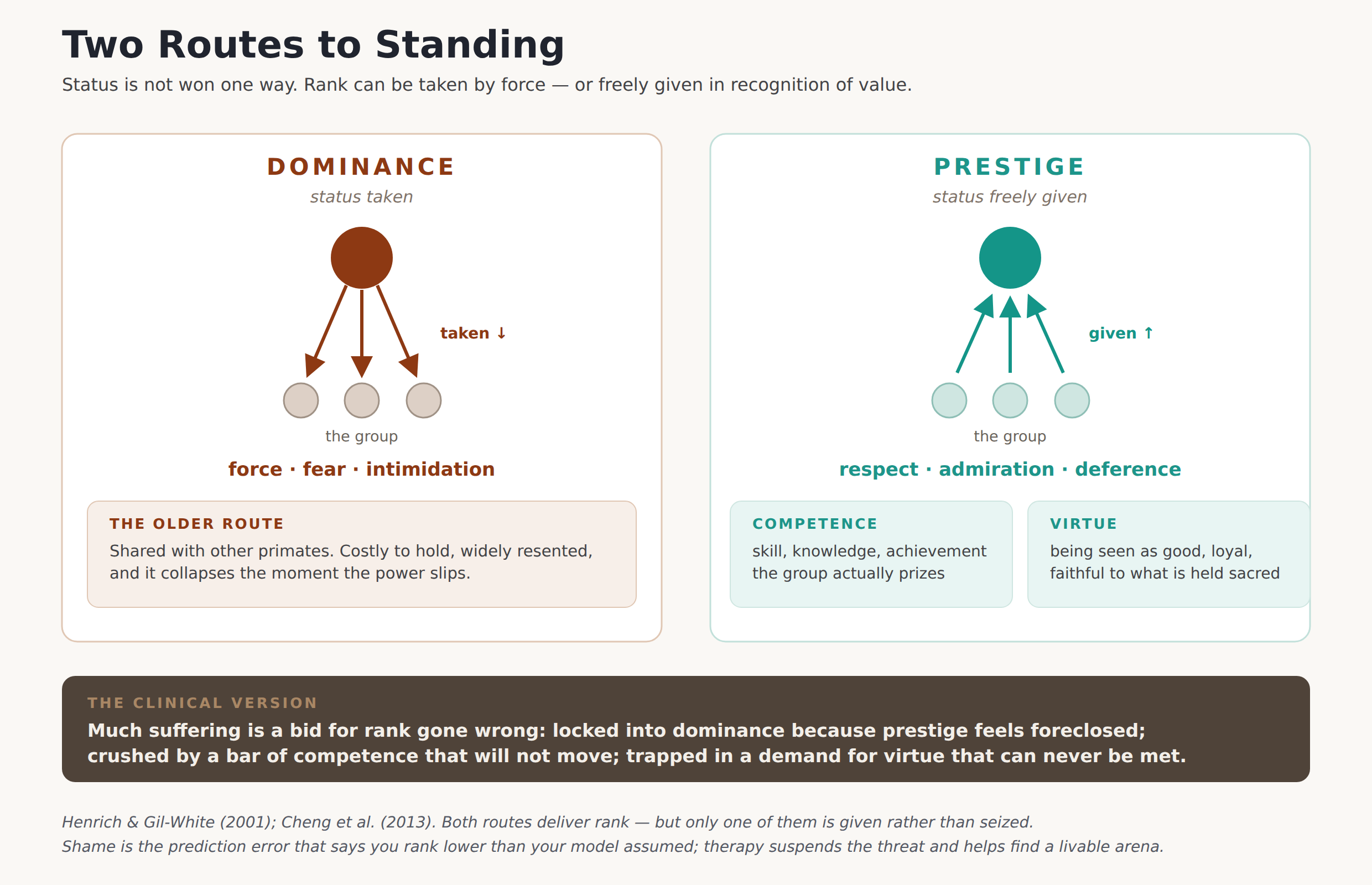
Dominance takes rank by force; prestige is conferred. Both deliver standing; only one is given rather than seized.
A great deal of suffering is a bid for rank gone wrong: the person locked into dominance because prestige feels foreclosed; the person crushed under a competence bar they cannot clear; the person trapped in a virtue standard whose terms can never be satisfied. Listen for which game the client is losing, and whether the arena is one they could ever win in — because one durable intervention, developed in Part 6, is not to raise the client's rank but to change the arena to one where their actual competence is legible.
4.4 Shame, humiliation, and the anger that carries them
In this vocabulary the central emotions of social life are prediction phenomena. Shame is a large, high-precision prediction error about one's own standing — the sudden signal that one ranks far lower than one's model assumed, felt in the body before it reaches words. Humiliation is that error inflicted publicly and made to feel permanent, which is why it is so catastrophic and so often a precursor to violence: it does not merely lower the estimate, it threatens to re-pour the foundation.
And anger — for many men socialized against the display of fear — is frequently not the disorder but the reading, rerouted into the only affect the person is licensed to show. The clinical move is to treat it as data and, when the alliance can hold it, offer the translation as a guess, not a verdict: I wonder whether you're angry at her — or angry that there's no one on earth you can tell you're scared. Delivered early, or delivered as certainty, the same sentence is mind-reading and earns the rupture it gets. Timed and tentative, an accurate version tends to land quickly, because it is the first account of the anger that does not ask the man to surrender in order to be understood.
4.5 Grief: the cost of being constituted in connection
If selves are genuinely built out of connection — as the relational tradition has long insisted (Miller & Stiver, 1997; Jordan, 2018) — the model makes a hard prediction: losing a person should not merely hurt; it should partially unmake the self. And it does. A large portion of any self-model is not located inside the person at all. It is distributed into roles and an anticipated future, and thousands of predictions are routed through the people one loves: I'll tell her about this later. We will grow old. I am the person who does this for him. When the person dies, every prediction routed through them begins throwing error at once. The bereaved client who says I don't know who I am anymore is not being poetic; they are accurately reporting a model that no longer corresponds to the world.
This is why grief arrives in ambushes — each one a prediction that had not yet been updated, firing into a world that no longer contains its object — and why the work is long: the model was never stored as a summary that could be revised in one stroke. The errors have to be lived to be counted. One correction from the grief literature keeps the mechanism honest: updating the model does not mean deleting the person. Healthy grieving typically ends not with the bond erased but with it transformed — the continuing-bonds finding (Klass, Silverman, & Nickman, 1996) — which in this vocabulary means the predictions are rewritten into forms the world can still honor: from I will call her today toward I am someone she shaped, and I carry her with me. And complicated grief has more than one route: a model protected from error by avoidance is one pathway; a model held in perpetual error by rumination and proximity-seeking is another. Two consequences for the room. First, the distress is in large measure the update mechanism running; the instinct to suppress it wholesale is partly an instinct against the healing — and a grief that never throws error never revises the model, which is one way of describing complicated grief. Second, expect bereavement to present as identity disturbance, not sadness alone. Who am I now is often the more honest question than how do I feel, because what was damaged is the model, not the mood.
4.6 The reef, briefly
One correction to the building before it misleads: a self is grown, not constructed. The better image is a reef — mostly skeleton, laid down by earlier life, with only a thin film at the surface alive and updating. Old priors are not deleted when outgrown; they are built over and continue to bear load, which is why a person can heal at the surface and still rest on a foundation poured decades ago.
Three sentences keep the image from proving too much. First, the reef describes the default regime — left alone, only the growing edge updates — and therapy is the engineered exception: a set of procedures for making a patch of old skeleton briefly live again, whether through the reactivation window that reconsolidation work aims at, the transference, or any moment a floor is, in Part 3.2's phrase, live and feeling; this is why Part 6.2 distinguishes the rewrite regime from the build-over regime, and both are reef events. Second, the reef and the building are two axes, not two rivals: the floor names a prior's format and picks the channel that can reach it; the reef names its age and consolidation and predicts its resistance and whether a reactivation window is needed. The two correlate in development and dissociate in the clinic — an adult-onset trauma is a low floor in young coral, often more updatable than its depth suggests, while a childhood verbal verdict is a glass floor with an old pane, less movable than its floor suggests. The correction amends the building's construction connotation; it does not replace the map. Third, the growth image buys one working prediction: under load — loss, illness, exhaustion — the living film thins and weight shifts back onto old skeleton, which is why a person who has been past something for years meets it again in the worst month of their life. That return is load-bearing structure re-engaging, not a relapse of character; expect it, name it in advance, and it largely de-shames itself.
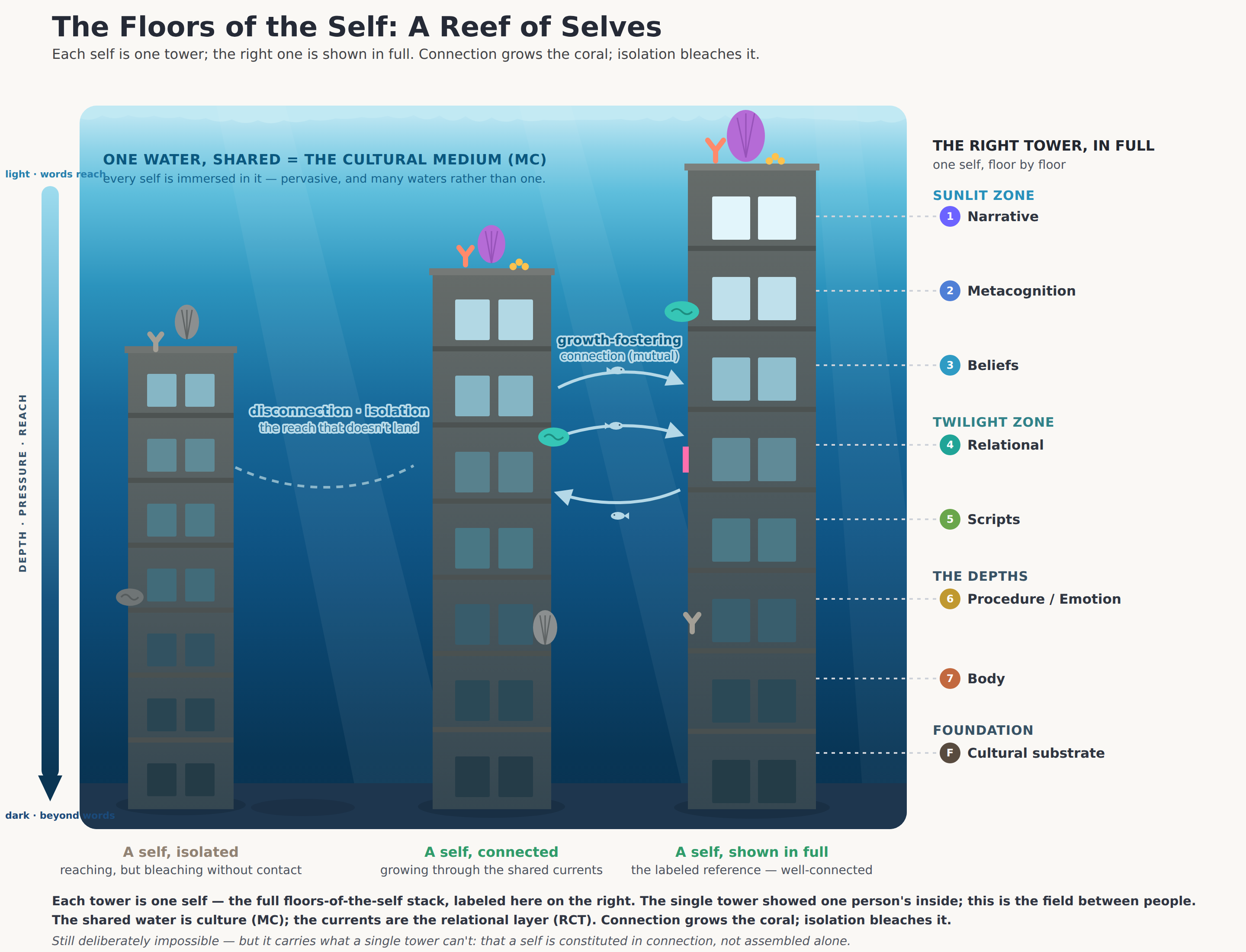
Selves as living towers in one shared water, connected by currents. Connection and standing are what flow between them; coral grows where both are flowing and bleaches where they are not. The shared water is the cultural substrate of Part 3.1, drawn as what it is: the medium, not a floor.
Zoom out and the reef makes the final point of this Part: selves stand in a shared cultural water, joined by currents that carry both of the things the animal cannot live without — mattering and standing. The isolated tower bleaches not because its structure differs but because the feeds are cut. That is what depression's withdrawal does, mechanically: it runs the avoid move of Part 2.3 against the entire mattering feed at once — a maintenance loop, since the withdrawal is itself a symptom of the illness it then sustains — and the estimator, which has no missing-data flag, reads the silence of a cut feed as evidence of worthlessness rather than as absence of input. The starving estimator's reading is then taken for the truth. The burdensomeness experiments of Part 6.3 are the direct counter: they restart the one input class the estimator evolved to read.
5. Why the Relationship Does the Work
The model now explains the field's most robust and most awkward finding — that the alliance predicts outcome better than the technique — and it explains it mechanically rather than sentimentally. Safety and trust are the conditions that lower precision on a locked prior. They are, in the vocabulary of this document, what turns the dimmer up, so that corrective signals which have been arriving all along can finally be weighted enough to move the model. And the relationship simultaneously feeds the two priors the social animal cannot live without: it supplies mattering, and it grants standing — a space in which the client is accorded worth that the furnace did not manufacture, because they did not perform for it.
The sharpest objection the model raises against itself belongs right here. If regard counts as evidence only when it was free to be withheld — the very rule the furnace uses to discount a compliance, a performed-for kindness, a partner who stays for the mortgage — then the therapist's regard looks disqualified from the start. It is paid for, time-bounded, and professionally obliged; it could not easily have been otherwise, and by the model's own logic a response that could not have been otherwise carries no information. A guarded client feels this precisely, and credits the warmth to the fee rather than to himself — the consulting-room version of the wall that credits every kindness to the performance. The answer is not to deny the fee but to locate where the free evidence actually lives. The fee guarantees only the floor: professional conduct, reliability, the door open next week. It does not guarantee that the therapist's regard survives contact with the real thing — and that survival is the one increment the arrangement cannot manufacture. So the informative moments are the ones where the regard could genuinely drop and does not: the client attacks and is met without retaliation or withdrawal; discloses the thing he predicted would end it and the room holds; tests, goes opaque, ruptures the alliance — and the therapist neither collapses nor leaves, but repairs. Rupture-and-repair is therefore not a threat to the alliance but the mechanism by which a paid relationship generates un-manufactured evidence (Eubanks, Muran, & Safran, 2018); a therapy that never ruptures has never put the therapist's regard on the line, and a regard never at risk teaches a floor-four prior nothing. This turns a rupture from a failure to be managed into the most valuable event the relationship can offer — the moment the mattering gauge finally receives a reading the client cannot dismiss as bought.
Two honesty notes belong here, because a careful reader will bring them anyway. The alliance–outcome association, though the most consistent predictor the field has, is modest — meta-analytically on the order of r ≈ .28 (Flückiger, Del Re, Wampold, & Horvath, 2018) — and it is correlational: early symptom relief strengthens the alliance as surely as the alliance produces relief, and the direction of causation remains contested. And the claim that safety works by lowering precision is this model's proposal about the mechanism, not an established finding; it is offered as a testable prediction and should be held that way. What the model offers is not stronger data than the field has. It is a candidate explanation for why the data look the way they do.
So, on this model, the alliance is not the soil the technique grows in; it is closer to an active ingredient than a backdrop, and the techniques are ways of organizing what happens inside it. But hold the claim precisely, because the map depends on it: the relationship is what makes any method work at all, and the right method for the right floor still matters. Reaching a bodily prior through pure conversation, or a relational template through a worksheet, will fail no matter how strong the alliance. The relationship turns the dimmer up and supplies mattering and standing; something floor-matched then has to come through it, and usually that something is a technique. When the prior is itself relational, the relationship is also what comes through — a person over time is the only evidence that bears on what closeness costs — so one object fills both roles. That is not an exception to the rule but what the rule produces when the channel and the floor coincide, and it is what Rogers (1957) was reporting when he called the conditions sufficient. A correct technique without the relationship is a corrective signal delivered with the dimmer off. A relationship that is only comfortable is the dimmer turned up with nothing sent through it: warmth that was never at risk teaches a floor-four prior nothing. You need the dimmer up, and you need something aimed at the floor where the prior lives.
Taken together, the relationship is doing four jobs in this account, and they are worth separating because they are different in kind. It is a condition: safety lowers precision on locked priors so corrective evidence can count — scaffolding, present-tense, and it comes down when the therapy ends. It is a capacity: being accurately understood, hour after hour, is how the client's own machinery for reaching his lower floors gets built (Part 3.4; Fonagy & Allison, 2014) — and unlike the condition, the capacity survives termination and keeps working on problems the therapy never touched. It is evidence, when the prior is relational: regard that was free to drop and did not is not preparation for the intervention but the intervention — a piece of lived history that contradicts the old prediction. And it is an input: independent of everything it enables, the hour itself feeds mattering and standing — a particular person, week after week, to whom the client demonstrably matters. Scaffolding, equipment, data, and nourishment. A formulation should know which of the four a given client is chiefly getting, because they end differently: the scaffolding comes down, the equipment leaves with him, the data stays written, and the feeding — Part 6.6's problem — must be handed off to a life that can continue it.
This is also the reconciliation of the model's one internal tension, worth naming because a sharp reader will find it. The strong common-factors reading says the relationship does essentially all the work; the floors say specific technique matters once you know where the problem lives. The resolution is that these operate at different stages of the same event: the relationship is necessary and does the precision work, and within the space it opens, floor-matched technique is where the differences between methods actually live. You do not have to choose. You have to sequence. The exception shows the rule's shape rather than breaking it: when the prior is relational the two stages collapse into a single event, which is why the strong common-factors reading is not merely popular but locally correct — and why it generalizes badly to a contamination prior or a bodily one. One caution on magnitude, since the equivalence data and the floors can seem to collide: floor-matching is a refinement inside the shared machinery, not a specific-ingredient claim that predicts large aggregate outcome gaps between bona fide therapies — and a modest average effect is easily swamped by the common factors and by measurement noise, which is one reason the aggregate horse race stays close even where floor-matching decisively helps the individual stuck case. "A method aimed at the wrong floor fails" is the limiting case that makes the map worth consulting when a case is stuck; it is not a prediction that brands should separate in the average.
6. The Clinical Model: Five Questions and a Toolbox
Everything above collapses into a formulation frame. Faced with a particular person, a clinician working from this model is not choosing a brand of therapy; they are answering five questions and assembling the response — and answering them with the client, out loud, not about them. A formulation the client co-owns is itself an intervention: it converts a private verdict into a shared engineering problem, and it recruits the person as the co-investigator the experiments below will require.
6.1 The five questions
1. WHERE does the stuck prediction live? Which floor — a story, a metacognition, a belief, a relational template, a script, a built emotion, a bodily state, a cultural given? This is the first question because it determines which interventions can reach the problem at all. Use the handles in Part 3.5: accurate insight that changes nothing, the body answering first, the every-time pattern, the enactment in the room, the disproportionate reaction, the client's own verbs.
WHERE has a companion question: what is holding it up now? Origin and maintenance are different addresses more often than not, and the intervention follows maintenance. A display rule poured in by the substrate — what a man shows costs him standing — may be perpetuated decades later by one person's furnace, firing in rooms where no enforcer remains; that problem is treated on floors three through six, whatever its cultural birthplace. The reverse case matters just as much: for the client whose environment is doing the damage now — ongoing discrimination, ongoing threat — maintenance sits in the substrate itself, no upper-floor tool reaches it, and reframing an accurate perception of a hostile world is not therapy but recruitment into the injury (Sue & Sue, 2016; Ratts et al., 2015). The insomnia literature codified this as predisposing, precipitating, and perpetuating factors, with treatment aimed at the third (Spielman, Caruso, & Glovinsky, 1987); the same discipline applies to every floor. Treat where the problem is maintained; acknowledge where it began — and when maintenance lives in the water, the honest move is the handoff: the substrate therapies of Part 3.4 and advocacy beyond the room, with Part 6.4's move reserved for the false verdict laid over a real loss.
2. By what LEVER does it change? Precision. The task is rarely to install a new belief — the client has usually heard it — but to re-weight an old one: lower the confidence on the locked prior, raise it on the disconfirming evidence, so an error can finally count.
3. Against what OBSTACLE? The furnace. Which of the five moves — provoke, avoid, filter, reinterpret, withdraw effort — is manufacturing the confirming evidence, and how will you interrupt it long enough for one unmanufactured error to land? Name the mechanism, not just the move: manufactured evidence wants the operant interrupted; a prevented test wants exposure; and discounted evidence is the dimmer again — for a pure filter-and-reinterpret client, this question's answer collapses into Question 2, which is itself diagnostic.
4. Under what CONDITIONS? The relationship. Safety and trust turn the dimmer up. Without them the corrective signal stays weighted to nothing, and no technique reaches its floor.
5. With what at STAKE? Mattering and rank. The priors a person defends most fiercely are the social ones. Ask where the injury weights — toward being unwanted (the inclusion input) or being low (the rank input) of one self-regard system — because the desire-driving weight is usually on mattering, and mattering is the reachable input — while lethality itself (acquired capability, and access to means) is governed by your risk protocol, not this frame.
The floors say where to aim; the dial says what has to change; the furnace says what will fight back; the relationship says what makes change possible; and the stakes say why it all matters so much to the person in the chair. The one-page version of this frame is Case Formulation — One Page; the step-by-step operational companions — the gates, the floor-locator, and the loop — are Decision Map — Locating the Floor (a rendered map) and Decision Aid — Locating the Floor (the text procedure).
6.2 When change actually happens
Put the parts in sequence and you get a recognizable picture of the moment a therapy turns. A stuck prior — installed early, held with high precision, defended by the furnace, often social at its root — has been refusing correction, sometimes for decades. Change requires several things at once, which is why it is hard and usually slow. A genuine corrective signal has to arrive, aimed at the floor where the prior actually lives rather than the floor where the client can talk about it. The furnace has to be interrupted, so the signal is real and not another piece of manufactured confirmation. And the precision has to loosen — through safety, through the relationship, through repeated unthreatening contact with the disconfirming evidence — so the error is finally weighted enough to move the model. When those coincide, the prior can update suddenly, which is why real change so often arrives not as the slow accumulation of insight but as something giving way. (Two regimes hide under giving way: a prior genuinely rewritten through reconsolidation, and a prior left intact but outcompeted by new learning — the second can return, which is why relapse is, on this model, an expected outcome rather than a surprise — and why the rewrite regime's permanence should itself be held loosely, since human reconsolidation-as-erasure is exactly the young, contested claim flagged above.) The one-line test of the whole section: if nothing surprised the client, nothing changed.
6.3 The toolbox: prediction-error experiments
The signature intervention of this model is the behavioral experiment reframed as a test of a prediction — and the reframe is the whole point. Therapy has often failed the guarded client (men especially) by demanding disclosure as a value: be vulnerable, share your feelings. Correctly heard, that is a demand to capitulate, and it trips the exact defense under discussion. Reframed as an experiment, the same act becomes something a self-respecting person will run, because it asks nothing except honesty about the result.
A belief held for predictive reasons updates only when a prediction is made explicit, tested, and fails. The protocol has six steps, and skipping any one wastes the experiment:
- Name the prediction out loud. If I tell my brother I've been struggling, he'll think less of me.
- Make it falsifiable and rate confidence. He'll change the subject — 90% sure. The number commits the client and makes the eventual gap undeniable.
- Write it down, before. Non-negotiable, and the single most-skipped step. Memory silently rewrites an unrecorded prediction to match the outcome; writing it fixes the prediction so the furnace cannot re-describe it, and directs attention to the gap before evidence arrives, which raises the weight the error will carry.
- Run the smallest real test. One named person, one true thing, once.
- Compare the written prediction to what actually happened, out loud. That gap is the prediction error, and it is the only thing that touches the prior.
- Ask: how many times would this have to happen before you'd revise the rule? This turns one result into a standing experiment and pre-commits the client to updating, which a furnace left alone will otherwise refuse.
(A protocol built on the client's own stated prediction may look as if it forgot Part 2.4's warning about the narrator. It didn't — the two point in different directions. What the narrator cannot deliver is the backward why, the cause of behavior already done; what the protocol asks for is a forward bet about an external event, which the world grades, not the storyteller. And when the stated bet misses sideways — the prediction said he'll change the subject and what arrived instead was a wave of shame with no subject change anywhere in it — that mismatch is not a failed experiment but a floor reading: the operative prior lives below the level the words could reach.)
Frame it as an experiment, never as a value: "be more vulnerable" is a demand to surrender and he will correctly refuse it; "I bet you're right — let's get the data" is a challenge, and he'll take it.
And one check before any experiment leaves the room: is the prior actually false? The protocol assumes a miscalibrated prediction, and some predictions are accurate reads of a punishing present — the partner who meets disclosure with contempt, the workplace that does punish weakness, the client facing real discrimination whose expectation of rejection is a rational summary of experience. Running a disclosure experiment into an environment that will confirm the fear is not therapy; it hands the prior fresh evidence with the therapist's signature on it. Assess the field first. Where the environment is the pathogen, the work is environmental — safety, boundaries, exits, advocacy — and the experiments wait for terrain that can actually disconfirm. This is the same discipline the model applies to structural injury: never privatize a loss the world is actively inflicting.
And a second gate, this one about safety rather than accuracy, because a prior can be false and the test still dangerous. Screen current risk before any mattering or burdensomeness experiment — an irreplaceability inventory is not run with a client in acute suicidal crisis — and screen for coercive control or intimate-partner violence before any relationship or disclosure experiment, because a disclosure sent into a punishing relationship escalates harm regardless of the prediction. Name the interpersonal downside as informed consent, choose a test whose worst case is survivable, and write the plan for a genuine negative result before running it, so a bad outcome is metabolized as information rather than delivered to the prior as proof.
And a third gate, this one behavioral: same form, different fuel. Before selecting an experiment, identify not only the belief but the contingency — what situation evokes the move, and what consequence is maintaining it. Two clients both "avoid": one's avoidance is fed by the relief of escape, the other's by a partner who rushes in and handles the feared thing for him. The first needs the exposure; the second needs the rescue contingency addressed first, or every experiment quietly keeps paying the old wage. Fit the experiment to the function, not the form — and define one observable target behavior to track across the weeks, because the client's own baseline is the honest comparison, and it is what lets you attribute a change to the experiment rather than to the weather.
A working catalogue, grouped by the prior each targets:
Disclosure — for if I show weakness, they withdraw (floor 4). Target selection is the protocol's front door, not an option — it is what keeps the experiment from confirming the prior:
- The escalation ladder — rank five people by how safe they feel; start at the safest, not the most important; work up over weeks. Run every other disclosure experiment through this ladder.
- Rung zero: the room — sometimes the safest first recipient is the therapist, and the disclosure the client is certain will cost him this relationship — the resentment toward therapy, the thing he is ashamed to have needed, the I almost didn't come back — is the purest floor-four experiment on the menu: prediction named, regard visibly free to drop, outcome witnessed by both people it happened between. This is Part 5's rupture-and-repair run deliberately rather than waited for.
- One true thing — tell one named person one true thing you'd normally withhold; not a confession, a small real thing ("this week kicked my ass"). The single most useful experiment in the kit for the suppression-and-mattering presentation; with a well-chosen recipient the outcome is usually closeness — and the choosing is part of the therapist's job.
- The ask — request help with something you could technically do alone. Predict contempt; watch what arrives. Men are routinely stunned that being needed is a gift to the other person — one they've spent a life refusing to give.
- The delayed report — tell someone about something hard after it is resolved. Lower stakes, still breaks the seal; a good entry point for the most defended.
- The text — for those who cannot do it face-to-face. Still tests the prediction; still counts.
Burdensomeness — for they'd be better off without me:
- Irreplaceability inventory — who specifically would have a worse week if you vanished: not "would be sad," but whose logistics would break? Predict the length of the list first; it is usually longer than predicted — and on the rare occasion it is not, that is critical risk information to act on, not a completed experiment.
- The unglamorous favor — show up with the truck, fix the fence, coach the team. Not behavioral activation repainted; it feeds the estimator the one input class it evolved to read, which was never rank but being needed by somebody in particular.
- The reference-class swap — join one bounded group where the client's specific competence is legible (gym, volunteer crew, shop, choir). Prescribe it like a drug; rank rises without moving the client one inch in the global distribution, and it looks nothing like therapy, which is part of why it works.
Mind which reading is starved before choosing from this block (Part 4.2): the inventory and the favor repair mattering proper — being needed; the bounded group repairs admission and arena. A client starving for significance sits in the new group feeling useless — run the favor first, then add the group to hold it.
Furnace-interrupt — for a prior the client keeps confirming:
- Block the manufactured evidence — identify one place the client arranges their own proof (seeking reassurance, over-preparing, testing a partner, withdrawing effort); block that one move; predict catastrophe; observe. Distinguishes a real correction from a manufactured one. Predict the burst in writing too: blocking a long-reinforced move reliably makes the urge spike before it fades — the extinction burst — and a client who caves at the peak has just paid the behavior on the most durable schedule there is, intermittent reinforcement. Named in advance, the spike arrives as evidence the mechanism is working; unnamed, it arrives as proof the blocking was a mistake.
Fear — for a specific feared outcome (floors 5–6):
- Exposure as expectancy-violation — state the prediction beforehand, block the safety behaviors that let the furnace manufacture an escape, vary the context so the learning is not filed as a lone exception (Craske, Treanor, Conway, Zbozinek, & Vervliet, 2014). Mind the mechanism, because it disciplines what to expect: inhibitory learning does not erase the original fear prior — it builds a competing safety association that must win a context-by-context contest against it, which is why context variation and boosters matter, and why relapse (renewal, reinstatement, spontaneous recovery) is the old prior returning rather than a treatment failure. It is the reef of Part 4.6 in miniature: built over, not deleted. A mainstream modality that describes prediction error, precision, and the furnace on its own evidence and vocabulary — independently convergent with this model rather than derived from it, which is the most one can honestly claim: expectancy-violation is consistent with predictive processing, not uniquely predicted by it.
Appetitive wall — for the client (often a builder or high-achiever) who disappeared into rewarding work rather than being punished out of connection (see Clinical Applications — Status, Mattering, and Rank for the full differential):
- Build with them — the engine does not care whether the project has other people in it, so you get presence for free. Caveat: this can quietly become the wall again, since it keeps a task between him and them forever.
- The dead-air experiment — twenty minutes, no phone, no project, no plan, with the people who matter; written prediction first ("I'll crawl out of my skin; I add nothing by just sitting here"). The load-bearing one, because children disclose into the unstructured gap, to the parent who is bored and available — a life with no gaps yields only the reportable version of them.
- The satiation check — after the next real win, predict in writing how long "enough" will last before the target moves, then measure it. Don't argue with the wanting system; let him watch it.
Five cautions. Aim each experiment at the floor the prior lives on — a disclosure test will not move a floor-seven bodily threat response, which needs the body, not a test of other people. Protect the debrief; the comparison step is where the update happens, and it is exactly the step a hurried session drops. Norm the experiments to the client's culture: emotional restraint is not pathology in traditions where it is ordinary dignity, disclosure hierarchies differ, and the mattering prescriptions presume access to community that a displaced or isolated client may not have — the substrate floor sets what counts as a test and what counts as closeness (Sue & Sue, 2016). And watch the experiment itself: for an appetitive-wall client, a structured program of self-experiments — logged, measured, optimized — is itself another exciting build, and the wall can reassert in the shape of the cure. Keep it to an index card; if the client turns it into a system, that is not diligence, it is the finding. Fifth, choose experiments whose worst case is survivable — and when a well-targeted test lands badly anyway, process the outcome as information rather than proof: a genuine negative result re-opens the formulation, it does not confirm the prior.
Two kinships are worth owning outright rather than discovering under cross-examination. The reference-class swap is the mechanism group therapy has always traded on — a bounded arena where standing is earned before witnesses. And the disclosure experiment run inside a couple session is, more or less, the enactment at the center of emotionally focused therapy. The model does not compete with those traditions; it proposes why they work.
And those two kinships are not special cases — they are two cells of a map. Every named therapy is a default combination: the lever it reaches for first, and the floor it tends to land on. Laid side by side, the several hundred approaches resolve into a handful of levers — content, precision, prediction error, the furnace, reconsolidation, and the dimmer — pulled by differently-named techniques.
| Modality | Primary lever(s) | Home floor(s) | Signature move |
|---|---|---|---|
| CBT | Content + prediction error | 3, 5 | Falsify a false belief with engineered evidence |
| ACT | Precision (the thought's grip, not its truth) + furnace | 2, 6–7 | Alter a thought's behavior-regulating grip, not its content or truth value (defusion, acceptance) |
| DBT | Precision management + dimmer | 7, conditions | Cool a hot precision system enough to work at all |
| Psychodynamic / EFT | Relational prediction error + new relational learning | 4, 6 | The live corrective emotional experience |
| EMDR | Reconsolidation (proposed; mechanism contested) | 6 | Destabilize a maximally consolidated memory prior |
| MI | Precision (whose evidence it is) + dimmer | change process | Move ambivalence without firing the furnace |
| Person-centered / humanistic | Dimmer + relational prediction error | conditions, 4 | Regard that was free to drop, and didn't |
Two disciplines keep this from collapsing into relabeling. First, the map is diagnostic, not decorative: when a technique stalls, it tells you which lever you are not pulling — a CBT that will not move is often a floor-six reconsolidation problem wearing a floor-three disguise, and the fix is to change lever, not to argue harder. Second, the convergence is a claim about practice, not theory. The sharpest case is ACT, whose own philosophy of science — functional contextualism — rejects the representational vocabulary used here and arrives at the identical clinical move anyway: change the client's relationship to a thought, not its truth value. That a framework built to refuse these terms performs these moves is practical convergence — which cannot be claimed as evidence for the mechanism: the agreement is in what the therapist does, not in why it works, and a functional contextualist is right to grant the first and refuse the second.
The full crosswalk — the six above plus the standard counseling-theories canon (Adlerian, Gestalt, person-centered, existential, reality, feminist, postmodern, and family-systems), each with a technique-by-technique table and, most usefully, a when it fails column — is the companion note How the Major Modalities Recalibrate Priors. The procedure that tells you which lever a given client actually needs is the Decision Aid — Locating the Floor. And a gentler on-ramp to the engine itself — the prediction machinery of Part 2, taught through everyday and social examples with none of this paper's vocabulary — is The Clinician's Guide to Predictive Processing, written to be handed to a colleague before this paper rather than after it.
6.4 The desert move
One intervention sits at the seam between this model and the determinism argument some clinicians hold, and it is worth naming because it changes affect without changing facts. A depressed client's low reading — I am low — is frequently powered not by the reading itself but by the verdict laid over it: therefore I am contemptible, and the contempt is deserved. Separate the two. The reading may be accurate; the person's rank or losses may be real and may not be changing back. What is false is the desert interpretation — that they deserve the standing, that it is a verdict on their worth rather than a fact about a causal history they did not author. Strip out the desert and the reading survives while the self-condemnation loses its footing. Same rank, different affect. It is structurally what happens when a survivor finally grasps that the abuse was not their fault: the fact does not move, the verdict does. Clients will accept this distinction when they will accept no reframe that tries to argue the loss itself away.
Pair the move with its partner claim, or it will be misheard as fatalism twice over — as stripping earned satisfaction along with contempt, and as licensing passivity. Neither follows. Forward-looking agency survives untouched: the reading still changes through what the person does next; satisfaction in skillful action is a fact about the action, not a cosmic verdict; and responsibility as response-ability — what do we do now — is exactly the part the move leaves standing. What dies is only the verdict. The steering wheel stays.
6.5 The clinician's own machinery
A model this clean tempts the clinician who was saved by one route to prescribe it. The therapist whose own striving lifted them out of low status will feel the pull to hand a stuck, angry client the striving prescription — get up, build, climb. But that client usually already tried it, and the world did not cooperate; that is why he is angry. Handing him the climb again delivers one more failure and reconfirms the exact prior that is killing him — that his worth is contingent on a rank he cannot reach. The failure mode of the entire "just work harder" wing of men's help is here, and it is part of why the men this work most wants to serve do not trust helpers. The discipline the model asks of its user is the same one it asks of the client: notice the prior you are running, and test it before you prescribe it.
And the hazard generalizes, because the model's claims do not stop at the client's chair. The clinician is also a predicting animal — running priors, a furnace, and a narrator that confabulates — and honest use of this framework points it at both chairs. That upgrade pays twice. First, the therapist's own reaction is an instrument. The pull to rescue, to argue, to impress, to check the clock — arriving on schedule with one particular client and no other — is often the client's fourth-floor field registering on the nearest available human. Read the pull the way Part 3.5 reads the client's disproportionate flare: as data about which prior is running in the room, not as a private failing to conceal. Second, expect to be recruited. A provoke-pattern client is not merely predicting your withdrawal; his machinery is working, in session, to produce it — and the hour in which you notice yourself becoming bored, punitive, or remote is the furnace succeeding on you. There the intervention is not a technique but a refusal: declining the role the prior has assigned, staying warm where the script called for retreat — which is, note, exactly the rupture-and-repair evidence of Part 5, generated live. The reflexive discipline of Part 6.7 — write the prediction your formulation makes, name what would retire it — is this same instrument pointed at your own map. This is it pointed at your own chest.
6.6 The ending is part of the treatment
A model that makes the relationship a mechanism owes an account of ending it, and its own Part 4.5 sets the stakes. If a self is partly constituted by its connections, then a therapy that worked has become one of the places the client's predictions live — a standing appointment routed into the model of the week, a person through whom mattering reliably arrived. Sever that without design and the mechanism predicts exactly what clinicians see: symptoms returning as the end approaches; the "sudden" rupture two sessions before the agreed finish; the client who quits abruptly first — pre-emptive abandonment, the furnace's last stand, manufacturing the leaving so that it happens on the old prior's terms.
So the ending is run as the final experiment rather than the withdrawal of the treatment. Name it early, and return to it — an ending visible from far off throws small, dosed prediction errors instead of one large one. Taper where the structure allows, so the model updates on a gradient rather than a cliff. Make the continuing bond explicit, because the goal was never to delete the relationship from the client's predictive model but to change its form — Part 4.5's grief logic applied deliberately: what was scaffolding becomes structure, and I know what he would ask me here is a prior that survives the last session and keeps working. And say plainly what the fee never touched — that the regard was real, that the ending is a boundary of the frame and not a verdict on the person — because the oldest prior in the room will be listening for exactly that verdict, and this is the final chance to disconfirm it with the lights on. A termination handled this way is not the end of the corrective experience; it is the proof that it happened: an important relationship that ended without abandonment and without collapse, on schedule, in daylight, with both people intact.
One caveat matching the register of the rest of this document: "termination" here means the planned ending of a completed treatment. The abrupt endings — insurance, relocation, dropout — are losses of Part 4.5's ordinary kind, and are grieved, not engineered.
6.7 What this changes in the room
The model earns its place only if it changes what a clinician does, so here is the delta, stated flatly. Six things move.
First, you stop trying to install beliefs the client has already heard. When a correction doesn't land, the question is no longer what is the right thing to tell them but why isn't the correction counting — and the answer is precision, which you work through safety and repeated contact, not through a better argument.
Second, you locate the floor before you choose a method. "Which therapy?" becomes "which level is this on, and what can reach it?" — and non-response gets re-read: a client who understands and does not change is not resistant, and you have not failed; the intervention was aimed at the wrong floor. But bound that move, or it becomes the model's own furnace — reinterpreting every non-response as a mis-aim until nothing could count against the formulation. Cap it: after the second re-aim on the same case, the formulation itself goes on trial, not the floor. Turn the Part 6.3 protocol on your own case conception — write the prediction your formulation makes, rate your confidence, name in advance the result that would retire it, and let the gap count. A model that cannot say what would make it wrong in the room has, by its own account, stopped listening to the world.
Third, you treat resistance as the furnace. Instead of pushing the correction harder against someone who keeps disconfirming it, you find the move that manufactures the confirmation and interrupt that first.
Fourth, you treat the alliance as a mechanism, not the warm-up. It is what turns the dimmer up, so you invest in it as the intervention it is, and you don't fire technique with the switch off.
Fifth, you listen for the mattering-or-rank injury under the presenting complaint, and you run corrective experiences as tested predictions — named, written down, debriefed — rather than as reassurance or homework.
Sixth, you measure at the scale of the whole treatment, not only the single experiment. The write-it-down-and-check-the-gap discipline of Part 6.3 is also the discipline of the therapy as a whole: track a validated symptom measure and a brief alliance measure session over session, read against reliable-change benchmarks, so progress and stall are data rather than impression. This is the external check the formulation needs — the macro version of the same move the model asks of every prior, let the world say whether the estimate is right — and the instrument that distinguishes 'wrong floor, re-aim' from a client quietly deteriorating (Lambert, 2010, and the routine-outcome-monitoring and feedback-informed-treatment literature).
None of these requires a new modality. They are a way of deciding what to do with the ones you already have, and — when a case is stuck — of knowing which of five things to check. The operational companions Decision Map — Locating the Floor and Decision Aid — Locating the Floor are this section turned into a procedure.
7. Where This Model Should Not Be Used
A framework that argues against over-confident structures is obliged to name the boundaries of its own competence. This is a formulation heuristic that sits alongside evidence-based practice and standard clinical judgment — not a replacement for either, and not a stand-alone treatment.
- Acute risk comes first, always. Active suicidality, danger to others, abuse, and crisis are governed by your standard risk-assessment and safety protocols, full stop. The mattering/burdensomeness lens in Part 4 helps you understand suicidal desire; it does not replace risk assessment, safety planning, means restriction, or the duty to escalate. When the two conflict, the protocol wins.
- The dial can fail the other way. This model is built to loosen priors held too tightly. Where the failure is the opposite — psychosis, mania, the dial turned up so that noise carries the weight of signal (Part 2.2) — "loosen the prior, run experiments to generate prediction error" is the wrong instinct and can be destabilizing. These presentations need their own standard of care, frequently including medication and psychiatric referral, and this framework does not substitute for any of it.
- Some suffering is biological, some is structural, and some patterns are cultural. A depression with a strong biological loading may need medication before any prior will move; refer. Where the injury is genuinely structural — the plant closed, the loss is real and is not reversing — do not privatize it into a cognitive distortion. Name the loss as real, then separate it from the false verdict laid over it (Part 6.4); the model helps with the verdict, it does not pretend to undo the loss, and a client knows the difference instantly. And a pattern that reads as suppression against one culture's norm may be ordinary dignity within the client's own — the substrate floor is assessed, not assumed.
- It is a lens, not a proof. Predictive processing is a powerful and increasingly mainstream account of the brain, but its extension to beliefs, relationships, and selves is interpretation, not established fact; the precision mathematics is far better grounded for low-level perception than for the upper floors this model leans on. The evolutionary claims of Part 4 are the most speculative layer and are held as useful framing, not settled science. And whether healing comes mainly from common factors or specific ingredients is a live debate in which this document takes a side. None of that disables the framework as a way of seeing — it disciplines how firmly to hold it.
- Match modality to floor, not to fashion. The map's whole warning is that a method aimed at the wrong floor fails regardless of skill. If the problem is bodily and you only have words, the honest move is to add a modality or refer, not to talk harder.
Held that way, the model does what a clinical framework should: it takes a fragmented field and a suffering person and lets you see where the person is stuck, why the obvious correction is not landing, what is defending it, what conditions would let it change, and what is at stake underneath — a predicting, social animal, built to need each other, trying to update beliefs that were built not to. It should be held exactly as it asks its clients' beliefs to be held: firmly enough to act on, and loosely enough to revise.
8. The Whole Model on One Page — An Invitation
Every claim in this paper can be drawn as a single building.
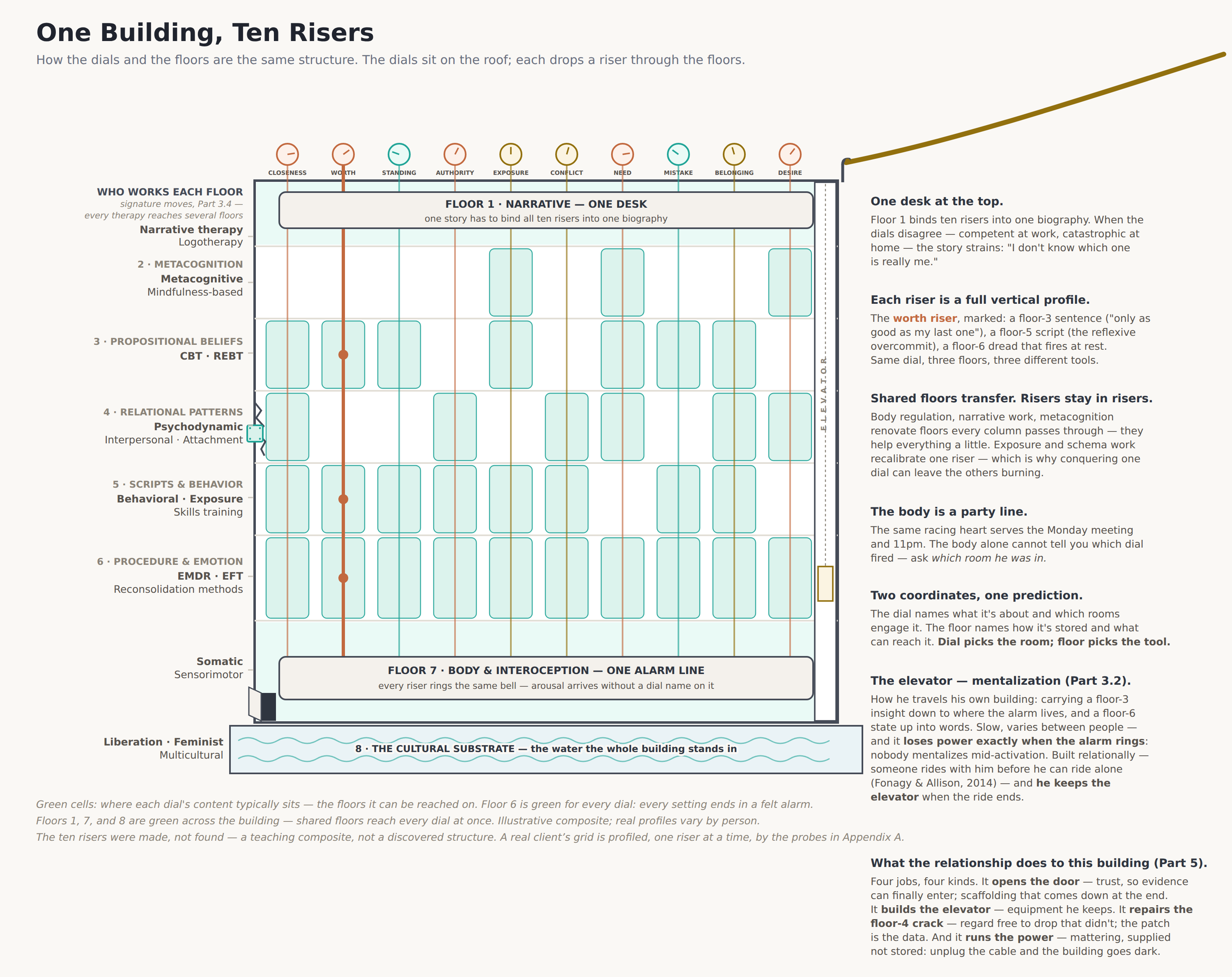
One building, ten risers. The floors sort predictions by format; the dials sort them by domain. Green cells mark where each riser's content typically sits — an illustrative composite, made not found; a real client's grid is profiled by the Appendix A probes, one riser at a time. Part 5's four functions of the relationship are drawn into the structure: the door (condition), the elevator (capacity), the patched crack on floor 4 (evidence), and the lights (input — supplied, not stored).
The floors sort a person's predictions by format — how they are stored, and therefore which tool can reach them (Part 3). The dials sort the same predictions by domain — what they are about, and therefore which rooms activate them (Parts 2 and 4). These are not two systems; they are two coordinates on one prediction. I'll be abandoned has a dial — closeness, engaged in intimate rooms and asleep at the coffee counter — and floor addresses: sayable near floor three, a template on floor four, an alarm fused at floor six. The dial picks the room; the floor picks the tool. And two working rules fall out of the plumbing. Work on the shared floors — body regulation, mentalizing, narrative integration — renovates floors every riser passes through, and so transfers across domains: that is what transdiagnostic means when it is derived rather than asserted. Work inside one riser stays in the riser — which is why the client who conquered the exposure dial can still burn down every intimate room he enters, and why generalization should be planned, never assumed.
I have put this figure last because it is the paper's largest claim and its least tested. The ten risers were made, not found; the green cells are a composite; no reliability data exist for any of it. So here is the standing request, in the same spirit as the appendices: test it. If the map is right, three things should be checkable in ordinary practice. Two clinicians profiling the same client from the same hour should land on the same riser, and on nearby floors, more often than chance. Work aimed at a shared floor should generalize across domains, and riser-specific work should not. And a riser profile taken at intake should predict which interventions move which complaints — before the treatment is chosen rather than after. If the categories don't hold — if the same hour floors differently in different hands, if the transfer rule fails — that is the finding worth having, and it can only come from other people looking. Run it against your caseload. Report what breaks.
References
- Anderson, C., Hildreth, J. A. D., & Howland, L. (2015). Is the desire for status a fundamental human motive? A review of the empirical literature. Psychological Bulletin, 141(3), 574–601.
- Barrett, L. F. (2017). How emotions are made: The secret life of the brain. Houghton Mifflin Harcourt.
- Baumeister, R. F., & Leary, M. R. (1995). The need to belong: Desire for interpersonal attachments as a fundamental human motivation. Psychological Bulletin, 117(3), 497–529.
- Beck, A. T. (1976). Cognitive therapy and the emotional disorders. International Universities Press.
- Bowlby, J. (1969). Attachment and loss, Vol. 1: Attachment. Basic Books.
- Case, A., & Deaton, A. (2020). Deaths of despair and the future of capitalism. Princeton University Press.
- Cheng, J. T., Tracy, J. L., Foulsham, T., Kingstone, A., & Henrich, J. (2013). Two ways to the top: Evidence that dominance and prestige are distinct yet viable avenues to social rank and influence. Journal of Personality and Social Psychology, 104(1), 103–125.
- Clark, A. (2016). Surfing uncertainty: Prediction, action, and the embodied mind. Oxford University Press.
- Corlett, P. R., Frith, C. D., & Fletcher, P. C. (2009). From drugs to deprivation: A Bayesian framework for understanding models of psychosis. Psychopharmacology, 206(4), 515–530.
- Craske, M. G., Treanor, M., Conway, C. C., Zbozinek, T., & Vervliet, B. (2014). Maximizing exposure therapy: An inhibitory learning approach. Behaviour Research and Therapy, 58, 10–23.
- Ecker, B., Ticic, R., & Hulley, L. (2012). Unlocking the emotional brain: Eliminating symptoms at their roots using memory reconsolidation. Routledge.
- Eubanks, C. F., Muran, J. C., & Safran, J. D. (2018). Alliance rupture repair: A meta-analysis. Psychotherapy, 55(4), 508–519.
- Flückiger, C., Del Re, A. C., Wampold, B. E., & Horvath, A. O. (2018). The alliance in adult psychotherapy: A meta-analytic synthesis. Psychotherapy, 55(4), 316–340.
- Fonagy, P., & Allison, E. (2014). The role of mentalizing and epistemic trust in the therapeutic relationship. Psychotherapy, 51(3), 372–380.
- Friston, K. (2010). The free-energy principle: A unified brain theory? Nature Reviews Neuroscience, 11(2), 127–138.
- Gazzaniga, M. S. (2011). Who's in charge? Free will and the science of the brain. Ecco/HarperCollins.
- Haidt, J. (2006). The happiness hypothesis: Finding modern truth in ancient wisdom. Basic Books.
- Haidt, J. (2012). The righteous mind: Why good people are divided by politics and religion. Pantheon.
- Hamilton, W. D. (1964). The genetical evolution of social behaviour, I and II. Journal of Theoretical Biology, 7(1), 1–52.
- Henrich, J., & Gil-White, F. J. (2001). The evolution of prestige: Freely conferred deference as a mechanism for enhancing the benefits of cultural transmission. Evolution and Human Behavior, 22(3), 165–196.
- Herzog, P., Kube, T., & Fassbinder, E. (2022). How childhood maltreatment alters perception and cognition — the predictive processing account of borderline personality disorder. Psychological Medicine, 52(14), 2899–2916.
- Hofmann, S. G., & Hayes, S. C. (2019). The future of intervention science: Process-based therapy. Clinical Psychological Science, 7(1), 37–50.
- Hohwy, J. (2013). The predictive mind. Oxford University Press.
- Janoff-Bulman, R. (1992). Shattered assumptions: Towards a new psychology of trauma. Free Press.
- Joiner, T. E. (2005). Why people die by suicide. Harvard University Press.
- Jordan, J. V. (2018). Relational-cultural therapy (2nd ed.). American Psychological Association.
- Kapur, S. (2003). Psychosis as a state of aberrant salience: A framework linking biology, phenomenology, and pharmacology in schizophrenia. American Journal of Psychiatry, 160(1), 13–23.
- Kelly, G. A. (1955). The psychology of personal constructs. Norton.
- Klass, D., Silverman, P. R., & Nickman, S. L. (Eds.). (1996). Continuing bonds: New understandings of grief. Taylor & Francis.
- Lambert, M. J. (2010). Prevention of treatment failure: The use of measuring, monitoring, and feedback in clinical practice. American Psychological Association.
- Leary, M. R., Tambor, E. S., Terdal, S. K., & Downs, D. L. (1995). Self-esteem as an interpersonal monitor: The sociometer hypothesis. Journal of Personality and Social Psychology, 68(3), 518–530.
- Mahadevan, N., Gregg, A. P., & Sedikides, C. (2019). Is self-regard a sociometer or a hierometer? Self-esteem tracks status and inclusion, narcissism tracks status. Journal of Personality and Social Psychology, 116(3), 444–466.
- Miller, J. B., & Stiver, I. P. (1997). The healing connection: How women form relationships in therapy and in life. Beacon Press.
- Nisbett, R. E., & Wilson, T. D. (1977). Telling more than we can know: Verbal reports on mental processes. Psychological Review, 84(3), 231–259.
- O'Connor, R. C., & Kirtley, O. J. (2018). The integrated motivational–volitional model of suicidal behaviour. Philosophical Transactions of the Royal Society B, 373(1754), 20170268.
- Rao, R. P. N., & Ballard, D. H. (1999). Predictive coding in the visual cortex: A functional interpretation of some extra-classical receptive-field effects. Nature Neuroscience, 2(1), 79–87.
- Ratts, M. J., Singh, A. A., Nassar-McMillan, S., Butler, S. K., & McCullough, J. R. (2015). Multicultural and social justice counseling competencies. American Counseling Association.
- Rogers, C. R. (1951). Client-centered therapy: Its current practice, implications, and theory. Houghton Mifflin.
- Rogers, C. R. (1957). The necessary and sufficient conditions of therapeutic personality change. Journal of Consulting Psychology, 21(2), 95–103.
- Seth, A. (2021). Being you: A new science of consciousness. Dutton.
- Solms, M. (2021). The hidden spring: A journey to the source of consciousness. W. W. Norton.
- Spielman, A. J., Caruso, L. S., & Glovinsky, P. B. (1987). A behavioral perspective on insomnia treatment. Psychiatric Clinics of North America, 10(4), 541–553.
- Story, G. W., Smith, R., Moutoussis, M., Berwian, I. M., Nolte, T., Bilek, E., Siegel, J. Z., & Dolan, R. J. (2024). A social inference model of idealization and devaluation. Psychological Review, 131(3), 749–780.
- Sue, D. W., & Sue, D. (2016). Counseling the culturally diverse: Theory and practice (7th ed.). Wiley.
- Trivers, R. (2011). The folly of fools: The logic of deceit and self-deception in human life. Basic Books.
- Trivers, R. L. (1971). The evolution of reciprocal altruism. Quarterly Review of Biology, 46(1), 35–57.
- Van Orden, K. A., Witte, T. K., Cukrowicz, K. C., Braithwaite, S. R., Selby, E. A., & Joiner, T. E. (2010). The interpersonal theory of suicide. Psychological Review, 117(2), 575–600.
- Villiger, D. (2025). An integrative model of psychotherapeutic interventions based on a predictive processing framework. Journal of Contemporary Psychotherapy, 55(1), 39–49. https://doi.org/10.1007/s10879-024-09637-7
- Wampold, B. E., & Imel, Z. E. (2015). The great psychotherapy debate: The evidence for what makes psychotherapy work (2nd ed.). Routledge.
- Young, J. E., Klosko, J. S., & Weishaar, M. E. (2003). Schema therapy: A practitioner's guide. Guilford Press.
Appendices — what these are, and what they are not
The four documents that follow turn Parts 2, 3, and 6 into something you can hold during a session: a grid mapping each in-room sign to the floor it points at, a text procedure that walks the whole sequence — gates, locate, formulate, act, loop — a one-page formulation template, and a set of worked examples of the furnace running in the wild.
They are teaching aids derived from the model. They are not instruments. None of it has been tested for reliability, for agreement between two clinicians reading the same session, or for any effect on outcome. A grid looks like an instrument whatever the surrounding prose says, so the claim belongs in the place the format makes it: these are for organizing your thinking. They do not license a decision you would not otherwise make, and they do not stand in for clinical judgment, supervision, or your own training.
Two specific limits. Where this material runs near risk — burdensomeness, thwarted belonging, lethality — it is a way of thinking about what a client may be telling you, not a risk assessment, and it does not substitute for one. And I write as a counseling student rather than a licensed practitioner, which is worth knowing before you weigh any of it.
They are published rather than kept private for one reason. An aid nobody can see cannot be checked. If the categories don't hold, if two clinicians land on different floors from the same hour, if the sequence sends people somewhere useless — that is the finding worth having, and it can only come from other people looking. Consider this an invitation.